



- UNESCO
- Free 1st Sunday
Photo: Rione Colonna, CC BY 4.0 · Wikimedia Commons
Archaeological site, 550s BC
Ancient Roman circus in Rome
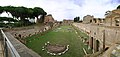
The Circus Maximus (Latin for "largest circus"; Italian: Circo Massimo) is an ancient Roman chariot-racing stadium and mass entertainment venue in Rome, Italy. In the valley between the Aventine and Palatine hills, it was the first and largest stadium in ancient Rome and its later Empire. It measured 621 m (2,037 ft) in length and 118 m (387 ft) in width and could accommodate over 150,000 spectators. In its fully developed form, it became the model for circuses throughout the Roman Empire. The site is now a public park.
The Circus was Rome's largest venue for ludi, public games connected to Roman religious festivals. Ludi were sponsored by leading Romans or the Roman state for the benefit of the Roman people (populus Romanus) and gods. Most were held annually or at annual intervals on the Roman calendar. Others might be given to fulfill a religious vow, such as the games in celebration of a triumph. In Roman tradition, the earliest triumphal ludi at the Circus were vowed by Tarquin the Proud to Jupiter in the late Regal era for his victory over Pometia.
Ludi ranged in duration and scope from one-day or even half-day events to spectacular multi-venue celebrations held over several days, with religious ceremonies and public feasts, horse and chariot racing, athletics, plays and recitals, beast-hunts and gladiator fights. Some included public executions. The greater ludi (meaning sport or game in Latin) at the Circus began with a flamboyant parade (pompa circensis), much like the triumphal procession, which marked the purpose of the games and introduced the participants.
During the Roman Republic, the aediles organized the games. The most costly and complex of the ludi offered opportunities to assess an aedile's competence, generosity, and fitness for higher office. Some Circus events, however, seem to have been relatively small and intimate affairs. In 167 BC, "flute players, scenic artists and dancers" performed on a temporary stage, probably erected between the two central seating banks. Others were enlarged at enormous expense to fit the entire space. A venatio held there in 169 BC, one of several in the 2nd century, employed "63 leopards and 40 bears and elephants", with spectators presumably kept safe by a substantial barrier. …
The Circus Maximus was sited on the level ground of the Valley of Murcia (Vallis Murcia), between Rome's Aventine and Palatine Hills. In Rome's early days, the valley would have been rich agricultural land, prone to flooding from the river Tiber and the stream which divided the valley lengthwise. The stream was probably bridged at an early date, at the two points where the track had to cross it, and the earliest races would have been held within an agricultural landscape, "with nothing more than turning posts, banks where spectators could sit, and some shrines and sacred spots".
In Livy's History of Rome, the first Etruscan king of Rome, Lucius Tarquinius Priscus, built raised, wooden perimeter seating at the Circus for Rome's highest echelons (the equites and patricians), probably midway along the Palatine straight, with an awning against the sun and rain. His grandson, Tarquinius Superbus, added the first seating for citizen-commoners (plebs, or plebeians), either adjacent or on the opposite, Aventine side of the track. Otherwise, the Circus was probably still little more than a trackway through surrounding farmland. By this time, it may have been drained but the wooden stands and seats would have frequently rotted and been rebuilt. The turning posts (metae), each made of three conical stone pillars, may have been the earliest permanent Circus structures; an open drainage canal between the posts would have served as a dividing barrier.
The games' sponsor (Latin editor) usually sat beside the images of attending gods, on a conspicuous, elevated stand (pulvinar) but seats at the track's perimeter offered the best, most dramatic close-ups. In 494 BC (very early in the Republican era) the dictator Manius Valerius Maximus and his descendants were granted rights to a curule chair at the southeastern turn, an excellent viewpoint for the thrills and spills of chariot racing. In the 190s BC, stone track-side seating was built, exclusively for senators. …
The southeastern turn of the track ran between two shrines which may have predated the Circus' formal development. One, at the outer southeast perimeter, was dedicated to the valley's eponymous goddess Murcia, an obscure deity associated with Venus, the myrtle shrub, a sacred spring, the stream that divided the valley, and the lesser peak of the Aventine Hill. The other was at the southeastern turning-post, where there was an underground shrine to Consus, a minor god of grain-stores, connected to the grain-goddess Ceres and to the underworld. According to Roman tradition, Romulus discovered this shrine shortly after the founding of Rome. He invented the Consualia festival, as a way of gathering his Sabine neighbours at a celebration that included horse-races and drinking. During these distractions, Romulus's men then abducted the Sabine daughters as brides. Thus the famous Roman myth of the Rape of the Sabine women had as its setting the Circus and the Consualia.
In this quasi-legendary era, horse or chariot races would have been held at the Circus site. The track width may have been determined by the distance between Murcia's and Consus' shrines at the southeastern end, and its length by the distance between these two shrines and Hercules' Ara Maxima, supposedly older than Rome itself and sited behind the Circus' starting place. The position of Consus' shrine at the turn of the track recalls the placing of shrines to Roman Neptune's Greek equivalent, Poseidon, in Greek hippodromes. In later developments, the altar of Consus, as one of the Circus' patron deities, was incorporated into the fabric of the south-eastern turning post. When Murcia's stream was partly built over, to form a dividing barrier (the spina or euripus) between the turning posts, her shrine was either retained or rebuilt. In the Late Imperial period, both the southeastern turn and the circus itself were sometimes known as Vallis Murcia. The symbols used to count race-laps also held religious significance; Castor and Pollux, who were born from an egg, were patrons of horses, horsemen, and the equestrian order (equites). Likewise, the later use of dolphin-shaped lap counters reinforced associations between the races, swiftness, and Neptune, as god of earthquakes and horses; the Romans believed dolphins to be the swiftest of all creatures. …
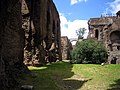
After the 6th century, the Circus fell into disuse and decay. The lower levels, ever prone to flooding, were gradually buried under waterlogged alluvial soil and accumulated debris, so that the original track is now buried six meters beneath the modern surface. In the 11th century, the Circus was "replaced by dwellings rented out by the congregation of Saint-Guy." In the 12th century, a watercourse was dug there to drain the soil, and by the 16th century the area was used as a market garden. During the renaissance, the site was one of many used as a convenient quarry for good quality building stone. Many of the Circus's standing structures survived these changes; in 1587, two obelisks were removed from the central barrier by Pope Sixtus V, and one of these was re-sited at the Piazza del Popolo. In 1852, a gas works was built on the site by the Anglo-Italian Gas Society. It remained in site until 1910 when it was relocated to the edge of Rome. Mid-19th century workings at the circus site uncovered the lower parts of a seating tier and outer portico. Since then, a series of excavations has exposed further sections of the seating, curved turn and central barrier but further exploration has been limited by the scale, depth and waterlogging of the site.
The Circus site now functions as a large park area, open to the public and often used for concerts, meetings, and celebrations.
Text from Wikipedia, the free encyclopedia, under CC BY-SA 4.0. Full article: «Circus Maximus».
Events and people from Wikidata (CC0).
Distances are as the crow flies, not walking or driving.


Circus Maximus is in Rome, in the province of Roma (Lazio), Italy. GPS coordinates: 41.88590, 12.48570.
According to OpenStreetMap data, the site is partly wheelchair accessible.
Wikidata dates it to 550s BC.
Nearby you’ll find: Domus Praeconum (200 m away), Domus Severiana (200 m away), Paedagogium (200 m away).
Text. Wikipedia, the free encyclopedia (CC BY-SA 4.0).
Data. Wikidata (CC0); opening hours and contacts OpenStreetMap (ODbL).
Photos. Wikimedia Commons, author and licence on every image.
Updated 28 October 2026. All sources and licences