



- UNESCO
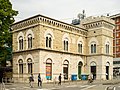
Photo: This Photo was taken by Wolfgang Moroder. Feel free to use my photos, but please mention me as the author and send me a message. This image is not in the public domain. Please respect the copyright…, CC BY-SA 3.0 · Wikimedia Commons
Abbey / Monastery, 1621
Church in Brescia, Italy
The church of Saints Faustinus and Jovita, also known as the church of San Faustino Maggiore, is a church in Brescia, located on the street of the same name, Via San Faustino, along the last stretch to the north. It is the patron church of the city of Brescia and, for this reason, it is the most important religious building in the city after the cathedrals, the Old Cathedral and the New Cathedral.
The church, linked to the adjoining monastery founded in the 9th century by Bishop Ramperto, has its origins in a building possibly dating back to the 8th century, which has seen numerous extensions and reconstructions over the centuries, particularly the 17th-century intervention, which involved a radical renovation of the structure and decorations.
The church preserves extensive Baroque frescoes, particularly the one in the nave by Tommaso Sandrino and the one in the chancel, the Apotheosis of Saints Faustinus, Jovita, Benedict and Scholastica by Giandomenico Tiepolo. Notable works of pictorial art are also the Nativity of Jesus by Lattanzio Gambara, the Deposition of Christ by Sante Cattaneo, and the standard of the Blessed Sacrament painted by Romanino.
The church of Santa Maria in Silva, the primitive core of the sanctuary, was probably built in the 8th century on the same site occupied by the present building, near the Garza stream, in the populous north-central district of the walled city. On May 9, 806, the transfer of the relics of Saints Faustinus and Jovita from the basilica of San Faustinus ad Sanguinem (since 1956 renamed to the church of Sant'Angela Merici) to Santa Maria in Silva took place, thus assuming considerable importance within the city's religious scene. Among other things, at a moment when the procession stopped near Porta Bruciata (the west end of Via Musei, at the corner of Piazza della Loggia) the remains are said to have exuded blood: Duke Naimon of Bavaria, who was present at the moment of the miracle, is said to have converted to Catholicism and thus donated to the city the relic of the True Cross, which has been kept in the Old Cathedral ever since as the main piece of the treasure of the Holy Crosses. The church of San Faustino in Riposo would also be built on the site of the miracle. However, the reasons that led to this transfer, which certainly had a strong impact in the city, are not known. …
The architectural structure of the church dates entirely from the first half of the 17th century, when the building was profoundly remodeled. The same applies to the chancel and the choir, which were indeed burned down in 1743 but did not collapse: consequently, only the paintings and some decorative details are of later date, while the structure itself is still the original one.
On the outside, the church is visible from the public street only on the façade and the south side, the latter of which was freed from the pre-existing buildings in 1927 and is therefore evident along its entire length. The presence of an intermediate pitched roof showcases the three-aisle interior layout, while the walls are opened by large lunette windows. Near the apse area, on the widening in front of the side of the church, is the former oratory of St. James, once the church's baptistery, marked by a low neoclassical facade. The bell tower is also clearly visible from the widening, while continuing on to the facade, oriented parallel to the street.
The facade of the church is the work of Giuseppe Cantone, who designed and built it between 1699 and 1705 with subsequent finishing work completed in 1711. It is considered the best work of the sculptor, who specialized mainly in altar construction. The work is made entirely of Botticino marble. It has two main levels, a wider base level and a narrower upper level. The lower level is decorated by a series of lesenes of Tuscan order, resting on a unified pedestal and supporting an entablature whose frieze is occupied by the dedicatory inscription recalling the fundamental bequest of Orazio Fenaroli, who in fact allowed the construction of the facade. The central part of the lower level, in line with the narrower upper level, projects in slight overhang with a temple-front motif, with four lesenes of the same Tuscan order, entablature and triangular pediment at the top. …
The church of Saints Faustinus and Jovita houses numerous pictorial and sculptural works, a remarkable testimony to early 17th-century Brescian art in the fields of decoration, painting and sculpture, which reaches a particularly high level of quality in certain pieces such as the sepulchral ark of the two titular saints, the altars of St. Benedict and the Nativity, the chancels and the confessionals. These works are then joined by Sandrino's frescoes and Tiepolo's work, the latter from the 18th century. Practically absent, on the other hand, are artistic evidences of earlier periods, for example, of Gothic art or Romanesque art, which have completely disappeared from the artistic treasury of San Faustino.
All the ceilings of the hall, both the central and side vaults, are completely frescoed with the illusionistic architecture of Tommaso Sandrino, complemented by scenes by other authors. The extensive fresco on the nave consists of a continuous balustrade, supported by corbels, on which rest mighty Solomonic columns supporting a false ceiling, ideally higher and deeper than the real one. The basic balustrade is not linear, but follows a continuous ascent and descent of faux staircases that bypass the open lunette windows at the base of the vault. Finally, the whole is largely embellished with various decorations and architectural motifs. The work of Antonio Gandino and his son Bernardino is the large central panel, depicting the Glory of the martyred saints Faustinus and Jovita. The fresco depicts the two saints as they ascend to heaven in the presence of the Trinity amid a riot of musician angels. The two ascending saints wear transparent, fluttering white robes and wear stoles in the manner of the priestly Faustinus and the diaconal Jovita, so as to make specific the identity of each according to the data of tradition. …
In the rooms attached to the church is preserved a remarkable treasure consisting of liturgical objects, reliquaries and vestments. Among the numerous pieces, special mention is made of the Cross of St. Faustinus, that is, the reliquary where the fragment of the True Cross acquired by the church in 1828 was contained. Other pieces include chalices, monstrances, services for incensation and ablution, candelabra, candlesticks, processional insignia, reliquaries, chasubles, and altar cloths, all made mainly between the seventeenth and nineteenth centuries. Prominent among them is the chalice of the Eucharistic Mystery, a fine 1823 work by Milanese goldsmith and sculptor Eugenio Brusa.
Also part of the treasury is the urn of the Patron Saints, a reliquary made in 1925 to hold the two femurs of the saints taken from the ark in 1923. The urn is kept directly in the church, in a side niche in the Chapel of the Crucifix.
Text from Wikipedia, the free encyclopedia, under CC BY-SA 4.0. Full article: «Church of Saints Faustinus and Jovita».
Events and people from Wikidata (CC0).
Distances are as the crow flies, not walking or driving.


Church of Saints Faustinus and Jovita is in Brescia, in the province of Brescia (Lombardy), Italy. Address: Via San Faustino, 70. GPS coordinates: 45.54375, 10.22002.
Wikidata dates it to 1621.
Nearby you’ll find: Palazzo Calini ai Fiumi (100 m away), Castelletto dei dazi (100 m away), Museo nazionale della fotografia (200 m away).
Text. Wikipedia, the free encyclopedia (CC BY-SA 4.0).
Data. Wikidata (CC0); opening hours and contacts OpenStreetMap (ODbL).
Photos. Wikimedia Commons, author and licence on every image.
Updated 28 October 2026. All sources and licences