

- UNESCO
Photo: G.dallorto, Attribution · Wikimedia Commons
Abbey / Monastery, 8th century
Church in Pavia, Lombardy, Italy
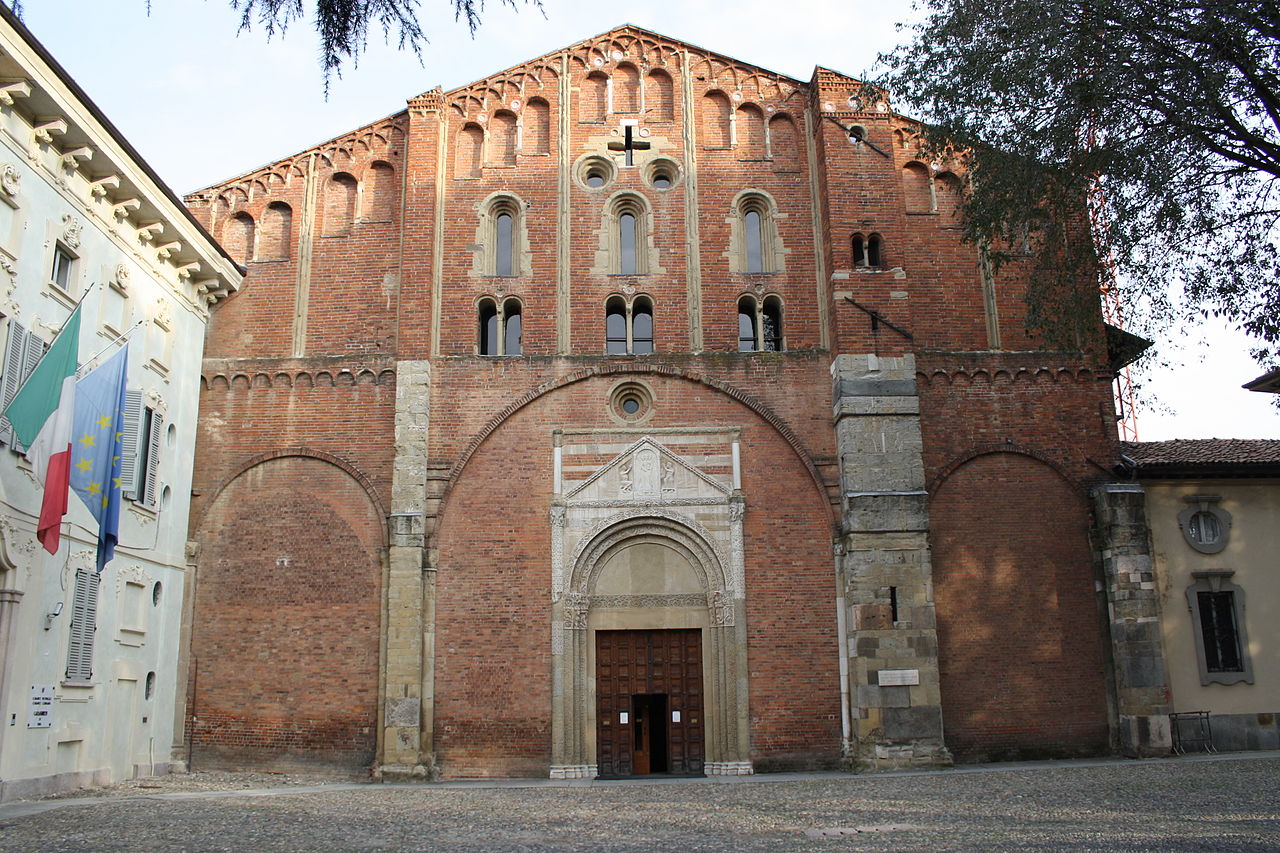
The Basilica of St. Peter in the Golden Sky (Italian: Basilica di San Pietro in Ciel d'Oro) is an 8th-century Catholic basilica and monastery church served for centuries by the Augustinian friars in Pavia, in the Lombardy region of Italy. The basilica is noted for being the resting place of St. Augustine of Hippo as well as of the 6th-century philosopher Boethius.
Its name refers to the mosaics of gold leaf behind glass tesserae that decorate the ceiling of the apse. The plain exterior is of brick, with sandstone quoins and window framing. The paving of the church floor is now lower than the modern street level of Piazza San Pietro in Ciel d'Oro, which lies before its façade.
A church of Saint Peter is recorded in Pavia in 604; it was renovated by Liutprand, King of the Lombards (who is buried here) between 720 and 725. The present Romanesque church was consecrated by Pope Innocent II in 1132.
The church is the resting place for the remains of Augustine of Hippo, who died in 430 in his home diocese of Hippo Regius, and was buried there, during the time of the Vandals. According to Bede's True Martyrology, the body was removed to Cagliari, Sardinia by the Catholic bishops whom the Arian Vandal Huneric had expelled from north Africa. Bede tells that the remains were subsequently redeemed out of the hands of the Saracens there—by Peter, bishop of Pavia, and uncle of the Lombard king Liutprand—and deposited in the church of Saint Peter about the year 720.
A monastic community was established in connection with the church by the 7th century, by Celtic monks who were actively evangelizing the Kingdom of the Lombards, with its significant Celtic native population. They established a string of monasteries, such as Bobbio Abbey. These monastic communities, following the Rule of St. Columbanus, were also centers of learning.
An important scriptorium was established at the monastery in the 9th century as well as a school, led by the Irish monk Dungal. In the Olonese capitular a decree was issued by the Emperor Lothair in the royal palace of Corteolona in 825, requiring students from Milan, Brescia, Bergamo, Lodi, Novara, Vercelli, Tortona, Asti, Acqui, Genoa and Como to go there to study. From the 10th century the monastery enjoyed numerous privileges, including that of being subject only to the authority of the pope. Since the 11th century, the monks of San Pietro in Ciel d'Oro, who at least since 974 owned vineyards and winepresses near San Damiano al Colle, extended the vine culture in Oltrepò Pavese, producing wines that, thanks to the Po and Ticino, were then transported to Pavia, where the part not absorbed by the consumption of the monks was destined for trade. …
Very few remains of the Lombard church remain, hidden under the Romanesque reconstruction completed around 1132. San Pietro in Ciel d'Oro looks like this, like many other Pavia churches of the time: a brick building, with three naves with transept, apse and crypt.
The façade is marked by two buttresses that divide it into three zones, corresponding to the internal naves; the buttress on the right, more often, houses an internal staircase that allows access to the roof. The top is crowned by a blind loggia and a motif with intertwined arches. The stone (sandstone) is used only for the most important parts, such as the portal and the windows. The portal, in sandstone and marble, bears, within the tympanum, the figure of San Michele in the center, flanked on the sides by the images of two prayers. These sculptures probably come from the previous basilica, since they are dated to 1050–1090. Along the buttresses there are traces of an ancient narthex, or perhaps a quadriporticus, which preceded the entrance to the church.
The interior is marked by five spans, rectangular in the central nave and square in the side aisles. Compared to the basilica of San Michele Maggiore, one immediately perceives the different proportions of the central nave, wider, longer and less slender, the more rigorous succession of the pillars, all roughly in the same section rather than alternating as in the other church, and the absence of the matronaea. The spans from the second to the fifth are covered with rib vaults; the first, higher, almost as a function of an internal atrium (endonarthex) or even a false transept, is covered by a barrel vault. …
According to tradition, in 504 the Vandal king Thrasamund exiled Saint Fulgentius of Ruspe and other North African Catholic bishops to Sardinia. They brought the saint's relics with them, and in Cagliari they found asylum in an underground chapel, located in largo Carlo Felice, in the Stampace district and accessible by a spiral staircase in the Accardo Palace.
In 722–723 Liutprand probably sent a delegation to Cagliari charged with purchasing the relics with a large sum of money and transporting them to Pavia to bring prestige to the kingdom's new capital. The box was then donated by the Longobard king to the Monastery of San Pietro in Ciel d'Oro around 725.
Having lost track of the original 14th-century burial, around 1360, in the sacristy of the Order of the Augustinian hermits, it was replaced by a candid marble ark, the work of Campionese masters. It is mentioned by Petrarch in a letter sent to Boccaccio dated December 22 1365 (currently collected in his Seniles, V, 1).
Besides being the burial place of Liutprand and Augustine, San Pietro in Ciel d'Oro contains in its crypt that of Boethius, whose Consolation of Philosophy is often taken as the final literary production of Late Antiquity. Dante mentions this in Il Paradiso, canto X:
Lo corpo ond’ella fu cacciata giacegiuso in Cieldauro; ed essa da martiroe da essilio venne a questa pace
("The body whence it was chased forth / lieth down below in Cieldauro and itself from martyrdom / and exile came unto this peace.")
Boccaccio's Decameron features a chapter (tenth day, ninth novella) that takes place in the basilica: the sumptuous bed of Thorello, soundly sleeping, is magically transported to San Pietro in Ciel d'Oro, where the sacristan discovers him at Matins the following morning.
Text from Wikipedia, the free encyclopedia, under CC BY-SA 4.0. Full article: «San Pietro in Ciel d'Oro».
Events and people from Wikidata (CC0).
Distances are as the crow flies, not walking or driving.


San Pietro in Ciel d'Oro is in Pavia, in the province of Pavia (Lombardy), Italy. Address: Piazza San Pietro in Ciel d'Oro, 1-5. GPS coordinates: 45.19128, 9.15494.
Wikidata dates it to the 8th century.
Nearby you’ll find: Palazzo INCIS (100 m away), Casa Milani (100 m away), Porta Milano (200 m away).
Text. Wikipedia, the free encyclopedia (CC BY-SA 4.0).
Data. Wikidata (CC0); opening hours and contacts OpenStreetMap (ODbL).
Photos. Wikimedia Commons, author and licence on every image.
Updated 28 October 2026. All sources and licences