




Photo: Tempo61, CC BY-SA 3.0 · Wikimedia Commons
At a glance
- Type
- Museum
- Protection
- Italian national heritage
- Coordinates
- 45°11′24″ N, 9°09′30″ E
- Address
- Viale 11 Febbraio, 35, 27100 Pavia
History and description
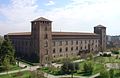
The Civic Museums of Pavia (Italian: Musei Civici di Pavia) are a number of museums in Pavia, Lombardy, northern Italy. They are housed in the Visconti Castle (Castello Visconteo), built in 1360 by Galeazzo II Visconti, soon after taking the city, a free city-state until then. The credited architect is Bartolino da Novara. The castle used to be the main residence of the Visconti family, while the political capital of the state was Milan. North of the castle a wide park was enclosed, also including the Certosa of Pavia, founded 1396 according to a vow of Gian Galeazzo Visconti, meant to be a sort of private chapel of the Visconti dynasty. The Battle of Pavia (1525), climax of the Italian Wars, took place inside the castle park.
The Civic Museums of Pavia include the Pinacoteca Malaspina, Museo Archeologico and Sala Longobarda, Sezioni Medioevale e Rinascimentale Quadreria dell’800 (Collezione Morone), Museo del Risorgimento, Museo Robecchi Bricchetti, and the Cripta di Sant’Eusebio.
History
The museum was built by the will of the Marquis Luigi Malaspina di Sannazzaro, an enlightened artist (1754/1835), who donated his art collections to the municipality on his death. The collection, which over time was enriched by numerous donations, was initially housed in the Malaspina Palace and was moved to the castle only in 1951.
Collections
The archaeological collection includes materials found by chance during agricultural or building works; the museum has come mainly from private collecting (Giuletti, Reale collection, etc.). The arcades on the ground floor of the castle house the Lapidarium made up of stelae, sarcophagi, funerary and votive altars, epigraphs, capitals, colonnems and Roman milestones.
Among the locally sourced pieces, particular mention should be made of those made from Egyptian granite and Proconnesian marble, which were discovered in Corteolona (curtis Ollone), the site of the palace of the Lombard king Liutprand. They are part of a collection of artifacts brought from Rome, likely in 729, following Liutprand’s visit to Pope Gregory II. During this journey, the king had venerated the relics of Saint Anastasius and, upon his return, dedicated the church and monastery within the royal palace at Corteolona to the saint.
Along the south side of the portico, several sarcophagi from the Roman period are displayed, nearly all made of granite from the Alps. Each consists of two separate elements: the lid and the chest. In the Middle Ages, sarcophagi were often reused, both as everyday objects (such as basins, animal troughs, or containers) and for the burial of prominent individuals or saints. In such cases, the original Roman inscription was often removed, altered, or replaced with a more recent one. …
Text from Wikipedia, the free encyclopedia, under CC BY-SA 4.0. Full article: «Pavia City Museums».
Timeline
- 1838Opened
Events and people from Wikidata (CC0).
Photos
Getting there
Pavia Porta GaribaldiTrain, nearest
900 m as the crow flies
Pavia City MuseumsViale 11 Febbraio, 35, 27100 Pavia
Aeroporto di Milano-Linate29.6 km
Distances are as the crow flies, not walking or driving.
Loading map…
Nearby
See on the mapMore museums in Lombardy

- Free 1st Sunday


Frequently asked questions
Where is Pavia City Museums?
Pavia City Museums is in Pavia, in the province of Pavia (Lombardy), Italy. Address: Viale 11 Febbraio, 35, 27100 Pavia. GPS coordinates: 45.19000, 9.15833.
What are the opening hours of Pavia City Museums?
According to OpenStreetMap the opening hours are: Monday: Closed; Tuesday to Friday: 14:30–18:00; Saturday and Sunday: 11:00–19:00. Always check the official website before your visit.
How much does it cost to visit Pavia City Museums?
There is an admission charge. Up-to-date prices are on the official website.
What else is there to see near Pavia City Museums?
Nearby you’ll find: Visconti Castle (100 m away), Malaspina Picture Gallery (100 m away), Palazzo INCIS (200 m away).
Sources and licences
Text. Wikipedia, the free encyclopedia (CC BY-SA 4.0).
Data. Wikidata (CC0); opening hours and contacts OpenStreetMap (ODbL).
Photos. Wikimedia Commons, author and licence on every image.
Credits for the 2 photos
- Castello Sforzesco (2) — Tempo61, CC BY-SA 3.0
- Porticato interno del castello visconteo — Manuel.frassinetti, CC BY-SA 4.0
Updated 28 October 2026. All sources and licences