




Photo: Tempo61, CC BY-SA 3.0 · Wikimedia Commons
At a glance
- Type
- Castle
- Period
- Middle Ages, 1360
- Style
- Gothic architecture
- Architect
- Bartolino da Novara
- Owner
- Galeazzo II Visconti
- Protection
- Italian national heritage
- Coordinates
- 45°11′26″ N, 9°09′32″ E
- Address
- Piazza Castello
History and description
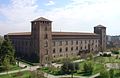
The Visconti Castle of Pavia (Italian: Castello Visconteo di Pavia) is a medieval castle in Pavia, Lombardy, Northern Italy. It was built after 1360 in a few years by Galeazzo II Visconti, Lord of Milan, and used as a sovereign residence by him and his son Gian Galeazzo, first duke of Milan. Its wide dimensions induced Petrarch, who visited Pavia in the fall of 1365, to call it "an enormous palace in the citadel, a truly remarkable and costly structure". Adjacent to the castle, the Visconti created a vast walled park that reached the Certosa di Pavia, a Carthusian monastery founded in 1396 by the Visconti as well and located about 7 kilometres (4.3 mi) to the north.
In the 16th century, an artillery attack on Pavia destroyed a wing and two towers of the castle. The frescos that entirely decorated the castle rooms are today almost completely lost. The castle had been the seat of the Visconti Library until its transfer to Paris in 1499. Today, it hosts the Pavia Civic Museums.
History
In 1359 the Visconti of Milan conquered Pavia. The city became part of the western portion of the Visconti territories, ruled by Galeazzo II Visconti. His idea to build a castle came from Pavia's ancient role as the capital of the Lombard Kingdom and the Visconti's ambition to extend their dominion to its territory. He chose the site of the castle in the most elevated part of Pavia, in the direction of Milan. There, he created a citadel, isolated by a moat from the rest of the city. The castle occupied the eastern portion of the citadel.
The castle was conceived as a residential palace to host the sovereign court, the chancellery, and the ruler's family. The military functions were concentrated in the Citadel outside the castle. The construction began in 1360 and was completed in about five years. The castle extended over a square surface with 142-meter-long sides. Internally, the four sides had a series of eleven square rooms, elevated on two floors. Each room received light through a single mullioned window overlooking the moat. Four square towers, 43-meter high, were erected at the corners of the castle. Mullioned windows were opened on the four tower's floor.
The four sides faced the courtyard internally with a portico on the ground floor and a loggiato, open through four-light windows, on the first floor. Crenelated roofs covered the wings and the towers.
The architect of the castle is unknown. Some details, such as the internal square module and the four-light windows, have tentatively identified the Venetian architect Bernardo da Venezia, who was nevertheless active in Pavia only after 1389. …
Today
The castle hosts the Civic Museums of Pavia (Musei civici di Pavia). They include the Pinacoteca Malaspina, Museo Archeologico and Sala Longobarda, Sezioni Medioevale e Rinascimentale, Quadreria dell’800 (Collezione Morone), Museo del Risorgimento, Museo Robecchi Bricchetti, and the Crypt of Sant’Eusebio. In the western tower, where once stood the Visconti Library, a virtual reconstruction allows the consultation of the books once kept there. The rooms with the survived frescos and decorations can be visited as part of the museums' tour. In the portico on the ground floor there are traces of the first pictorial decoration with geometric figures, while on the vaults the starry sky was painted, ordered by Galeazzo II for the whole castle in 1366. The geometric painting, however, had to leave room, in the walls, also to figurative scenes. The remains of frescoes, depicting the View of Pavia (south wing, third span) and Knights (west wing, sixth and eighth spans) dating back to the seventh decade of the fourteenth century and recently attributed to Giusto de 'Menabuoi. Some doors open onto the portico still retain the inscription in Gothic characters which identified the entrance to rooms used as offices, including the one intended for the accountancy of the Duchess Caterina Visconti. On the ground floor of the south-west tower is the "blue room", the result of the pictorial interventions of 1469, particularly sumptuous for the preciousness of the techniques and materials used. The decoration is made up of squares with raised and gilded frames, which divide the walls, always in relief and covered with gold foils are the heraldic motifs (lilies of France and Sforza emblems) and stars, on alternately blue and green backgrounds. On the ground floor, immediately to the right of the southern entrance, there is the chapel, with a rectangular plan and rib vaults, on the portal of the chapel there is a sinopia depicting the Pietà, by Michelino da Besozzo, while inside there are frescoes, such as Geometry or The Blessing Christ, by Andrea da Bologna. …
Text from Wikipedia, the free encyclopedia, under CC BY-SA 4.0. Full article: «Visconti Castle».
Timeline
- 1360Built
Events and people from Wikidata (CC0).
Photos
Getting there
Pavia Porta GaribaldiTrain, nearest
900 m as the crow flies
Visconti CastlePiazza Castello
Aeroporto di Milano-Linate29.5 km
Distances are as the crow flies, not walking or driving.
Loading map…
Nearby
See on the mapMore castles in Lombardy


Frequently asked questions
Where is Visconti Castle?
Visconti Castle is in Pavia, in the province of Pavia (Lombardy), Italy. Address: Piazza Castello. GPS coordinates: 45.19058, 9.15900.
How old is Visconti Castle?
Wikidata dates it to 1360.
What else is there to see near Visconti Castle?
Nearby you’ll find: Malaspina Picture Gallery (100 m away), Pavia City Museums (100 m away), Palazzo INCIS (200 m away).
Sources and licences
Text. Wikipedia, the free encyclopedia (CC BY-SA 4.0).
Data. Wikidata (CC0); opening hours and contacts OpenStreetMap (ODbL).
Photos. Wikimedia Commons, author and licence on every image.
Credits for the 9 photos
- Castello Sforzesco (2) — Tempo61, CC BY-SA 3.0
- Castello Visconteo (Pavia) - facciata — Congolandia.g, CC BY-SA 4.0
- Castello Visconteo (Pavia) - porta sud — Congolandia.g, CC BY-SA 4.0
- Castello Visconteo (Pavia) — Giorgio Gonnella, CC BY-SA 3.0
- 2012.M09.PAVIA.castello — Giuditta, CC BY-SA 3.0
- Castello di Pavia - Cortile interno (94065) — Mannivu, CC BY-SA 4.0
- Castello di Pavia - Torrione — Mannivu, CC BY-SA 4.0
- Castello di Pavia DSC07226 — AssoLaTo, CC BY-SA 4.0
- Castello di Pavia — Castva, CC BY-SA 4.0
Updated 28 October 2026. All sources and licences