


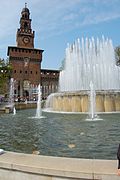


Photo: Jakub Hałun, CC BY-SA 4.0 · Wikimedia Commons
At a glance
- Type
- Castle
- Period
- Middle Ages, 1360
- Style
- Renaissance architecture
- Architect
- Filarete
- Protection
- Italian national heritage
- Coordinates
- 45°28′16″ N, 9°10′47″ E
- Address
- piazzale Castello
History and description
The Sforza Castle is a medieval fortification located in Milan, northern Italy. It was built in the 15th century by Francesco Sforza, Duke of Milan, on the remnants of a 14th-century fortification. Later renovated and enlarged, in the 16th and 17th centuries it was one of the largest citadels in Europe. Extensively rebuilt by Luca Beltrami in 1891–1905, it now houses several of the city's museums and art collections.
History
The original construction was ordered by Galeazzo II Visconti, a local nobleman, in 1358 – c. 1370; this castle was known as the Castello di Porta Giova (or Porta Zubia), from the name of a gate in walls located nearby. It was built in the same area of the ancient Roman fortification of Castrum Portae Jovis, which served as castra pretoria when the city was the capital of the Roman Empire. It was enlarged by Galeazzo's successors, Gian Galeazzo, Giovanni Maria and Filippo Maria Visconti, until it became a square-plan castle with 200 m-long sides, four towers at the corners and up to 7-metre-thick (23 ft) walls. The castle was the main residence in the city of its Visconti lords, and was destroyed by the short-lived Golden Ambrosian Republic which ousted them in 1447.
In 1450, Francesco Sforza, once he had shattered the republicans, began reconstruction of the castle to turn it into his princely residence. In 1452 he hired the sculptor and architect Filarete to design and decorate the central tower, which is still known as the Torre del Filarete. After Francesco's death, the construction was continued by his son Galeazzo Maria, under the architect Benedetto Ferrini. The decoration was executed by local painters. In 1476, during the regency of Bona of Savoy, the tower bearing her name was built. Architect Pietro Antonio Solari took inspiration from castle while working on Moscow Kremlin in 1485.
In 1494 Ludovico Sforza became lord of Milan, and called on numerous artists to decorate the castle. These include Leonardo da Vinci (who frescoed several rooms, in collaboration with Bernardino Zenale and Bernardino Butinone) and Bramante, who painted frescoes in the Sala del Tesoro; the Sala della Balla was decorated with Francesco Sforza's deeds. Around 1498, Leonardo worked on the ceiling of the Sala delle Asse, painting decorations of vegetable motifs. In the following years, however, the castle was damaged by assaults from Italian, French and German troops; a bastion, known as tenaglia, was added, perhaps designed by Cesare Cesariano. In 2025, evidence of tunnels sketched by da Vinci were identified below the structure. …
Description
The castle has a quadrangular plan, on a site across the city's walls. The wall which once faced the countryside north of Milan has square towers and an ogival gate. This was once accessed through a drawbridge. The northern tower is known as the Torre della Corte, and its counterpart to the west is the Torre del Tesoro; both received wide windows during the Sforza age.
The corner defended by the Torre Ducale is characterized by a loggia bridge, attributed to Bramante, and commissioned by Ludovico Sforza in the late 15th century to connect the Corte Ducale (the court in the area used as a ducal residence) and the Cortile della Ghirlanda. This ghirlanda refers to a wall, protected by a ditch filled with water, built under Francesco Sforza, of which few traces remain today, including the Porta del Soccorso. Remains of two later ravelins can be seen in correspondence of the point in which the castle was joined by the city walls (near the Porta Comasina gate) and the Porta del Carmine. The Porta della Ghirlanda gate was entered through a ravelin (now lost) and had two entrances accessed through runways, which led to an underground passage which continued along the walls.
The external side which once faced the walled city has two round towers, commissioned by Francesco Sforza to replace the former square ones, which had become less suitable to defend against fire weapons. The central tower, called the Torre del Filarete, is a modern reconstruction. The round towers lost their upper parts under the Austrians, who needed open space for their artillery; the towers' present-day upper sections are modern reconstructions. The Torre del Filarete and the Porta del Santo Spirito, located further to the south, are both preceded by a ravelin.
The main gate leads to a large court from which several internal features can be seen. These include the Tower of Bona of Savoy (1476) and the Rocchetta, a sort of internal defensive ridotto with a gate of its own. At the right of the Porta del Carmine are the remains of two 15th-century courts. The Rocchetta, whose access gate from the main court (a modern addition) features the Sforza coat of arms, has an internal court with, on three sides, a portico with 15th-century arcades. The Corte Ducale is the wing of the castle originally used as a ducal residence; it features a court with two loggias, a smaller one on the left and a larger one at its end, called Loggiato dell'Elefante due to the presence of a fresco of an elephant.
Civic museums
The Sforza Castle complex includes the following museums:
The Pinacoteca del Castello Sforzesco with an art collection which includes Andrea Mantegna's Trivulzio Madonna and masterpieces by Canaletto, Tiepolo, Vincenzo Foppa, Titian and Tintoretto
The Museum of Ancient Art which includes the armoury, the tapestry room and some funerary monuments
The Achille Bertarelli Print Collection. In the same building that formerly housed Scuola Superiore d'Arte Applicata all'Industria.
The Museum of the Rondanini Pietà, which includes Michelangelo's last sculpture (the Rondanini Pietà)
In 2012, new paintings attributed to Michelangelo Merisi da Caravaggio were discovered at the castle.
Biblioteca Trivulziana
The Biblioteca Trivulziana is a library of the Municipality of Milan located inside the Sforza Castle, annexed to the Civic Historical Archive. The Biblioteca Trivulziana has a collection of around 180,000 books, including 1,300 manuscripts and 1,300 incunabula. Notable items in the collection include an illuminated codex of Dante's Divine Comedy from 1337 and a rare 14th-century text of De vulgari eloquentia. The library's most famous possession is the Codex Trivulzianus, a notebook filled with Leonardo da Vinci's writings, sketches and studies. The Civic Historical Archive possesses an extensive civic documentation for the city of Milan and the Duchy dating from 1385 onwards.
Text from Wikipedia, the free encyclopedia, under CC BY-SA 4.0. Full article: «Sforza Castle».
Timeline
- 1360Built
People
Events and people from Wikidata (CC0).
Photos
Getting there
Milano CadornaTrain, nearest
400 m as the crow flies
Sforza Castlepiazzale Castello
Aeroporto di Milano-Linate7.7 km
Distances are as the crow flies, not walking or driving.
Loading map…
Nearby
See on the mapMore castles in Lombardy


Frequently asked questions
Where is Sforza Castle?
Sforza Castle is in Milan, in the province of Milano (Lombardy), Italy. Address: piazzale Castello. GPS coordinates: 45.47100, 9.17969.
How old is Sforza Castle?
Wikidata dates it to 1360.
What else is there to see near Sforza Castle?
Nearby you’ll find: Egyptian Museum of Milan (0 m away), Antique Furniture & Wooden Sculpture Museum (0 m away), Sforza Castle Civic Museums (0 m away).
Sources and licences
Text. Wikipedia, the free encyclopedia (CC BY-SA 4.0).
Data. Wikidata (CC0); opening hours and contacts OpenStreetMap (ODbL).
Photos. Wikimedia Commons, author and licence on every image.
Credits for the 9 photos
- 20110725 Castello Sforzesco Milan 5557 — Jakub Hałun, CC BY-SA 4.0
- 20170706 MilanoSfoncesco 9656 (36607968271) — Ray Swi-hymn from Sijhih-Taipei, Taiwan, CC BY-SA 2.0
- 20170706 MilanoSfoncesco 9741 (36607964541) — Ray Swi-hymn from Sijhih-Taipei, Taiwan, CC BY-SA 2.0
- 20170706 MilanoSforzesco 9355 (36607959681) — Ray Swi-hymn from Sijhih-Taipei, Taiwan, CC BY-SA 2.0
- 20170706 MilanoSforzesco 9365 (35912949564) — Ray Swi-hymn from Sijhih-Taipei, Taiwan, CC BY-SA 2.0
- 20170706 MilanoSforzesco 9368 (35937953333) — Ray Swi-hymn from Sijhih-Taipei, Taiwan, CC BY-SA 2.0
- 20170706 MilanoSforzesco 9376 (35912942504) — Ray Swi-hymn from Sijhih-Taipei, Taiwan, CC BY-SA 2.0
- Alba al Castello Sforzesco — Giuliaazh, CC BY-SA 4.0
- Alba colorata al Castello — Giuliaazh, CC BY-SA 4.0
Updated 28 October 2026. All sources and licences