


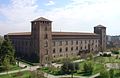


Photo: Geobia, CC BY-SA 3.0 · Wikimedia Commons
At a glance
- Type
- Historic theatre
- Period
- Early modern period, 1773
- Architect
- Antonio Galli da Bibiena
- Protection
- Italian national heritage
- Coordinates
- 45°11′19″ N, 9°09′21″ E
- Address
- Strada Nuova, 136
History and description
The Teatro Fraschini is an opera house in Pavia, Italy. It was inaugurated in 1773 and is considered one of the most important historic theatres in Lombardy. The theatre is renowned for its horseshoe-shaped auditorium and rich Baroque interior.
History
The Theater of the Four Noble Knights – the original name of Fraschini – was designed to counter the whims of the noble Giacomo Omodei, an aristocrat from Pavia and owner of one of the most popular theaters in the city around the middle of the 18th century. In fact, it seems that Giacomo Omodei forced the public, and the other aristocrats, to wait for the start of the shows until his arrival.
In 1772 four noble Pavesi lords joined to form the Society of Knights: Count Francesco Gambarana Beccaria, Marquis Pio Bellisomi, Marquis Luigi Bellingeri Provera and Count Giuseppe Giorgi of Vistarino. They shared the administration and direction of the theater and had entrusted the project for its realization to Antonio Galli da Bibbiena, representative of an ancient and prestigious family of scenographers-architects. The works for the construction of the Theater of the Four Noble Knights began in 1771 and the theater inaugurated its first season in 1773, in the presence of Archduke Ferdinand Karl of Austria-Este. The theater was inaugurated on May 24, 1773, with the opera Il Demetrio, composed by the Czech composer Josef Mysliveček on verses by Pietro Metastasio.
In 1869, the Municipality of Pavia acquired the ownership of the theater, which was soon to be renamed Teatro Fraschini, in honor of the Pavese tenor Gaetano Fraschini.
Architecture
The Fraschini is an Italian theater; the great hall of the theater is almost in the shape of a horseshoe and seats 409, according to the prevailing taste in the 18th century; it is the artistic example of the perspective research of the Baroque. The floor plan of the hall is bell-shaped with a sound box (optimal solution for acoustics) obtained from an impracticable gallery under the stalls. Above a Tuscan-type bossaged arcade, there are three tiers of boxes (with Doric, Ionic Corinthian composite and Attic capitals) and in addition two upper tiers (the fourth order is a tribune and the fifth is “loggione” and two galleries). The large ceiling fresco was remade in 1909 by Osvaldo Bignami. The two large statues on either side of the proscenium, the work of Michele Forabosco, represent respectively Music and Poetry. On the second level there is an oven still clearly visible and preserved (the theatrical life of the nobles crossed the limit of attending the shows, and extended to entertainment with dinners and board games in the boxes of the property and in the sitting rooms of the backstage). Each stage has a dressing room and most of them retain stuccos and frescoes from the 18th century, different from each other according to the personal taste of the original owners. In fact, since the foundation, the boxes were sold to private individuals who were required to furnish with tapestries, furniture, frescoes, stuccos, doors and curtains, as long as they did not break the overall appearance and architecture of the hall. The façade, which opens onto Strada Nuova, has a porticoed atrium open into three porticoes and two upper floors marked horizontally by Doric, Ionic and Corinthian cornices, between which windows with a tympanum hat open.
Although already a few decades after its inauguration it was considered grand, but far from the neoclassical style, now dominant, the theater has remained miraculously intact in the original structure.
Text from Wikipedia, the free encyclopedia, under CC BY-SA 4.0. Full article: «Teatro Fraschini».
Timeline
- 1773Built and opened
Events and people from Wikidata (CC0).
Photos
Getting there
PaviaTrain, nearest
900 m as the crow flies
Teatro FraschiniStrada Nuova, 136
Aeroporto di Milano-Linate29.8 km
Distances are as the crow flies, not walking or driving.
Loading map…
Nearby
See on the mapMore historic theatres in Lombardy


Frequently asked questions
Where is Teatro Fraschini?
Teatro Fraschini is in Pavia, in the province of Pavia (Lombardy), Italy. Address: Strada Nuova, 136. GPS coordinates: 45.18854, 9.15581.
How old is Teatro Fraschini?
Wikidata dates it to 1773.
What else is there to see near Teatro Fraschini?
Nearby you’ll find: Palazzo del Governo (100 m away), Palazzo Malaspina (100 m away), Museum of Archeology of the University of Pavia (200 m away).
Sources and licences
Text. Wikipedia, the free encyclopedia (CC BY-SA 4.0).
Data. Wikidata (CC0); opening hours and contacts OpenStreetMap (ODbL).
Photos. Wikimedia Commons, author and licence on every image.
Credits for the 5 photos
- 859PaviaTeatroFraschini — Geobia, CC BY-SA 3.0
- Teatro Fraschini - Pavia — Capricornis crispus, CC BY-SA 4.0
- Teatro Fraschini 01 — Paperkat, CC BY-SA 3.0
- TeatroFraschini — Semiva21, CC BY-SA 3.0
- Dream theater — Giaaaaa, CC BY-SA 4.0
Updated 28 October 2026. All sources and licences