


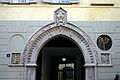
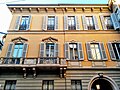
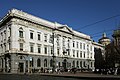


Photo: Jakub Hałun, CC BY-SA 4.0 · Wikimedia Commons
At a glance
- Type
- Historic theatre
- Period
- Early modern period, 1778
- Style
- Neoclassicism in Milan
- Architect
- Giuseppe Piermarini
- Protection
- Italian national heritage
- Coordinates
- 45°28′03″ N, 9°11′21″ E
- Address
- Via Filodrammatici 2, Milano
History and description
La Scala is a historic opera house in Milan, Italy. The theatre was inaugurated on 3 August 1778 and was originally known as il Nuovo Regio Ducale Teatro alla Scala (lit. 'the New Royal Ducal Theatre at the Scala', which previously was a church). The premiere performance was Antonio Salieri's Europa riconosciuta.
Most of Italy's greatest operatic artists, and many of the finest singers from around the world, have appeared at La Scala. The theatre is regarded as being one of the leading opera and ballet theatres globally. It is home to the La Scala Theatre Chorus, La Scala Theatre Ballet, La Scala Theatre Orchestra, and the Filarmonica della Scala orchestra. The theatre also has an associate school, known as the La Scala Theatre Academy (Italian: Accademia Teatro alla Scala), which offers professional training in music, dance, stagecraft, and stage management.
Overview
La Scala's season opens on 7 December, Saint Ambrose's Day, the feast day of Milan's patron saint. All performances must end before midnight and long operas start earlier in the evening when necessary.
The Museo Teatrale alla Scala (La Scala Theatre Museum), accessible from the theatre's foyer and a part of the house, contains a collection of paintings, drafts, statues, costumes, and other documents regarding the history of La Scala and of opera in general. La Scala also hosts the Accademia d'Arti e Mestieri dello Spettacolo (Academy for the Performing Arts). Its goal is to train a new generation of young musicians, technical staff, and dancers (at the Scuola di Ballo del Teatro alla Scala, one of the academy's divisions).
Above the boxes, La Scala has a gallery—called the loggione—where the less wealthy can watch the performances. The gallery is typically crowded with the most critical opera aficionados, known as the loggionisti, who can be ecstatic or merciless towards singers' perceived successes or failures. For their failures, artists receive a "baptism of fire" from these aficionados, and fiascos are long remembered. For example, in 2006, tenor Roberto Alagna left the stage after being booed during a performance of Aida, forcing his understudy, Antonello Palombi, to quickly replace him mid-scene without time to change into a costume. Alagna did not return to the production.
History
A fire destroyed the previous theatre, the Teatro Regio Ducale, on 25 February 1776, after a carnival gala. A group of ninety wealthy Milanese, who owned private boxes in the theatre, wrote to Archduke Ferdinand of Austria-Este asking for a new theatre and a provisional one to be used while completing the new one. The neoclassical architect Giuseppe Piermarini produced an initial design. However, it was rejected by Count Firmian (the governor of the then Austrian Lombardy).
A second plan was accepted in 1776 by Empress Maria Theresa. The new theatre was built on the former location of the church of Santa Maria della Scala, from which the theatre gets its name. The church was deconsecrated and demolished. Over a period of two years, the theatre was completed by Pietro Marliani, Pietro Nosetti, and Antonio and Giuseppe Fe. The theatre had a total of "3,000 or so" seats organized into 678 pit-stalls, arranged in six tiers of boxes above which is the 'loggione' or two galleries. Its stage is one of the largest in Italy (16.15m d x 20.4m w x 26m h).
Building expenses were covered by the sale of boxes, which were lavishly decorated by their owners, impressing observers such as Stendhal. La Scala (as it came to be known) soon became the preeminent meeting place for noble and wealthy Milanese people. In the tradition of the times, the main floor had no chairs, and spectators watched the shows standing up. The orchestra was in full sight, as the orchestra pit had not yet been built. As with most of the theatres at that time, La Scala was also a casino, with gamblers sitting in the foyer. Conditions in the auditorium, too, could be frustrating for the opera lover, as Mary Shelley discovered in September 1840:
At the Opera they were giving Otto Nicolai's Templario. Unfortunately, as is well known, the theatre of La Scala serves, not only as the universal drawing-room for all the society of Milan but every sort of trading transaction, from horse-dealing to stock-jobbing, is carried on in the pit; so that brief and far between are the snatches of melody one can catch. …
Recent developments
As early as 1958 R. Vermeulen of Philips Electronics experimented with "loudspeakers for stereo reverberation" at La Scala, which were "concealed in the cove along the ceiling".
The theatre underwent a major renovation from early 2002 to late 2004. The theatre closed following the traditional 7 December 2001 season-opening performances of Otello, which ran through December. From 19 January 2002 to November 2004, the opera company transferred to the new Teatro degli Arcimboldi, built in the Pirelli-Bicocca industrial area 4.5 miles (7.2 km) from the city center.
The renovation by architect Mario Botta proved controversial, as preservationists feared that historic details would be lost. However, the opera company was satisfied with the improvements to the structure and the sound quality, which was enhanced when the heavy red carpets in the hall were removed. The stage was entirely rebuilt, and an enlarged backstage allows more sets to be stored, permitting more productions.
Seats now include monitors for the electronic libretto system provided by Radio Marconi, an Italian company, allowing audiences to follow opera libretti in English and Italian in addition to the original language. The opera house re-opened on 7 December 2004 with a production, conducted by Riccardo Muti, of Salieri's Europa riconosciuta, the opera performed at La Scala's inauguration in 1778. Tickets for the re-opening fetched up to €2,000.
The renovations cost a reported €61 million and left a budget shortfall that the opera house overcame in 2006. …
Text from Wikipedia, the free encyclopedia, under CC BY-SA 4.0. Full article: «La Scala».
Timeline
- 1778Built and opened
- 1943Conflagration
- 2000sArchitectural reconstruction
Events and people from Wikidata (CC0).
Photos
Getting there
Milano CadornaTrain, nearest
1.1 km as the crow flies
La ScalaVia Filodrammatici 2, Milano
Aeroporto di Milano-Linate6.9 km
Distances are as the crow flies, not walking or driving.
Loading map…
Nearby
See on the mapMore historic theatres in Lombardy


Frequently asked questions
Where is La Scala?
La Scala is in Milan, in the province of Milano (Lombardy), Italy. Address: Via Filodrammatici 2, Milano. GPS coordinates: 45.46750, 9.18917.
Is La Scala wheelchair accessible?
According to OpenStreetMap data, the site is wheelchair accessible.
How old is La Scala?
Wikidata dates it to 1778.
What else is there to see near La Scala?
Nearby you’ll find: Theater museum La Scala (0 m away), Casino Ricordi (0 m away), Palazzo Talenti (0 m away).
Sources and licences
Text. Wikipedia, the free encyclopedia (CC BY-SA 4.0).
Data. Wikidata (CC0); opening hours and contacts OpenStreetMap (ODbL).
Photos. Wikimedia Commons, author and licence on every image.
Credits for the 9 photos
- 20110725 Milano La Scala 5507 — Jakub Hałun, CC BY-SA 4.0
- 20170706 MilanoScala 9332 (36607980811) — Ray Swi-hymn from Sijhih-Taipei, Taiwan, CC BY-SA 2.0
- 20170706 MilanoScala 9334 (36607979101) — Ray Swi-hymn from Sijhih-Taipei, Taiwan, CC BY-SA 2.0
- 20170706 MilanoScala 9342 (36607973931) — Ray Swi-hymn from Sijhih-Taipei, Taiwan, CC BY-SA 2.0
- 5100MilanoTeatroScala — Geobia, CC BY-SA 4.0
- 5102MilanoTeatroScala — Geobia, CC BY-SA 4.0
- 5108MilanoTeatroScala — Geobia, CC BY-SA 4.0
- 6053MilanoTeatroScala — Geobia, CC BY-SA 4.0
- 6054MilanoTeatroScala — Geobia, CC BY-SA 4.0
Updated 28 October 2026. All sources and licences