


Photo: Sailko, CC BY 3.0 · Wikimedia Commons
Abbey / Monastery
Torba Abbey
Unesco world heritage site in northern Italy
Gornate-Olona (VA), Lombardy
At a glance
- Type
- Abbey / Monastery
- Style
- Lombard architecture
- Area
- 919 m²
- Protection
- Part of UNESCO World Heritage Site
- UNESCO World Heritage
- Longobards in Italy. Places of the Power (568-774 A.D.)
- Coordinates
- 45°43′46″ N, 8°51′48″ E
- Address
- Via Stazione, 2, 21040 Gornate Olona
History and description
Torba Abbey, otherwise Torba Monastery (Italian: monastero di Torba, abbadia di Torba) is a former Benedictine nunnery in Torba, a frazione of Gornate Olona, Lombardy, Italy, in the Castelseprio Archaeological Park. The buildings are part of a list of structures associated with "Longobards in Italy, Places of Power (568–774 A.D.)", that is dating to the Lombard era of the early middle ages. The abbey was entered on the UNESCO List of World Heritage Sites in June 2011.
History
The first nucleus of the Castelseprio complex, of which Torba is part, originated under the Romans in the fifth century A.D. as part of one of the military outposts built to defend against barbarian incursions along the south-western face of the Alps. The area around the river Olona where Torba was founded, the Seprio (originally called Sibrium), was a place of some strategic importance in the Roman period, partly because of its water supply, partly because of its position on an important axis of communication across the Alps. A castrum or fortress was built here, the origin of the present Castelseprio. One of its outliers was a look-out station and tower, at what is now Torba.
The castrum was used over the next few centuries by the Goths, the Byzantines and finally the Lombards. During the long period of the pax longobarda the group of buildings at Torba lost its military function and acquired a religious one, thanks to the settlement here in the 8th century of a group of Benedictine nuns, They led to the construction of a monastery, adding to the original structures further buildings to accommodate the cells, the refectory and the oratory, as well as a portico of three arches to shelter travelers and pilgrims. In the 11th century, a new small church dedicated to the Virgin Mary. During the Frankish period the Seprio became the seat of a count, thus acquiring additional agricultural importance. In the following centuries it became a battleground for some of the most powerful Milanese families, especially the Della Torre and the Visconti in the 13th century. In 1287, Ottone Visconti, Archbishop of Milan, in order to stop his rivals using the fortifications against him, ordered the demolition of the castrum of Castelseprio, with the exception of the religious buildings. At Torba the nunnery included the Roman tower, which thus survived. …
Architecture
The church, dedicated to the Virgin Mary, was built in several phases between the 8th and 13th centuries, using stones collected from the river Olona bound with sand and lime. The interior contains traces of an earlier ecclesiastical structure: the remains of a campanile with a square outline, pre-dating the present construction, are still visible. The external wall of the apse, with large pebbles, has four lesene dividing it into five parts, within which are single window openings in splayed surrounds. The upper perimeter is decorated with "hanging" or inverted arches in cotto brick, which create an interesting chromatic effect popular in Lombard Romanesque architecture. Inside the church, some tombs have been rediscovered and a crypt with an ambulatory, datable to the 8th century, which is reached by two flights of stone stairs set into the side walls. To the originally rectangular church was added in the 12th and 13th centuries an apse of tufa and brick. To increase the capacity of the building a removable wooden mezzanine structure was added to the main body of the church, over the crypt.
The pictures on the limed walls, because of their poor state of preservation, are rather fragmentary and do not permit the exact identification of their subject matter. The frescoes have two identifiable phases of the frescoes: the older one is of the 9th-10th centuries, and the later one of the 11th-13th centuries. Some visible fragments on the campanile are of the later phase: among them can be identified the face of Joachim, together with the inscription (A)KIM. The variety in the external walling testifies to the tortuous history of the church through the centuries.
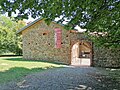
The restoration works of the FAI have brought to light the large arches of the portico of the main conventual building, now a refreshment area, set on the Roman line of the wall, still visible inside the refectory, where can also be seen the large original fireplace. The portico was a provision for pilgrims and travellers, who were thus enabled to rest under its cover and to make use of the oven near which is the stairway leading to the upper floor of the tower. …
Text from Wikipedia, the free encyclopedia, under CC BY-SA 4.0. Full article: «Torba Abbey».
Photos
Getting there
Venegono InferioreTrain, nearest
2.6 km as the crow flies
Torba AbbeyVia Stazione, 2, 21040 Gornate Olona
Aeroporto internazionale Milano Malpensa "Silvio Berlusconi"15.4 km
Distances are as the crow flies, not walking or driving.
Loading map…
Nearby
See on the mapMore abbeys and monasteries in Lombardy

- Free 1st Sunday


- UNESCO

Frequently asked questions
Where is Torba Abbey?
Torba Abbey is in Gornate-Olona, in the province of Varese (Lombardy), Italy. Address: Via Stazione, 2, 21040 Gornate Olona. GPS coordinates: 45.72958, 8.86340.
What are the opening hours of Torba Abbey?
According to OpenStreetMap the opening hours are: 25 February, 30 September · Wednesday to Sunday: 10:00–18:00; 1 October to 11 December · Wednesday to Sunday: 10:00–17:00. Always check the official website before your visit.
How much does it cost to visit Torba Abbey?
There is an admission charge. Up-to-date prices are on the official website.
Is Torba Abbey wheelchair accessible?
According to OpenStreetMap data, the site is partly wheelchair accessible.
What else is there to see near Torba Abbey?
Nearby you’ll find: Castrum in Castelseprio - antiquarium (200 m away), Archaeological Park of Castelseprio (300 m away), Castrum in Castelseprio - fortified house (300 m away).
Sources and licences
Text. Wikipedia, the free encyclopedia (CC BY-SA 4.0).
Data. Wikidata (CC0); opening hours and contacts OpenStreetMap (ODbL).
Photos. Wikimedia Commons, author and licence on every image.
Credits for the 8 photos
- Monastero di Torba, esterno 02 — Sailko, CC BY 3.0
- Monastero di Torba - Torba (Gornate Olona) — Capricornis crispus, CC BY-SA 4.0
- Monastero di Torba, chiesa di santa maria, 06 angelo custode — Sailko, CC BY 3.0
- Monastero di Torba, esterno 01 — Sailko, CC BY 3.0
- Monastero di Torba, esterno, fornace — Sailko, CC BY 3.0
- Monasteroretro — RoyalMailShip, CC BY-SA 3.0
- Monastery of Torba 01 — Derbrauni, CC BY 4.0
- Torba - Monastero 0070 — Phyrexian, CC BY-SA 4.0
Updated 28 October 2026. All sources and licences