


- UNESCO
- Free 1st Sunday
Photo: Sailko, CC BY 3.0 · Wikimedia Commons
Archaeological site
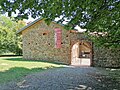
Archeological site in Castelseprio, Italy
Castelseprio (VA), Lombardy
Castelseprio was the site of a Roman fort in antiquity, and a significant Lombard town in the early Middle Ages, before being destroyed and abandoned in 1287. It is today preserved as an archaeological park in the modern comune of Castelseprio, near the modern village of the same name. It is in the north of Italy, in the Province of Varese, about 50 km northwest of Milan.
The fame of Castelseprio lies in the Early Medieval frescoes contained in the apse of the small Church of Santa Maria foris portas, which were only rediscovered in 1944. These frescoes are of exceptional rarity and artistic significance, and show strong Byzantine influence. The dating of the frescoes and the origin of their painter or painters remain controversial, although the first half of the 9th century seems to be emerging as the most likely date.
In 2011, the church - and the castrum with the Torba Tower - became a UNESCO World Heritage Site as part of a group of seven inscribed as Longobards in Italy, Places of Power (568-774 A.D.).
Castelseprio originated as a Roman fort that commanded an important crossroad. During the early Middle Ages, the Lombards occupied the Roman fort, turning it into a fortified citadel or small town. At one point coins were minted there - a sign of its importance. The Church of Santa Maria foris portas ("foris portas" meaning "outside the gates" in Latin) which contains the famous frescoes, lay just outside the walls of the citadel. The early dedication of the church to Mary is an assumption; the first documented mention of a church dedicated to Mary in Castelseprio (which is assumed to be this one) comes from the 13th century.
The whole citadel was completely destroyed by Ottone Visconti, Archbishop of Milan, after he captured it in 1287, to prevent it being used again by his rivals. Investigations into the church, which began in 1934, finally uncovered the famous Byzantinesque frescoes below later plaster in 1944.
The whole area is now an archaeological zone containing the remains of the walls and of the much larger three-aisled 5th-century Basilica of San Giovanni Evangelista. There is also a baptistry of the 5th to 7th centuries dedicated to St. John the Baptist. This has two fonts, perhaps for the use of different Rites, and is octagonal with a small apse to the east. A third Church of San Paolo has a central hexagonal plan and was built between the 6th and 12th centuries. There are some ruins left from the castle. Nearby is a large tower, once used as a convent.
When the Church of Santa Maria foris portas was investigated in 1944, it was found to contain, as well as later frescoes, a highly important and sophisticated cycle of fresco paintings showing very strong Byzantine influence.
It is thought by some scholars, including Leveto, that two different hands can be detected, but the origins of these artists are uncertain and subject to speculation.
The frescoes are sophisticated, expressive and confident. The artists adapt traditional compositional types to the particular site without strain or disproportion. Poses are natural and rhythmic, and the whole has "a great ardor and conviction, an intense response to the human meaning of the subject" (Schapiro).
While some aspects of the frescoes, notably the iconography, are clearly Byzantine, others may draw on the Christian art of Syria or Egypt.
The frescoes also have significant aspects which relate most closely to the late antique art of Italy. Several of the buildings are successfully foreshortened, and the relationship between buildings and figures is more effectively managed than in most Byzantine painting. The painting is done with unusual freedom compared to most Byzantine work; it is this feature in particular which relates to much earlier works from the late antiquity such as paintings found in the catacombs of Rome.
Some art historians see the style as coming from the tradition of Alexandria, from which no other painting on a similar scale remains. John Beckwith is somewhat less enthusiastic than some art historians, describing the frescos as "wholly competent" and worthy of comparison with 7th century works in Rome He believed the "drapery folds... a complex series of angular ridges emphasized by highlights... make a decidedly metallic impression, and betray the copyist, who foreshadows in a disturbing way tenth-century mannerisms". …
Text from Wikipedia, the free encyclopedia, under CC BY-SA 4.0. Full article: «Archaeological Park of Castelseprio».
Distances are as the crow flies, not walking or driving.


Capo di Ponte (BS)

Archaeological Park of Castelseprio is in Castelseprio, in the province of Varese (Lombardy), Italy. Address: Via Castelvecchio, 1513 - Castelseprio. GPS coordinates: 45.72873, 8.85951.
Nearby you’ll find: Castrum in Castelseprio - antiquarium (100 m away), Castrum in Castelseprio - fortified house (100 m away), Torba Abbey (300 m away).
Text. Wikipedia, the free encyclopedia (CC BY-SA 4.0).
Data. Wikidata (CC0); opening hours and contacts OpenStreetMap (ODbL).
Photos. Wikimedia Commons, author and licence on every image.
Updated 28 October 2026. All sources and licences