




Photo: Anna Zacchi, CC BY 2.5 · Wikimedia Commons
Castle, 1406
Saint George Castle
Oldest part of the Palazzo ducale, Mantua, Italy
- Within the UNESCO World Heritage Site “Mantua and Sabbioneta”
At a glance
- Type
- Castle
- Period
- Middle Ages, 1406
- Architect
- Bartolino da Novara
- Commissioned by
- Francesco I Gonzaga
- Protection
- Italian national heritage
- Coordinates
- 45°09′39″ N, 10°47′60″ E
- Address
- Lungolago dei Gonzaga
History and description
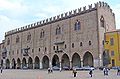
The Castello di San Giorgio is part of the Ducal palace of Mantua. It is a moated rectangular castle, each of which's four corners has a large tower and the moat is crossed by three drawbridges.
History
It was built between 1395 and 1406 on the ruins of the church of Santa Maria di Capo di Bove for Francesco I Gonzaga, to designs by Bartolino da Novara. Ludovico III Gonzaga gave over his rooms in the "Corte Vecchia" to pope Pius II for the Council of Mantua in 1459 - that year, he commissioned Luca Fancelli to rebuild the castle as a palazzo rather than as a defensible castle. He also commissioned the frescoes of the castle Camera degli Sposi. In 1490 the castle became the site of the studiolo of Isabella d'Este, remaining there until she moved it to the "Corte Vecchia" in 1519-1522. In 1496 the condottiero Paolo Vitelli was captured by Francesco II and imprisoned in the castle. It remained the main Gonzaga residence for around a century until Guglielmo Gonzaga moved his apartments to the rebuilt "Corte Vecchia".
In 1810 the Tyrolean fighter Andreas Hofer was imprisoned in the castle before his execution by the Kingdom of Italy. Mantua became part of the Austrian Empire in 1814 and from 1815 it was a maximum security prison for the Empire's political opponents, such as the Belfiore martyrs from 1852 onwards. Others pro-Risorgimento figures imprisoned there included Ciro Menotti and Teresa Arrivabene. The building's structure was damaged by the 2012 Emilia earthquake.
Rooms
Sala dei Soli, ground floor, contains 15th century frescoes, redesigned by Giulio Romano in 1531 and then by Giovan Battista Bertani
Sala dello Zodiaco, with the remains of paintings by Giulio Romano, the room used to house Pietro Frattini, one of the Belfiore martyrs, and Ciro Menotti
Camera degli Sposi.
Scalone di Enea, designed by Bertani in 1549, just after his appointment as "Prefect of the Ducal Buildings" by cardinal Ercole Gonzaga, directly connects the castle's courtyard and loggiato with the Salone di Manto in the Ducal Palace
Text from Wikipedia, the free encyclopedia, under CC BY-SA 4.0. Full article: «Saint George Castle».
Timeline
- 1406Built
Events and people from Wikidata (CC0).
Photos
Getting there
MantovaTrain, nearest
1.3 km as the crow flies
Saint George CastleLungolago dei Gonzaga
Escursioni in barca8.1 km
Aeroporto Valerio Catullo di Verona-Villafranca27.1 km
Distances are as the crow flies, not walking or driving.
Loading map…
Nearby
See on the mapMore castles in Lombardy


Frequently asked questions
Where is Saint George Castle?
Saint George Castle is in Mantua, in the province of Mantova (Lombardy), Italy. Address: Lungolago dei Gonzaga. GPS coordinates: 45.16091, 10.79994.
How old is Saint George Castle?
Wikidata dates it to 1406.
What else is there to see near Saint George Castle?
Nearby you’ll find: Palazzo Ducale Mantua (100 m away), National Archaeological Museum of Mantua (100 m away), Ducal Palace Museum (200 m away).
Sources and licences
Text. Wikipedia, the free encyclopedia (CC BY-SA 4.0).
Data. Wikidata (CC0); opening hours and contacts OpenStreetMap (ODbL).
Photos. Wikimedia Commons, author and licence on every image.
Credits for the 9 photos
- SanGiorgioMN — Anna Zacchi, CC BY 2.5
- 2022 Mantova Castello di San Giorgio 1 — Qasinka, CC0
- Castello di San Giorgio - Mantova, Italia - 14 Novembre 2025 01 — GiorgioGaleotti, CC BY-SA 4.0
- Castello di San Giorgio - Mantova, Italia - 14 Novembre 2025 — GiorgioGaleotti, CC BY-SA 4.0
- Castello di San Giorgio (Mantua) — WhiteGuard, CC BY-SA 4.0
- Castello di San Giorgio in Mantua (1) — Tournasol7, CC BY-SA 4.0
- Castello di San Giorgio — Assianir, CC BY-SA 3.0
- Dipinto del Castello di San Giorgio di Mantova — Alfonso Monfardini, CC BY-SA 3.0
- Mantova - Castello di San Giorgio - 2023-09-13 13-21-51 001 — Maurizio Moro5153, CC BY-SA 4.0
Updated 28 October 2026. All sources and licences