


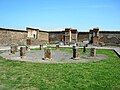


Photo: Giorgio Sommer, Public domain · Wikimedia Commons
Archaeological site
House of the Tragic Poet
Building in Pompei, Italy
- Within the UNESCO World Heritage Site “Archaeological Areas of Pompei, Herculaneum and Torre Annunziata”
At a glance
- Type
- Archaeological site
- Protection
- Italian national heritage
- Coordinates
- 40°45′02″ N, 14°29′02″ E
- Address
- Scavi archeologici di Pompei - Regio VI - Insula 8 - 5
History and description
The House of the Tragic Poet (also called The Homeric House or The Iliadic House) is a Roman house in Pompeii, Italy dating to the 2nd century BCE. The house is famous for its elaborate mosaic floors and frescoes depicting scenes from Greek mythology.
Discovered in November 1824 by the archaeologist Antonio Bonucci, the House of the Tragic Poet has interested scholars and writers for generations. Although the size of the house itself is modest, its interior decorations are not only numerous but of the highest quality among other frescoes and mosaics from ancient Pompeii, preserved by the eruption of Mount Vesuvius in 79 AD.
Traditionally, Pompeii is geographically broken up into nine regional areas, which are then further broken up into insular areas. The House of the Tragic Poet sat in Regio VI, Insula 8, the far-western part of Pompeii. The house faced the Via di Nola, one of Pompeii's largest streets that linked the forum and the Street of the Tombs. Across the Via di Nola from the House of the Tragic Poet sat the Forum Baths of Pompeii.
Layout
Like many Roman homes of the period, the House of the Tragic Poet is divided into two primary sections. The front, south-facing portion of the house serves as a public, presentation-oriented space. Here, two large rooms with outward-opening walls serve as shops run by the homeowners, or, less likely, as servants quarters. These shops lie on either side of a narrow vestibule. At the end of this hall sits the atrium, the most decorated of the rooms within the House of the Tragic Poet. Here, a large rectangular impluvium, or sunken water basin sits beneath an open ceiling, collecting water to be used by members of the household. Near the northern end of the impluvium sits a wellhead to be used for drawing water from the basin. Still farther from the entrance sits the tablinum, a second, open common area.
From these main areas extend smaller, private rooms, marking the second section of the house. Along the western wall of the atrium lie a series of cubicula, or bedrooms. Opposite these lie an additional cubiculum, an ala (a service area for a dining room), and an oecus (a small dining area). The northern end of the tablinum opens onto a large, open peristyle, or garden courtyard. To the right of the peristyle sits the drawing room, which is believed to have been used as the main dining salon. Adjacent to the drawing room is a small kitchen area. Near the left side of the peristyle, a small back door opens onto an additional street. Finally, into north-western corner of the peristyle is built a small lararium, or shrine to be used in worshipping the Lares Familiares, or family gods. This shrine contained a marble statuette depicting a satyr carrying fruit.
Although records and archaeological experts have confidently confirmed the existence of an upper story in the House of the Tragic Poet, little is known about its specific layout.
Art
The house originally contained more than twenty painted and mosaic panels, six of which have been relocated to the National Archaeological Museum in Naples, Italy. These panels were selected for their relation to the Iliad, and were the inspiration behind the names Homeric House and Iliadic House. The painted wall panels within the house are examples of the Fourth Pompeiian style.
The vestibule floor was decorated with a mosaic picture of a domesticated dog leashed and chained to an arbitrary point. Below the figure were the words "CAVE CANEM", meaning Beware of the dog. These words, much like similar signs today, warned visitors to enter at their own risk and served as protection over the more private quarters of the home. The rest of the vestibule floor was decorated in a tesserae or checker-like pattern, in black and white tiles. This pattern was framed by a border of two black stripes that surrounded the room.
The atrium was the focal point of art in the House of the Tragic Poet. Except for the House of the Vettii, it contained more large-scale, mythological frescoes than any other home in Pompeii. Each image was approximately four feet square, making figures slightly smaller than life-size. The images in the atrium frequently feature seated men and women in movement. The women are usually the focus of the images, undergoing important changes in their lives in famous Greek myths.
This panel depicts the gods Hypnos, Hera, and Zeus on Mt. Ida. Hypnos is presenting Hera to Zeus, who sits seated on the right side of the painting. Zeus is holding Hera by the wrist, and Hera is looking at the viewer reluctantly with her veil removed. The three young figures at the bottom right of the painting are possibly dactyli. In the background, there is a pillar with three lions perched on it. This panel is part of the collection at the Archaeological Museum in Naples, Italy.
The image of Aphrodite is now almost entirely destroyed, but what remained of the painting when it was discovered was copied in tempera by the artist Francesco Morelli. The painting may have contained a seated male lover. Because Aphrodite is smaller than the figures in the other paintings, it's also possible the painting contained more figures and depicted the Judgment of Paris. …
Cultural references
The House of the Tragic Poet has served as the focus of many works of fiction and poetry. Among the more famous works is Lord Edward Bulwer Lytton's The Last Days of Pompeii, in which the author invents the personal life of the owner, Glaucus, but accurately describes the house's details. In the Redness of Dawn by author Waldemar Kaden depicts the house as being inhabited by a Christian man named Gaius Sabinus. Another well-known work is Vladimir Janovic's The House of the Tragic Poet, an epic poem based on images from the mosaic and fresco images throughout the villa. The house is also featured in JoJo's Bizarre Adventure: Golden Wind, where the Boss of the gang Passione hides a key near the dog mosaic. The next story features three of the protagonists traveling to Pompeii to retrieve the key.
Interpretations
Art historians and Classics scholars have long been fascinated by the House of the Tragic Poet because of the unique way in which it juxtaposes images from different periods and locations throughout mythological Greece. No single angle within the villa allows one to view all of the images present. Instead, one is required to move around the villa, looking at different combinations of pieces. This logistical fact allows viewers to draw on larger themes of Greek mythology, especially on the relationships between the powerful men and women and also the deities of ancient Greece.
Text from Wikipedia, the free encyclopedia, under CC BY-SA 4.0. Full article: «House of the Tragic Poet».
Photos
Getting there
Pompei Scavi - Villa dei MisteriTrain, nearest
300 m as the crow flies
House of the Tragic PoetScavi archeologici di Pompei - Regio VI - Insula 8 - 5
Porto di Castellammare di Stabia6.5 km
Aeroporto di Napoli Capodichino22.1 km
Distances are as the crow flies, not walking or driving.
Loading map…
Nearby
See on the mapMore archaeological sites in Campania

- UNESCO
- Free 1st Sunday

- UNESCO

- UNESCO

- UNESCO
- Free 1st Sunday

- Free 1st Sunday
Frequently asked questions
Where is House of the Tragic Poet?
House of the Tragic Poet is in Pompei, in the province of Napoli (Campania), Italy. Address: Scavi archeologici di Pompei - Regio VI - Insula 8 - 5. GPS coordinates: 40.75067, 14.48381.
What else is there to see near House of the Tragic Poet?
Nearby you’ll find: Forum Baths, Pompeii (0 m away), Temple of Fortuna Augusta (0 m away), House of the Faun (100 m away).
Sources and licences
Text. Wikipedia, the free encyclopedia (CC BY-SA 4.0).
Data. Wikidata (CC0); opening hours and contacts OpenStreetMap (ODbL).
Photos. Wikimedia Commons, author and licence on every image.
Credits for the 9 photos
- Sommer, Giorgio (1834-1914) - n. 1210 - Pompei - Casa del Poeta — Giorgio Sommer, Public domain
- 1982-10-07 Casa del Poeta Tragico — Dave Cooper, CC BY-SA 4.0
- Casa del poeta tragico - panoramio — Maaike Hage, CC BY-SA 3.0
- Casa del poeta tragico (xilografia) — Unknown author Unknown author, Public domain
- Casa del Poeta Tragico Pompeii 01 — User:MatthiasKabel, CC BY-SA 3.0
- Casa del poeta tragico. 05 — Miguel Hermoso Cuesta, CC BY-SA 4.0
- Painted columns and capitals from Casa delle Baccanti,, Casa di Sallustio, Casa del Centauro, Casa dei Capitelli Colorati, Casa del Poeta Tragico in Pompeii Wilhelm Zahn — Wilhelm Zahn (d. 1871), Public domain
- Pompei, Casa del Poeta Tragico - panoramio - Carlo Pelagalli (1) — Carlo Pelagalli, CC BY-SA 3.0
- Pompei, Casa del Poeta Tragico - panoramio — Carlo Pelagalli, CC BY-SA 3.0
Updated 28 October 2026. All sources and licences