




Photo: Porsche997SBS, CC BY-SA 3.0 · Wikimedia Commons
Archaeological site, 2nd century BC
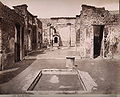
House of the Faun
Roman domus in Pompeii, perhaps the largest in the city at the time of its destruction
- Within the UNESCO World Heritage Site “Archaeological Areas of Pompei, Herculaneum and Torre Annunziata”
At a glance
- Type
- Archaeological site
- Period
- Antiquity, 2nd century BC
- Protection
- Italian national heritage
- Coordinates
- 40°45′04″ N, 14°29′04″ E
- Address
- Scavi archeologici di Pompei - Regio VI - Insula 12 - 2
History and description
The House of the Faun (Italian: Casa del Fauno), constructed in the 2nd century BCE during the Samnite period (180 BCE), was a grand Hellenistic residence that was framed by peristyle in Pompeii, Italy. The historical significance in this impressive estate is found in the many great pieces of art that were well preserved from the ash of the eruption of Mount Vesuvius in 79 CE. It is one of the most luxurious aristocratic houses from the Roman Republic, and reflects this period better than most archaeological evidence found even in Rome itself.
Houses of the higher class
The House of the Faun, along with the House of Pansa and the House of the Silver Wedding represent the higher class of the Roman houses of the Republic. More than 190 years after its excavation, the craftsmanship and quality of materials have been found to be exceptional, even amongst the other noble houses in Pompeii. There is evidence, most notably in the eastern walls of the tetrastyle atrium, that after the AD 62 Pompeii earthquake, the House of the Faun was rebuilt and repaired, as revealed by excavation beneath the floor of the house; yet, the building was only used again until CE 79, when it was ultimately rendered unusable by the eruption of Mount Vesuvius. Although the eruption was devastating, the layers of ash covering the city preserved artworks, like the mosaics, which would have otherwise been likely destroyed or severely decayed due to the passage of time.
Faun statue
The bronze statue of a dancing faun (actually a satyr, since the lower body is that of a man) is what the House of the Faun is named after. In the centre of the atrium there is a white limestone impluvium, a basin for collecting water. The statue was found on October 26 of 1830 near one side of the impluvium and a small fountain in the center. The original statue is currently located in the National Archaeological Museum (Museo Archeologico Nazionale) in Naples, thus the statue seen today in the house’s ruins is a copy. Fauns are spirits of untamed woodland; they are typically depicted as half human and half goat. Literate and Hellenized Romans often connected their depictions of fauns with Pan and Greek satyrs, who were the wild followers of the Greek god of wine and drama, Dionysus. It is purely a decorative sculpture of high order: "the pose is light and graceful," Sir Kenneth Clark observed.
Inscriptions and their familial associations
Archaeologists discovered an inscription bearing the cognomen Saturninus, suggesting that the dwelling was owned by the important gens, or clan, Satria; a ring bearing the family name Cassius was also found, indicating that someone of the Cassii family married into the gens Satria and lived in the House of the Faun.
Excavations
The House of the Faun was initially excavated in 1830 by the German archaeological institute.
Five bodies were found in the house including one woman and three boys.
The most notable of the artworks found in the House of the Faun is the Alexander Mosaic; a reconstructed version of the mosaic can be seen today; the original was removed from the floor where it was found and placed in the National Archaeological Museum in Naples. In the 1830s when it was first discovered, the mosaic was thought to represent a battle scene depicted in the Iliad, but architectural historians have found the mosaic actually depicts the Battle of Issus in 333 BCE between Alexander the Great and Darius III of Persia, which took place about 150 years before the House of the Faun was constructed. This mosaic may be inspired by or copied from a Greek painting finished in the late fourth century BCE, probably by the artist Philoxenus of Eretria. Unlike most Pompeian pavements of the late second and early first centuries, this mosaic is made of tesserae, and not the more common opus signinum, or other kinds of stone chips set in mortar.
The Alexander Mosaic is complemented by other floor mosaics with Nilotic scenes and theatrical masks. Other notable works of art from the House of Faun include an erotic Satyr and Nymph and the fish mosaic, a piece closely resembling other mosaics in Pompeii.
Text from Wikipedia, the free encyclopedia, under CC BY-SA 4.0. Full article: «House of the Faun».
Timeline
- 2nd century BCBuilt
Events and people from Wikidata (CC0).
Photos
Getting there
Pompei Scavi - Villa dei MisteriTrain, nearest
400 m as the crow flies
House of the FaunScavi archeologici di Pompei - Regio VI - Insula 12 - 2
Porto di Castellammare di Stabia6.5 km
Aeroporto di Napoli Capodichino22.1 km
Distances are as the crow flies, not walking or driving.
Loading map…
Nearby
See on the mapMore archaeological sites in Campania

- UNESCO
- Free 1st Sunday

- UNESCO

- UNESCO

- UNESCO
- Free 1st Sunday

- Free 1st Sunday
Frequently asked questions
Where is House of the Faun?
House of the Faun is in Pompei, in the province of Napoli (Campania), Italy. Address: Scavi archeologici di Pompei - Regio VI - Insula 12 - 2. GPS coordinates: 40.75125, 14.48458.
How old is House of the Faun?
Wikidata dates it to the 2nd century BC.
What else is there to see near House of the Faun?
Nearby you’ll find: Temple of Fortuna Augusta (100 m away), House of Labyrinth (100 m away), House of the Dioscuri (VI.9.6) (100 m away).
Sources and licences
Text. Wikipedia, the free encyclopedia (CC BY-SA 4.0).
Data. Wikidata (CC0); opening hours and contacts OpenStreetMap (ODbL).
Photos. Wikimedia Commons, author and licence on every image.
Credits for the 9 photos
- HouseOfTheFaunOverview — Porsche997SBS, CC BY-SA 3.0
- 1982-10-07 Casa del Fauno (1) — Dave Cooper, CC BY-SA 4.0
- Casa del Fauno (Pompei) WLM 019 — Mentnafunangann, CC BY-SA 3.0
- Casa del Fauno 14 — Mentnafunangann, CC BY-SA 3.0
- Casa del fauno entrada 09 — Miguel Hermoso Cuesta, CC BY-SA 4.0
- Casa del Fauno peristilo. 01 — Miguel Hermoso Cuesta, CC BY-SA 4.0
- Casa del Fauno, Pompei - — DinaBenedettoFerrandina, CC BY-SA 4.0
- Casa di Fauno Pompeii 04 — User:MatthiasKabel, CC BY-SA 3.0
- Mosaico pavimentale, Casa del Fauno, Pompei — DinaBenedettoFerrandina, CC BY-SA 4.0
Updated 28 October 2026. All sources and licences