
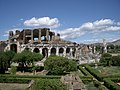


Photo: Fabiobranno, CC BY-SA 4.0 · Wikimedia Commons
Archaeological site
Roman amphitheatre of Santa Maria Capua Vetere
Roman amphitheatre in Santa Maria Capua Vetere, Italy
At a glance
- Type
- Archaeological site
- Area
- 38,500 m²
- Protection
- Italian national heritage
- UNESCO World Heritage
- Via Appia. Regina Viarum
- Coordinates
- 41°05′10″ N, 14°15′00″ E
- Address
- Piazza Primo Ottobre 1860, Piazza Adriano 36, 81055 Santa Maria Capua Vetere
History and description
The Amphitheatre of Capua was a Roman amphitheatre in the ancient city of Capua (modern Santa Maria Capua Vetere), second only to the Colosseum in size and probably the model for it. It may have been the first amphitheatre to be built by the Romans. and was the location of the first and most famous gladiator school.
Today, its remains are found in the comune of Santa Maria Capua Vetere, on Piazza I Ottobre. Much of the stone from the amphitheatre was reused by the Capuans in the Norman period to build the Castello delle Pietre. Some of the ornamental busts that were originally used as keystones for the arches of the amphitheatre are found today in the façade of the Palazzo del comune of Capua. Since December 2014, the museum, amphitheatre, and mithraeum have been under the control of the state museum of Campania. In 2024 the amphitheatre, along with ancient Capua as part of the Appian Way, has been recognised as a UNESCO World Heritage Site.
Structure
Like all amphitheatres, the building had an elliptical plan. Its dimensions approach those of the Colosseum in Rome, with which it shares so many structural features that the Capuan amphitheatre is believed to have provided the direct model for the Colosseum.
The major axis of the structure is 170 metres (560 ft) and the minor axis is 139 metres (456 ft). The façade had a total height of 46 metres (151 ft), divided into four levels, all of the Tuscan order. The lower three levels consisted of 80 arches, each made of travertine and decorated with a bust of a god in the keystone. Seven of these busts have been incorporated into the Palazzo Municipale of Capua, where they remain visible. Others are displayed in the city's museum.
Some remains are visible in the Museo Campano in Capua and in the Museo archeologico dell'antica Capua in Santa Maria Capua Vetere. More remains can be seen in the National Archaeological Museum in Naples, such as the Venus of Capua, which was discovered in the general area of the amphitheatre.
History
During the excavations of September 1726, a damaged inscription was found in front of the southern gate. It was restored by archaeologist Alessio Simmaco Mazzocchi, as follows:
COLONIA IULIA FELIX AUGUSTA CAPUA FECIT DIVUS HADRIANUS AUG RESTITUIT IMAGINES ET COLUMNAS ADDI CURAVIT IMP CAES T AELIUS HADRIANUS ANTONINUS AUG PIUS DEDICAVIT
The inscription, originally placed at the entrance to the amphitheatre, was put on display under the arch of the church of St Eligio a Capua, but is now conserved in the Museo Campano in Capua.
As a result, reconstructing the history of the amphitheatre was possible. It was constructed by the colony after its establishment by Augustus following the Battle of Actium in 31 BC, and was restored by Hadrian in 119 AD, who added statues and columns. Emperor Antoninus Pius inaugurated it in AD 155.
Not all historians agree on the date of the amphitheatre's construction in the first century BC, which would make it the oldest of all known amphitheatres. Many claim that the current structure was built around AD 100 on the ruins of an earlier amphitheatre. If this hypothesis is correct, then the earliest known amphitheatre would instead be the Amphitheatre of Pompeii, built in 70 BC.
After the fall of the Western Roman Empire, the amphitheatre was damaged by the Vandals under Genseric. Along with the rest of the city, it was further damaged by the Saracens in 841, during the war of succession for the Duchy of Benevento. The structure was used as a fortress by the Lombard princes of Capua.
From the end of the 9th century, it was largely spoliated by the Capuans themselves following the transfer of the Civitas Capuana from its old Roman site to Casilinum (the current location of the town), especially for the construction of the Lombard castle. It was also used as a quarry of marble and other materials for the construction of the Capua Cathedral, the campanile, and several palaces in Capua. Later, it was also spoliated for the construction of the Church of the Annunciation, but the story that the amphitheatre was spoliated for the construction of the Royal Palace of Caserta is false. The spoliation was very thorough. Large blocks were broken up to get at the bronze and lead that held them together, and the smaller stones were used for paving the streets. Only in the Bourbon period was the destruction of the amphitheatre halted, when the king declared it a national monument.
Text from Wikipedia, the free encyclopedia, under CC BY-SA 4.0. Full article: «Roman amphitheatre of Santa Maria Capua Vetere».
Photos
Getting there
AnfiteatroTrain, nearest
400 m as the crow flies
Roman amphitheatre of Santa Maria Capua VeterePiazza Primo Ottobre 1860, Piazza Adriano 36, 81055 Santa Maria Capua Vetere
Aeroporto di Napoli Capodichino22.7 km
Distances are as the crow flies, not walking or driving.
Loading map…
Nearby
See on the mapMore archaeological sites in Campania

- UNESCO

- UNESCO

- UNESCO
- Free 1st Sunday

- Free 1st Sunday

Frequently asked questions
Where is Roman amphitheatre of Santa Maria Capua Vetere?
Roman amphitheatre of Santa Maria Capua Vetere is in Santa Maria Capua Vetere, in the province of Caserta (Campania), Italy. Address: Piazza Primo Ottobre 1860, Piazza Adriano 36, 81055 Santa Maria Capua Vetere. GPS coordinates: 41.08611, 14.25000.
What are the opening hours of Roman amphitheatre of Santa Maria Capua Vetere?
According to OpenStreetMap the opening hours are: Tuesday to Sunday: 9:00–18:00; Monday: Closed. Always check the official website before your visit.
Can I visit Roman amphitheatre of Santa Maria Capua Vetere for free?
Yes: entry is free on the first Sunday of every month, under the Italian “Domenica al museo” scheme.
What else is there to see near Roman amphitheatre of Santa Maria Capua Vetere?
Nearby you’ll find: Ancient Capua (0 m away), Santa Maria Capua Vetere Gladiator Museum (100 m away), Domus of Publius Confuleius Sabbio (700 m away).
Sources and licences
Text. Wikipedia, the free encyclopedia (CC BY-SA 4.0).
Data. Wikidata (CC0); opening hours and contacts OpenStreetMap (ODbL).
Photos. Wikimedia Commons, author and licence on every image.
Credits for the 9 photos
- Amphitheatre Santa Maria di Capua Vetere - EyeSky — Fabiobranno, CC BY-SA 4.0
- Anfiteatro Campano (Santa Maria di Capua Vetere) 17 — Saverio.G, CC BY-SA 4.0
- Santa Maria Capua Vetere - Anfiteatro campano - 202209101610 — Viaggiatore73, CC BY-SA 4.0
- The Amphitheatre of Santa Maria Capua Vetere 001 — Dom De Felice e Carla Nunziata, CC BY-SA 3.0
- The Roman Amphitheatre, Capua (15833604106) — Carole Raddato from FRANKFURT, Germany, CC BY-SA 2.0
- Anfiteatro Capua 01 — Miguel Hermoso Cuesta, CC BY-SA 4.0
- Capua (5542642564) — jimmyweee, CC BY 2.0
- ATT 1403037687466 IMG 0505 — Marcellona, CC BY-SA 3.0
- Mura contro il cielo — Fabiobranno, CC BY-SA 4.0
Updated 28 October 2026. All sources and licences