





Photo: Rico Heil, CC BY-SA 3.0 · Wikimedia Commons
Archaeological site
Ancient Capua
Ancient city of Italy
At a glance
- Type
- Archaeological site
- UNESCO World Heritage
- Via Appia. Regina Viarum
- Coordinates
- 41°05′10″ N, 14°15′01″ E
History and description
Santa Maria Capua Vetere is a town and comune in the province of Caserta, in the region of Campania, southern Italy.
It is nicknamed by the locals "The city of Spartacus"
After the destruction of Ancient Capua, the town developed during the medieval period near the site of the Roman amphitheatre and the old Christian basilica of Santa Maria Maggiore, which is the old name of the town. Its name was later changed to Santa Maria Capua Vetere—with Capua Vetere meaning "Old Capua"—to reflect its historical association with the ancient city.
History
The city lies on what once was the great ancient city of Capua. Its founding date is uncertain, although the historian Velleius Paterculus claims it was founded around 800 B.C. The name probably comes from Etruscan Capeva, meaning "City of marshes".
In the area several settlements of the Villanovan culture were present in pre-historical times, and these were probably enlarged by the Oscans and Etruscans. In the 5th century BC the city underwent a serious restructuring of its urban layout under Etruscan rule, during this time, many oscan speaking peoples migrated to the city from further inland as cheap labour. They were granted citizenship by the Etruscan rulers in 438 BC and went on to dominate the city after Etruscan collapse in southern Italy. In the 4th century BC Capuae was the largest city in Italy after Rome. During a war against the invading Samnites, in 343 BC the city willingy submitted to Rome for protection and in 338 BC it became a 'civitas sine suffragio', however it retained its own laws, customs, language and senate. The city was connected to Rome in 312 B.C. after the construction of the Via Appia, the most important roman road in Italy. It was the capital of Campania Felix.
In 3rd century BC the city continued to grow, and at the start of the second punic war it furnished 30.000 infantry and 4.000 cavalry. Until the Roman defeat at Cannae, it remained loyal to Rome. …
Main sights
The main sight present in Santa Maria Capua Vetere is the roman amphitheatre of ancient Capua. It is the second biggest amphitheatre after the colosseum and in front of it lie the ruins of a smaller amphitheatre, which is where Spartacus fought.
Built during Augustus' rule, it was restored by Hadrian. The exterior was composed of 80 Doric arcades four stories high, with only two remaining. The keystones had sculpted heads of divinities. The underground tunnels are well preserved and explorable. The dimensions are as follows: the longer diameter is 170 metres (560 ft), the shorter 140 metres (460 ft), and the arena measures 75 by 45 metres (246 by 148 ft), the corresponding dimensions in the Colosseum at Rome being 188, 155, 85, 53 metres (615, 510, 279 and 174 ft).
Close to it lies also the Arch of Hadrian which was located at the northwestern entrance to the city.
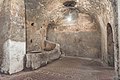
The mithraeum is also an important landmark being one of the few very well preserved ones in the former empire.
The other principal landmark within Santa Maria Capua Vetere is the basilica of Santa Maria Maggiore, which, according to tradition, was founded by Pope Symmachus (the city's Patron saint) in the 5th century. The original structure featured a single nave, but was expanded in 787 by the Lombard prince Arechis II of Benevento. A further renovation took place in 1666 under Cardinal Robert Bellarmine, adding two additional aisles. The church's current Late Baroque appearance results from restoration works carried out between 1742 and 1788, during which the original mosaic decoration in the apse was unfortunately destroyed.
Traditions
Every year on the 14th of August the city celebrates its patron Saint, the Beata Vergine Maria Assunta, with a procession through the city and a pyrotechnical spectacle on the bell tower: the Incendio del campanile (Fire of the bell tower). The first mentions of this celebrations come from the XV century vistits by the sovreigns of Aragon.
Text from Wikipedia, the free encyclopedia, under CC BY-SA 4.0. Full article: «Ancient Capua».
Photos
Getting there
AnfiteatroTrain, nearest
400 m as the crow flies
Ancient Capua
Aeroporto di Napoli Capodichino22.7 km
Distances are as the crow flies, not walking or driving.
Loading map…
Nearby
See on the mapMore archaeological sites in Campania

- UNESCO
- Free 1st Sunday

- UNESCO

- UNESCO

- UNESCO
- Free 1st Sunday

- Free 1st Sunday
Frequently asked questions
Where is Ancient Capua?
Ancient Capua is in Santa Maria Capua Vetere, in the province of Caserta (Campania), Italy. GPS coordinates: 41.08624, 14.25036.
Can I visit Ancient Capua for free?
Yes: entry is free on the first Sunday of every month, under the Italian “Domenica al museo” scheme.
What else is there to see near Ancient Capua?
Nearby you’ll find: Roman amphitheatre of Santa Maria Capua Vetere (0 m away), Santa Maria Capua Vetere Gladiator Museum (100 m away), Domus of Publius Confuleius Sabbio (700 m away).
Sources and licences
Text. Wikipedia, the free encyclopedia (CC BY-SA 4.0).
Data. Wikidata (CC0); opening hours and contacts OpenStreetMap (ODbL).
Photos. Wikimedia Commons, author and licence on every image.
Credits for the 5 photos
- Capua Antica Amphitheatre — Rico Heil, CC BY-SA 3.0
- Santa Maria Capua Vetere Mithraeum Tauroctony — Dom De Felice, CC BY-SA 3.0
- The Arch of Hadrian spanning the Appian Way, Northern side, Capua (14574900116) — Carole Raddato from FRANKFURT, Germany, CC BY-SA 2.0
- Appian Way — Livioandronico2013, CC BY-SA 4.0
- Menelaus Paris Louvre G115 — Kalliades as potter (signed), Douris as painter (signed), Public domain
Updated 28 October 2026. All sources and licences