


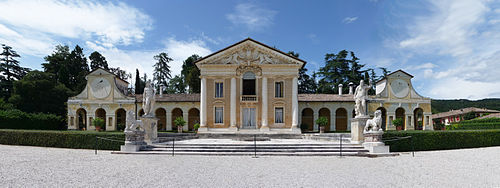
Photo: This Photo was taken by Wolfgang Moroder. Feel free to use my photos, but please mention me as the author and send me a message. This image is not in the public domain. Please respect the copyright…, CC BY-SA 3.0 · Wikimedia Commons
Historic villa / palace, 1710
Ca' Pesaro
Palace and museum in Venice, Italy
- Within the UNESCO World Heritage Site “Venice and its Lagoon”
At a glance
- Period
- Early modern period, 1710
- Style
- Baroque architecture
- Architects
- Baldassare Longhena, Antonio Gaspari
- Protection
- Italian national heritage
- Coordinates
- 45°26′28″ N, 12°19′53″ E
- Address
- Santa Croce, 2076, 30135 Venezia (VE)
History and description
Ca' Pesaro is a Baroque marble palace turned art museum, facing the Grand Canal of Venice, Italy. Today it is one of the 11 museums run by the Fondazione Musei Civici di Venezia system.
The building was originally designed by Baldassarre Longhena in the mid-17th century, the construction was completed by Gian Antonio Gaspari in 1710. As at Longhena's Ca' Rezzonico, a double order of colossal columns and colonnettes flanking arch-headed windows, reinterpreting a motif of Jacopo Sansovino, Longhena creates the impression of double loggias extending across the main Grand Canal frontage, above a boldly rusticated basement.
The building
The palace was built in the second half of the 17th century for the noble and wealthy Pesaro family, a project by the Venetian architect, Baldassarre Longhena, who also designed the church of the Salute and Ca' Rezzonico.
Works began in 1659 starting from the landside; the courtyard was completed by 1676. By 1679, the façade on the Grand Canal had already reached the second floor, but when Longhena died 3 years after, the palace was still unfinished. The Pesaro family then entrusted its completion to Gian Antonio Gaspari who concluded it in 1710, according to the original project. Longhena was inspired by Sansovinian classicism when designing Ca’ Pesaro, creating expressions of a new and sumptuous harmony, with its complex and powerful composition, yet well-balanced. The Sansovinian motif is more explicit on the first floor, with the chiaroscuro rhythm of the arches and columns.
On the second floor, the façade is enriched by ornamentation in the pendentives and the entablatures. The entrance-hall, laid out along the axis of the entire building, contrasts with the clarity of the courtyard, articulated around the monumental well and enclosed by a terrace and an ashlar-arcade.
The palace still conserves some of the fresco and oil decorations of the ceilings by artists such as Bambini, Pittoni, Crosato, Trevisani and Girolamo Brusaferro. The collections of the Pesaro family, as documented in the archives, must have been even more remarkable, including works by artists such as Vivarini, Carpaccio, Bellini, Giorgione, Titian, Tintoretto, as well as other famous Venetian artists of the 17th and 18th centuries. This great heritage was completely dispersed by 1830, the year of the death of the last Pesaro family member, who auctioned most of the collection in London. The palace was passed on firstly to the Gradenigo family and then to the Armenian Mekhitarist Fathers in 1936, who used it as a college until 1850, before relocating to Ca' Zenobio. It was finally bought by the Bevilacqua family, and became the property of Duchess Felicita Bevilacqua La Masa. It was she who decreed the present usage of the building, bequeathing it to the city in 1898, as a museum of Modern Art. …
Modern art museum
Ca' Pesaro houses 19th and 20th century collections of paintings and sculptures, as well as a section on graphic art.
Room 1: Works by Venetian painters of the second half of the 19th century, such as Ippolito Caffi, Guglielmo Ciardi, Giacomo Favretto, and Pietro Fragiacomo are on display, testifying to the city's art variety in the 19th and the early 20th century.
Room 2: This room brings together 19th century Italian works: there are paintings by Signorini, Giovanni Fattori, De Nittis, Guiseppe Pellizza, Gaetano Previati, and Angelo Morbelli. The city of Venice was stirred by the presence of these artists at the city's Biennale to acquire their works, which testify to the vitality of Italian painting at the turn of the century. The collection of sculptures by Medardo Rosso is also of special importance.
Central Hall: The central hall displays works from the very first Venice Biennale up to the 1950s. The room begins with a homage to one of the founders of the Biennale, Riccardo Selvatico, portrayed by Alessandro Milesi, and continues with works by artists from England, Belgium, Scandinavia, Germany, France and Russia. Alongside masterpieces (such as Gustav Klimt’s Judith II and Aunt Luisa by Zuloaga), a number of other paintings that met with outstanding success during the early editions of the Biennale by Filipp Malyavin, Charles Cottet, and Joaquin Sorolla are exhibited. These works give an idea of the Biennale’s role in promoting “salon-art”, followed by others of experimental kind such as Kandinsky’s White Zig Zags. Finally, works from the museum’s graphic art collection and sculptures are also on display, together with some renowned paintings by Pierre Bonnard and Marc Chagall.
Room 3: This room is devoted to Adolfo Wildt's sculptures, donated to Ca' Pesaro by the Wildt-Scheiwiller heirs in 1990. The Milanese artist was a protagonist of the Symbolism, but also of a period of experimentalism and innovation that influenced later generations. …
Asian art museum
The upper floor is dedicated to the Oriental Art Museum (Italian: Museo Orientale), housing some 30,000 objects, mainly from Edo period Japan (armour, inros, netsukes, and art by Koryusai, Harunobu, Hokusai), but additionally artwork from China and Indonesia. This collection of oriental objects was brought back from a stay in Asia by Prince Henry of Bourbon-Parma, Count of Bardi, at the end of the 19th century, and bequeathed to the Italian state.
Text from Wikipedia, the free encyclopedia, under CC BY-SA 4.0. Full article: «Ca' Pesaro».
Timeline
- 1652Start of construction
- 1710Built
Events and people from Wikidata (CC0).
Photos
Getting there
Venezia Santa LuciaTrain, nearest
800 m as the crow flies
Ca' PesaroSanta Croce, 2076, 30135 Venezia (VE)
San Stae100 m
Aeroporto Marco Polo di Venezia7.1 km
Distances are as the crow flies, not walking or driving.
Loading map…
Nearby
See on the mapMore historic villas and palaces in Veneto

- Free 1st Sunday


- UNESCO

- UNESCO
- Free 1st Sunday
- UNESCO
Frequently asked questions
Where is Ca' Pesaro?
Ca' Pesaro is in Venice, in the province of Venezia (Veneto), Italy. Address: Santa Croce, 2076, 30135 Venezia (VE). GPS coordinates: 45.44100, 12.33146.
How old is Ca' Pesaro?
Wikidata dates it to 1710.
What else is there to see near Ca' Pesaro?
Nearby you’ll find: Museum of Oriental Art (0 m away), Palazzo Coccina Giunti Foscarini Giovannelli (0 m away), Palazzo Correggio (0 m away).
Sources and licences
Text. Wikipedia, the free encyclopedia (CC BY-SA 4.0).
Data. Wikidata (CC0); opening hours and contacts OpenStreetMap (ODbL).
Photos. Wikimedia Commons, author and licence on every image.
Credits for the 9 photos
- Ca'Pesaro di Baldassarre Longhena facciata sul Canal Grande — This Photo was taken by Wolfgang Moroder. Feel free to use my photos, but please mention me as the author and send me a message. This image is not in the public domain. Please respect the copyright…, CC BY-SA 3.0
- (Venice) Ca' Pesaro — Didier Descouens, CC BY-SA 4.0
- 0 Venise, La Ca' Pesaro — Jean-Pol GRANDMONT, CC BY 4.0
- Ca Pesaro dettaglio facciata 2014 — This Photo was taken by Wolfgang Moroder. Feel free to use my photos, but please mention me as the author and send me a message. This image is not in the public domain. Please respect the copyright…, CC BY-SA 3.0
- Cà Pesaro — Roby83, Public domain
- Ca' Pesaro (Venècia) — Joanbanjo, CC BY-SA 3.0
- Ca' Pesaro (Venezia) — Adriano, CC BY-SA 3.0
- Ca' Pesaro con gondole — Trapezaki, CC BY-SA 4.0
- Ca' Pesaro cortile — Adriano, CC BY-SA 3.0
Updated 28 October 2026. All sources and licences