




- UNESCO
- Free 1st Sunday
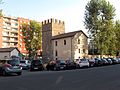
Photo: ? / Coldeel, Public domain · Wikimedia Commons
Aqua Anio Novus (Latin for "New Anio aqueduct") was an ancient Roman aqueduct supplying the city of Rome. Like the Aqua Claudia, it was begun by emperor Caligula in 38 AD and completed in 52 AD by Claudius, who dedicated them both on August 1.
The aqueduct—together with the Aqua Anio Vetus, Aqua Marcia and Aqua Claudia—is regarded as one of the four great aqueducts of Rome.
The quality of water Aqua Anio Novus delivered to the city of Rome left much to be desired, and before Frontinus' reforms of the water supply system its waters were used to supplement the flow of other aqueducts when needed—rendering waters in those too torpid in the process.
The building of Aqua Anio Novus was lacking in quality, and it required repairs after a few decades of use. In or around 71 AD the aqueduct was extensively restored by Vespasian. Further repairs took place during the reign of Trajan, and smaller repairs were made during Hadrian's reign as well. The aqueduct was again restored while the Severan dynasty was in power, in 201 AD. After 201 AD and before 381 AD many repairs were made to the Aqua Anio Novus, albeit they can not be dated exactly.
Frontinus describes its source as near that of the Aqua Claudia and "forty-second milestone on the via Sublacensis, in the district of Simbruvium. The water is taken from the river which, even without the effect of rainstorms, is muddy and discoloured, because it has rich and cultivated fields adjoining it and in consequence loose banks." Its flow at the intake was 197,000 m3 a day. The aqueduct was freely used to supply the deficiencies of other aqueducts by using cross-channels at several points along the route controlled by sluice gates, and being turbid, rendered them impure.
To improve the quality of the water Trajan connected additional sources from the two uppermost of the three lakes formed by Nero for the adornment of his villa at Subiaco, thus lengthening the aqueduct to 58 miles and 700 paces. The lakes were created by dams in the river, and were the tallest of any built by the Romans. They were swept away by the river in the Medieval period.
The aqueduct was split into two channels above Tivoli and combined again near Gericomo. From its filtering tank near the seventh milestone of the Via Latina, it was carried on the arches of the Aqua Claudia, in a channel immediately superposed on the latter. It terminated at a great tank on the Esquiline Hill near the temple of Minerva Medica.
The Aqua Anio Novus had the highest water level of all the aqueducts that came into Rome which allowed it to reach the highest districts, but also necessitated a route that was higher than the others with taller bridges.
It was built of tuff and brick.
Aqua Anio Novus bridges visible today include: Ponte degli Arci, Ponte Arcinelli, Ponte Sant Antonio and Ponte Barucelli.
The Ponte S. Antonio is considered one of the most beautiful bridges of aqueducts supplying Rome. It crosses the Acqua Raminga stream and is named after an ancient sanctuary now disappeared. …
Text from Wikipedia, the free encyclopedia, under CC BY-SA 4.0. Full article: «Anio Novus».
Distances are as the crow flies, not walking or driving.


Anio Novus is in Ciampino, in the province of Roma (Lazio), Italy. GPS coordinates: 41.84600, 12.56100.
Nearby you’ll find: Aqua Marcia (200 m away), Aqua Claudia (700 m away), Villa of the Sette Bassi (1.3 km away).
Text. Wikipedia, the free encyclopedia (CC BY-SA 4.0).
Data. Wikidata (CC0); opening hours and contacts OpenStreetMap (ODbL).
Photos. Wikimedia Commons, author and licence on every image.
Updated 28 October 2026. All sources and licences