




- Free 1st Sunday
Photo: ThePhotografer, CC BY-SA 4.0 · Wikimedia Commons
Museum, 2nd millennium
Monument built in honour of Victor Emmanuel II of Italy
The Victor Emmanuel II National Monument (Italian: Monumento Nazionale a Vittorio Emanuele II), also known as the Vittoriano or for synecdoche Altare della Patria ("Altar of the Fatherland"), is a large national monument built between 1885 and 1935 to honour Victor Emmanuel II, the first king of a unified Italy, in Rome, Italy. It occupies a site between the Piazza Venezia and the Capitoline Hill. The monument was realized by Giuseppe Sacconi.
From an architectural perspective, it was conceived as a modern forum, an agora on three levels connected by stairways and dominated by a portico characterized by a colonnade. The complex process of national unity and liberation from foreign domination carried out by King Victor Emmanuel II of Savoy, to whom the monument is dedicated, has a great symbolic and representative value, being architecturally and artistically centred on the unification of Italy—for this reason the Vittoriano is considered one of the national symbols of Italy.
The Vittoriano is on the Capitoline Hill, in the symbolic centre of ancient Rome, and is connected to the modern one thanks to roads that radiate from Piazza Venezia.
Its design is a neoclassical interpretation of the Roman Forum. It features stairways, Corinthian columns, fountains, an equestrian statue of Victor Emmanuel II, and two statues of the goddess Victoria riding on quadrigas. On its summit is a majestic portico characterized by a long colonnade and two imposing propylaea, one dedicated to the "unity of the homeland", and the other to the "freedom of the citizens", concepts metaphorically linked to the figure of Victor Emmanuel II.
The base houses the museum of Italian unification, and in 2007 a lift was added to the structure, allowing visitors to access the roof for 360-degree views of Rome. This terrace, which is the highest of the monument, can also be reached via 196 steps that start from the portico.
The structure is 135 m (443 ft) wide, 130 m (427 ft) deep, and 70 m (230 ft) high. If the quadrigae and Winged Victorys are included, the height reaches 81 m (266 ft). It has a total area of 17,550 m2 (188,907 sq ft) and possesses, due to the conspicuous development of the interior spaces, a floor area of 717,000 m2 (7,717,724 sq ft).
One of the architecturally predominant elements of the Vittoriano are the external staircases, which constitute in the complex 243 steps, and the portico on the top of the monument, which is inserted between two lateral propylaea. The entrance stairway is 41 m (135 ft) wide and 34 m (112 ft) long, the terrace of the Altar of the Fatherland is 66 m (217 ft) wide. The maximum depth of the Vittoriano underground reaches 17 m (56 ft) below street level. The colonnade is formed by columns 15 m (49 ft) high and the length of the porch is 72 m (236 ft). …
After the death of Victor Emmanuel II of Savoy on 9 January 1878, many initiatives were destined to raise a permanent monument that celebrated the first king of a united Italy, creator of the process of unification and liberation from foreign domination, which is indicated by historiography as "Father of the Fatherland" also due to the political work of the President of the Council of Ministers of the Kingdom of Sardinia Camillo Benso, Count of Cavour, and to the military contribution of Giuseppe Garibaldi. The goal was therefore to commemorate the entire Italian unification season ("Risorgimento") through one of its protagonists.
For this purpose, the Italian government approved the construction of a monumental complex on the Northern side of Rome's Capitoline Hill. The monument would celebrate the legacy of the first king of a united Italy and would become a symbol of national patriotism. The project was realized by Giuseppe Sacconi in 1885, in an eclectic style.
Sacconi was inspired by the Hellenistic sanctuaries, such as the Pergamon Altar and the Sanctuary of Fortuna Primigenia in Palestrina. The Vittoriano was conceived as a vast and modern forum open to citizens, on a sort of elevated square in the historic centre of Rome organized as an agora on three levels connected by tiers, with conspicuous spaces reserved for strolling visitors.
To erect the Vittoriano it was necessary, between the last months of 1884 and 1899, to proceed with numerous expropriations and extensive demolitions of the buildings that were on the site. The place chosen was in the heart of the historic centre of Rome and was therefore occupied by ancient buildings arranged according to urban planning that dated back to the Middle Ages. This was considered necessary because the Vittoriano should have been built in the heart of the historic centre of Rome, in a modern urban context, in front of a new large square (the future Piazza Venezia), which at the time was just a narrow open space in front of Palazzo Venezia. …
The monument holds the Tomb of the Italian Unknown Soldier with an eternal flame, built under the statue of goddess Roma after World War I following an idea of General Giulio Douhet. The body of the unknown soldier was chosen on 28 October 1921 from among 11 unknown remains by Maria Bergamas, a woman from Gradisca d'Isonzo whose only child was killed during World War I. Her son's body was never recovered. The selected unknown was transferred from Aquileia, where the ceremony with Bergamas had taken place, to Rome and buried in a state funeral on 4 November 1921.
His tomb is a symbolic shrine that represents all the fallen and missing of the war. The side of the tomb of the Unknown Soldier that gives outward at the Altar of the Fatherland is always guarded by a guard of honour and two flames that burn perpetually in braziers. The guard is provided with military personnel of the various weapons of the Italian Armed Forces, which alternate every ten years.
The allegorical meaning of the perpetually burning flames is linked to their symbolism, which is centuries old, since it has its origins in classical antiquity, especially in the cult of the dead. A fire that burns eternally symbolizes the memory, in this case of the sacrifice of the Unknown Soldier moved by patriotic love, and his everlasting memory of the Italians, even in those who are far from their country. The two perennial braziers next to the Tomb of the Unknown Soldier is placed a plaque whose text reads "Italians Abroad to the Motherland" in memory of donations made by Italian emigrants between the end of the 19th century and the beginning of the 20th century for the construction of the Vittoriano.
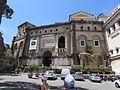
Inside the Vittoriano are some museums dedicated to the history of Italy, especially the Unification of Italy ("Risorgimento"): the Central Museum of the Risorgimento (Italian: Museo Centrale del Risorgimento) with an adjoining study institute, the Flag of Italy Memorial (Italian: Sacrario delle bandiere) and an area that hosts temporary exhibitions of artistic interest, historical, sociological and cultural called "ala Brasini".
Since 2020, together with Palazzo Venezia, it has been managed by the VIVE Institute, one of the eleven institutes of significant general interest of the Italian Ministry of Culture.
Access to the Central Museum of the Risorgimento is on the left side of the monument, at the back of the Santa Maria in Ara Coeli along via di San Pietro in Carcere. The period of Italian history between the end of the 18th century and the First World War is displayed by memorabilia, paintings, sculptures, documents (letters, diaries and manuscripts), drawings, engravings, weapons and prints.
On the entrance stairway of the Central Museum of the Risorgimento are visible engravings related to some significant episodes for the birth of the Risorgimento movement, from the seed thrown by the French Revolution to the Napoleonic Wars, to better frame and remember the national history included between the reform of the ancient Italian states and the end of the First World War. Along the walls, other marble engravings show some pieces of texts enunciated by prominent personalities, which better testify and describe this part of Italian history.
The Central Museum of the Risorgimento also includes the Shrine of the Flags, a museum where the war flags of dissolved military units and decommissioned ships from the Italian Army, Italian Air Force, Italian Navy, Carabinieri, Polizia di Stato, Penitentiary Police and Guardia di Finanza are collected and temporarily stored. In case a unit is reformed, the flags are retrieved by the unit. Access to the shrine is along Via dei Fori Imperiali, where memorabilia, relating mainly to the Risorgimento wars, in which the Italian Armed Forces took part, are also kept. …
Text from Wikipedia, the free encyclopedia, under CC BY-SA 4.0. Full article: «Altare della Patria».
Events and people from Wikidata (CC0).
Distances are as the crow flies, not walking or driving.


Altare della Patria is in Rome, in the province of Roma (Lazio), Italy. Address: Piazza Venezia 6, 00187 Roma. GPS coordinates: 41.89472, 12.48306.
Yes: entry is free on the first Sunday of every month, under the Italian “Domenica al museo” scheme.
Wikidata dates it to the 2nd millennium.
Nearby you’ll find: Sacrario delle bandiere (100 m away), Atrium Libertatis (100 m away), Insula Romana (100 m away).
Text. Wikipedia, the free encyclopedia (CC BY-SA 4.0).
Data. Wikidata (CC0); opening hours and contacts OpenStreetMap (ODbL).
Photos. Wikimedia Commons, author and licence on every image.
Updated 28 October 2026. All sources and licences