


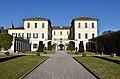


Photo: Niklas Schwartz, CC BY-SA 4.0 · Wikimedia Commons
At a glance
- Protection
- Italian national heritage
- Coordinates
- 45°50′37″ N, 8°48′57″ E
- Address
- Viale Giovanbattista Vico, 46 - 21100 Varese (VA)
History and description
Villa Toeplitz is a historic villa located in Varese, Lombardy, Italy. Construction was complete by 1901 and subsequently named after the banker Jósef Leopold Toeplitz (in Italian, Giuseppe Toeplitz), who bought the villa in 1914. It previously belonged to the Hannesens, a German family that used it as a country holiday house.
Villa Toeplitz is considered one of the ten most beautiful parks in Italy thanks to its carefully designed gardens, scenic fountains and water features. The villa also houses the headquarters of the Faculty of Communication Sciences of the University of Insubria, as well as the Ethno-Archeological Museum Castiglioni.
History
Villa Toeplitz was built on a hill in the Varese district of Sant'Ambrogio Olona, in the centre of a complex of orchards and farm buildings. It is one of 120 villas in a municipality that has 73% of the landscape protected. The villa was created as a country residence for the German Frey family. The Varese engineer Alfredo Speroni renovated the dwelling, having designed the original nucleus of the house, which was then handed over to the Hannesen family. In 1914 the founder of Banca Commerciale Italiana, Giuseppe Toeplitz, bought the building and it subsequently became known as Villa Toeplitz.
Giuseppe Toeplitz commissioned the Varese engineer Speroni to completely transform the residence. Due to World War I, the building was eventually re-opened in 1918. Speroni and the Roman architect Armando Brasini modified the existing building and made significant developments to the surrounding park, which was expanded to 8 hectares. Villa Toeplitz's park includes the main villa, the residential villa (dépendance) and the porter's lodge. The park was divided into several components: the orchard; a lawn area; access roads to the Villa; patches of shrubs and groups of trees; a "wood" of conifers and exotic plants; a lookout and chapel on the upper part of the property; a hornbeam rock; areas for bowls, tennis courts and croquet games; a flower garden; a swimming pool (today a pond); and, a wood-aged chestnut. The original orchard disappeared following the expansion of Sant'Ambrogio's cemetery, where the remains of the Toeplitz spouses are buried. There were also greenhouses (now abandoned) and some small stables. In 2010, due to the demolition of old cattle sheds and a no longer functioning water derivation room, an area was renovated for public access. …
Villa
The location of the villa provides extensive views of the Valceresio, the Olona Valley, the Mendrisiotto and part of the Comasco. The building has an eclectic architectural style, created by a mix of construction materials and approaches. These include the Lombard style of reusing existing materials, the 19th-century traditions of the architect Camillo Boito, and the use of Renaissance models that recall classical and mannerist art. Brick masonry is embedded in terracotta, and ashlar used on the ground floor. The grey stone that adorns the lower part of the building was obtained from the limestone quarries above nearby Barasso.
The villa was substantially restructured by Jósef Leopold Toeplitz in the years immediately after the First World War when he bought the existing building from the German industrialist Eugene Hannesen. The works, inspired by his second wife, continued until 1926, under the guidance of the prominent Roman architect Armando Brasini, known for his eclectic and visionary style. Once the renovation work was completed, the building became Toeplitz's favourite residence, and also a meeting place where famous names from the Italian and international economic, industrial and artistic scene stayed.
The upper floor is characterized by a loggia to give light to the panoramic room with arches closed by windows interrupted by a niche. A large panoramic terrace is located on the west side of the villa. It is furnished with two large flowerbeds under which there is an exedra fountain with a semi-dome cap decorated with rays to simulate a shell. On the lower side of this facade of the building, there are thermal windows that recall those used by Andrea Palladio in Villa Foscari, called the "Malcontenta". Other peculiar characteristics of the manor house are the use of the serliana and, above the windows, lunettes and gables, generally painted or decorated. The covers of the loggia above the main entrance and that of the tower are wooden coffered ceilings. Other interesting elements of the Italian floral or Art Nouveau style are, for example, the wrought iron with their decorations and the dormer windows on the upper floor that go over the cornice of the building interrupting the eaves. …
From guest house to the Ethno-Archeological Museum Castiglioni
Along the road that leads to the manor house, there is the building that Toeplitz designed to accommodate prominent figures that the banker welcomed in Varese. These included the Duke of Abruzzi, the writer Matilde Serao, the Agnelli, the Pirelli and, probably, Gabriele D'Annunzio. The building, externally, utilizes the characteristic materials of Lombard architecture and consists of a brick facade in the lower part and plaster in the upper half. The decorations in coloured bands, mainly in blue and gold, stand out in the upper part, under the roof, typical of early 20th-century architecture.
Today it hosts the Castiglioni Museum, housing an ethnoarchaeological collection of thousands of finds, donated by the brothers Alfredo and Angelo Castiglioni to the Municipality of Varese. In sixty years of research in the archaeological, anthropological and ethnological fields throughout the African continent, the two brothers collected and catalogued artefacts of the material and religious life of various ethnic groups, and made precise photo-cinematographic documentation.
The archaeological section on the ground floor houses Egyptian and prehistoric finds. These include the graffiti casts of Bergiug and exhibits on where and how gold was mined at the time of the Egyptian pharaohs. It also tells the stories of the discovery of Berenice Pancrisia, (the "all gold city" mentioned by Pliny the Elder in his "Naturalis Historia"), the origin of the silica glass, (the mysterious "glass of the stars", already known at the time of Tutankhamon), and the origin of the emeralds used since the time of Cleopatra.
The upstairs ethnographic section describes traditional populations from savannah and desert environments. These include exhibits of the typical elaborate hairstyles of the Nile Camiti, shepherds of the African savannah (Kenya, Tanzania, Uganda) and other objects of their material culture. A multimedia room reveals an original Tuareg people, telling the story of the customs and traditions of the "blue men". It is unique for the quality and variety of its exhibits.
Gardens
Villa Toeplitz's Gardens consist of 8 hectares. They are connected by a "complex" pathways running through a connected system of exotic plans, fountains and buildings. The Park was designed in 1927 by the Parisian studio L. Collin – A. Adam & C.
Two different gardening styles compose the main Villa Toeplitz's Gardens: a "specifically formal" Giardino all'italiana, characterized by low boxwood bushes and cypress trees; and an English landscape garden, with beech trees, oaks and cedar trees. A part of the park is currently occupied by a large chestnut wood, penetrated by tracks leading to a "deep nature contacting experience". The park also contains a series of fountains, waterfalls and symmetrical topiary architectures, that characterize the early origins of the garden. A natural pathway runs through a chestnut wood in the northern part of the gardens immediately behind the villa, from the southern entrance of the gardens to the northern one. It is composed of "sinuous and romantic" alleys that are interrupted by small hills and "elegant" iron gazebos. At the end of the promenade, a children's playground and a bocce field has been installed by the Administration of the City of Varese. On 21 December 1972, the Toeplitz Gardens, as well as the Villa, were acquired by the administration of the City of Varese.
The structure of the Gardens defines a division between two specific gardening styles: an "intricate" and "elegant" structure that characterize a typical Giardino all'Italiana contrasting with a more natural environment composing a more moderate English Garden.
The southern part of the garden, all'Italiana, hosts refined constructions, both vegetal and non, made by gardening architects coming from the whole province. The boxwood tree was used to create topiary bushes and balloons, along with the ivy trees, while cypress trees were used to create two imponent castles. Elaeagnus bushes form an intricate system of mazes.
Deeper in the gardens, right below the belvedere, several fountains take place. Within these architectural elements, water games and water shows used to take place in the Gardens' fountains. Due to the dryness of the source that used to aliment the fountains, the water games are no longer performed. …
Text from Wikipedia, the free encyclopedia, under CC BY-SA 4.0. Full article: «Villa Toeplitz».
Photos
Getting there
Induno OlonaTrain, nearest
1.8 km as the crow flies
Villa ToeplitzViale Giovanbattista Vico, 46 - 21100 Varese (VA)
Imbarco Isola Virginia8.2 km
Aeroporto di Lugano-Agno19.4 km
Distances are as the crow flies, not walking or driving.
Loading map…
Nearby
See on the mapMore historic villas and palaces in Lombardy


Frequently asked questions
Where is Villa Toeplitz?
Villa Toeplitz is in Varese, in the province of Varese (Lombardy), Italy. Address: Viale Giovanbattista Vico, 46 - 21100 Varese (VA). GPS coordinates: 45.84355, 8.81595.
What else is there to see near Villa Toeplitz?
Nearby you’ll find: Castello di Frascarolo (1.4 km away), Torre di Velate (1.8 km away), Villa Mylius (1.9 km away).
Sources and licences
Text. Wikipedia, the free encyclopedia (CC BY-SA 4.0).
Data. Wikidata (CC0); opening hours and contacts OpenStreetMap (ODbL).
Photos. Wikimedia Commons, author and licence on every image.
Credits for the 4 photos
- Villa with fountain in front — Niklas Schwartz, CC BY-SA 4.0
- Varese - Villa Toeplitz 0048 — Phyrexian, CC BY-SA 4.0
- 1 Paesaggio dalla terrazza Villa Padronale 2 — LIUCGroup5SF, CC BY-SA 4.0
- View from the main Balcony — Niklas Schwartz, CC BY-SA 4.0
Updated 28 October 2026. All sources and licences