
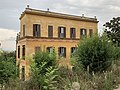


Photo: Pierreci, CC BY-SA 3.0 · Wikimedia Commons
At a glance
- Style
- High Renaissance
- Architect
- Raffaello Sanzio
- Commissioned by
- Clement VII
- Protection
- Italian national heritage
- Coordinates
- 41°55′42″ N, 12°27′10″ E
- Address
- Via di Villa Madama - Roma
History and description
Villa Madama is a Renaissance-style rural palace (villa) located on Via di Villa Madama #250 in Rome, Italy. Located west of the city center and a few miles north of the Vatican, and just south of the Foro Olimpico Stadium. Even though incomplete, this villa with its loggia and segmented columned garden court and its casino with an open center and terraced gardens, was initially planned by Raphael, and highly influential for subsequent architects of the High Renaissance.
Construction
In the 1518, then the Cardinal Giulio de' Medici, cousin of the reigning pontiff Leo X, commissioned the initial design of the villa from Raphael. However Raphael died in 1520, and the work continued under disciples of Raphael, including Antonio da Sangallo the Younger in construction and a large team involved in the decoration. There appear to have been frequent disputes over the plans. Construction soon ceased and the villa was far from complete, when after the death of Leo X in 1521, the cardinal had returned to Florence. In 1523, with Giulio de' Medici's ascension to Pope Clement VII, work restarted and the apartment and garden loggia were completed that year. The decorations of the Villa are by Giulio Romano and Baldassare Peruzzi, both major architects in their own right; Giovanni da Udine completed the bas-reliefs in stucco, inspired by the classic Ancient Roman reliefs unearthed from the then rediscovered Domus Aurea of Nero; and finally, both Giovan Francesco Penni ("il Fattore") and the Florentine sculptor Baccio Bandinelli worked there too. Aside from the Raphael loggia, the villa's greatest artistic element is the salone painted by Giulio Romano, with its magnificent vaulted ceiling.
In 1527, during the Sack of Rome, parts of the structure were pillaged and suffered from fire. Some sections were rebuilt, but the villa was never completed. It is not entirely clear how much of the layout and decoration can be attributed to any one of the artists involved.
Legacy and gardens
The Villa Madama was one of the first of the revived Roman type of suburban villas designed for parties and entertainment built in 16th century Rome, and it was consciously conceived to rival descriptions of the villas of Antiquity, like Pliny's famous description of his own.
It had a courtyard with a monumental flight of steps, a circular court around which formal gardens were arranged, an open-air theater excavated in the hillside, a hippodrome below, and a terraced garden with views of the Tiber river.
In the garden facing the loggia, the Elephant Fountain, designed by Giovanni da Udine, commemorates the Indian elephant "Annone", brought to Rome by a Portuguese ambassador for the consecration of Leo X in 1514.
Ownership after completion
The "Madama" of its name was Margaret of Austria, the same who is remembered in Palazzo Madama in Rome, seat of the Italian Senate. After the death of Clement VII, the villa remained Medici property, first belonging to Cardinal Ippolito de' Medici, and later to Duke Alessandro, Lord of Florence, who married Margaret of Parma the illegitimate daughter of Charles V, but left her a widow at the age of 15. She married Ottavio Farnese, a nephew of Pope Paul III and was soon widowed again, but at Margaret's death, the villa passed into the Farnese family, Dukes of Parma and Piacenza, who let it slowly fall into ruin.
The villa was restored by Count Carlo Dentice di Frasso, who acquired the property in 1925, and his American wife, the former Dorothy Cadwell Taylor. Eventually the Frassos leased it to the Italian Ministry for Foreign Affairs, and it was soon purchased by Mussolini in 1941. Mussolini's monumental neo-Roman Foro Italico sports complex is next to the villa, on the site of its racetrack.
Villa Madama is the property of the Italian Government, which uses it for international guests and press conferences. Entrance is limited and touring of gardens requires prior permission with Ministry of Foreign Affairs. On April 20, 2015 the Italian EU Presidency hosted a dinner in the Villa Madama for all Speakers and Presidents of national parliaments of the European Union.
Text from Wikipedia, the free encyclopedia, under CC BY-SA 4.0. Full article: «Villa Madama».
Timeline
- 1525Opened
Events and people from Wikidata (CC0).
Photos
Getting there
Roma BalduinaTrain, nearest
1.6 km as the crow flies
Villa MadamaVia di Villa Madama - Roma
Aeroporto di Roma-Ciampino18.4 km
Distances are as the crow flies, not walking or driving.
Loading map…
Nearby
See on the mapMore historic villas and palaces in Lazio

- Free 1st Sunday


Frequently asked questions
Where is Villa Madama?
Villa Madama is in Rome, in the province of Roma (Lazio), Italy. Address: Via di Villa Madama - Roma. GPS coordinates: 41.92835, 12.45278.
What else is there to see near Villa Madama?
Nearby you’ll find: Forte Monte Mario (400 m away), Villa Mazzanti (600 m away), Museum of Astronomical Observatory of Rome (600 m away).
Sources and licences
Text. Wikipedia, the free encyclopedia (CC BY-SA 4.0).
Data. Wikidata (CC0); opening hours and contacts OpenStreetMap (ODbL).
Photos. Wikimedia Commons, author and licence on every image.
Credits for the 9 photos
- Il giardino di Villa Madama — Pierreci, CC BY-SA 3.0
- Ceiling, Cove, and Wall Decorations of the "Guilio Romano" Room, Villa Madama MET DP812925 — Charles Percier Bassant / Pierre-François-Léonard Fontaine, CC0
- Charles Percier and Pierre-François-Léonard Fontaine, Villa Madama a Rome, in or before 1809, NGA 71382 — Charles Percier and Pierre-François-Léonard Fontaine, CC0
- Garden Elevation of the Villa Madama, Rome MET DP801744 — Pietro Paolo Coccetti, CC0
- Secretary Pompeo Arrives at Villa Madama (48831691378) — U.S. Department of State from United States, Public domain
- Villa Madama — Pierreci, Public domain
- Villa of Pope - Palazzo Farnese, Villa Madama (Rome), Julius 710 — Sir Banister Fletcher (1866-1953), Public domain
- Zentralbibliothek Zürich - Loggia der Villa Madama auf dem Monte Mario Rom - 991150370499705501 — Johann Rudolf Rahn, Public domain
- Decorazione a stucco dell'intradosso di un arco all'interno di una chiesa, before 1976 - Archivio Accademia delle Scienze Torino, Millon 66 29 435 — Henry A. Millon, Public domain
Updated 28 October 2026. All sources and licences