


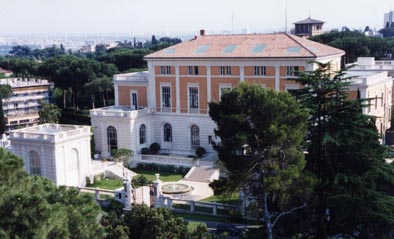

Photo: Lalupa, CC BY-SA 3.0 · Wikimedia Commons
Historic villa / palace
Villa Abamelek
Building in Rome, Italy
- Within the UNESCO World Heritage Site “Historic Centre of Rome, the Properties of the Holy See in that City Enjoying Extraterritorial Rights and San Paolo Fuori le Mura”
At a glance
- Owner
- Semyon Abamelek-Lazarev
- Coordinates
- 41°53′32″ N, 12°27′18″ E
History and description
Villa Abamelek, located near the Janiculum Hill in the immediate vicinity of Porta San Pancrazio, is one of Rome's urban villas. It is the residence of Russian ambassadors. The address of the diplomatic office is Via Aurelia Antica 12.
History
Constructed in the late seventeenth and early eighteenth centuries by the renowned Genoese marquis and banker Paolo Girolamo Torre, the building, now known as Palazzina Belvedere, was originally intended as his private residence in the area between Via Aurelia Antica and Porta Cavalleggeri. The villa was lavishly decorated with an array of frescoes by Giuseppe Passeri, though parts of this cycle have since been lost. In addition, a picture gallery featuring classicist and mythological themes was installed, showcasing works by Giuseppe Bartolomeo Chiari, Benedetto Luti, and other artists from the circle of the Accademia di San Luca.
The villa also played a significant historical role: on August 22, 1700, it hosted a meeting of bishops in preparation for the nearby conclave, which was convened due to the illness of Pope Innocent XII, who would pass away on September 27 that same year. Financial difficulties led the Torre family to sell the villa in 1722 to the Ospedale di Santo Spirito in Sassia. In 1734, the hospital resold the property to Monsignor Giuseppe Maria Feroni, a Florentine nobleman who would soon be elevated to cardinal. Feroni commissioned the Florentine architect Alessandro Galilei to renovate the complex with new furnishings that reflected contemporary tastes; in addition to the classic religious vestments required in clerical homes, the walls were adorned with rich Chinese papers, embracing the emerging vogue for chinoiserie.
From the end of the eighteenth century onward, the villa changed owners several times. In 1792, it passed to Giovanni Torlonia, then to his daughter Countess Maria Teresa Marescotti, and later to the Valentini and Giraud families. The Battle of the Janiculum in 1849, fought between the French army and the troops of the Roman Republic, severely damaged the building, marking a turning point in its history. In 1854, Prince Filippo Doria Pamphili purchased the villa with the eventual plan of annexing it to his nearby residence. Under his direction, architect Andrea Busiri Vici restored the complex and transformed the garden to reflect contemporary landscape tastes. The property was sold to the Ricasoli family in 1863 before eventually coming into the possession of Russian Prince Semyon Abamelek-Lazarev in 1907. …
Text from Wikipedia, the free encyclopedia, under CC BY-SA 4.0. Full article: «Villa Abamelek».
People
Events and people from Wikidata (CC0).
Getting there
Roma San PietroTrain, nearest
400 m as the crow flies
Villa Abamelek
Aeroporto di Roma-Ciampino15.4 km
Distances are as the crow flies, not walking or driving.
Loading map…
Nearby
See on the mapMore historic villas and palaces in Lazio

- Free 1st Sunday


Frequently asked questions
Where is Villa Abamelek?
Villa Abamelek is in Rome, in the province of Roma (Lazio), Italy. GPS coordinates: 41.89222, 12.45500.
What else is there to see near Villa Abamelek?
Nearby you’ll find: Villa Lante al Gianicolo (500 m away), Villa Gabrielli al Gianicolo (500 m away), Faro di Roma (500 m away).
Sources and licences
Text. Wikipedia, the free encyclopedia (CC BY-SA 4.0).
Data. Wikidata (CC0); opening hours and contacts OpenStreetMap (ODbL).
Photos. Wikimedia Commons, author and licence on every image.
Credits for the 1 photos
- Q13 - v Aurelia antica P1000668 — Lalupa, CC BY-SA 3.0
Updated 28 October 2026. All sources and licences