



- Most beautiful villages
Photo: WikiRomaWiki, CC BY-SA 4.0 · Wikimedia Commons
Historic village
Italian comune
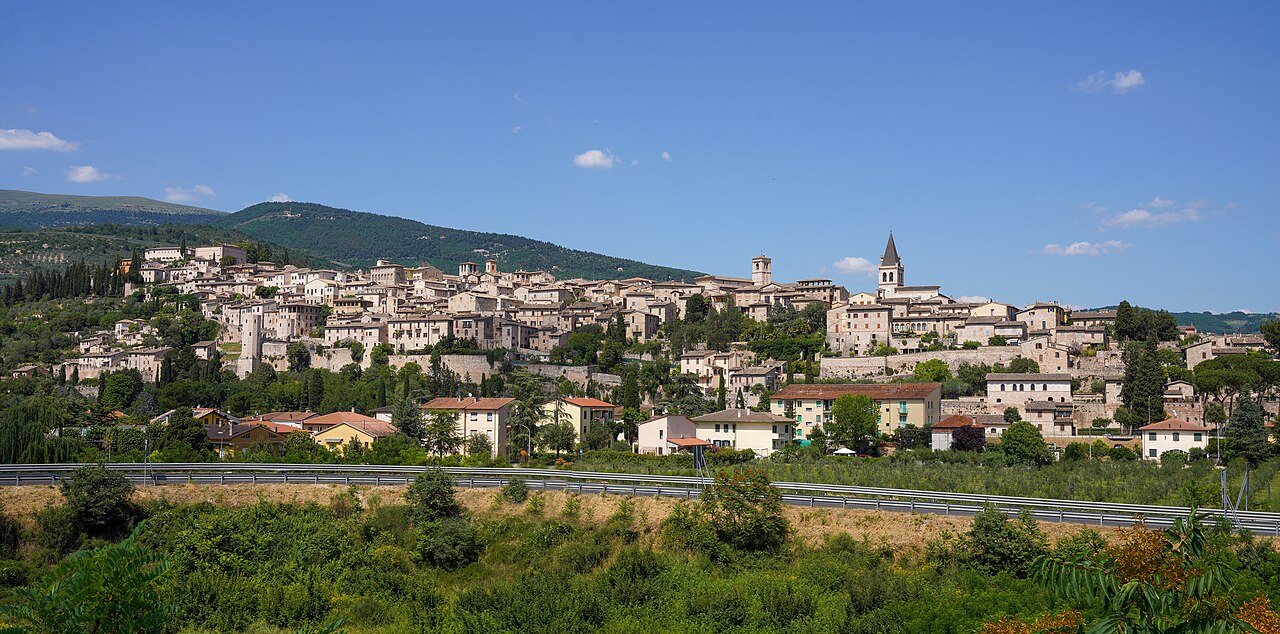
Spello (in Antiquity: Hispellum) is an ancient town and comune (township) of Italy, in the province of Perugia in eastern-central Umbria, on the lower southern flank of Monte Subasio. It is 6 km (4 mi) north-northwest of Foligno and 10 km (6 mi) south-southeast of Assisi. It is one of I Borghi più belli d'Italia ("The most beautiful villages of Italy").
The old walled town lies on a regularly northwest–southeast sloping ridge that eventually meets the plain. From the top of the ridge, Spello commands a good view of the Umbrian plain towards Perugia; at the bottom of the ridge, the town extends beyond its walls into a small modern section (or borgo), served by the rail line from Rome to Florence via Perugia.
Although no mention of Spello (Hispellum) is found before the Roman Empire, it was an important sacred place where Umbrian tribes gathered from at latest the 3rd c. BC as shown by archaeology. The sanctuary of Venus was first monumentalised in the Republican age (2nd-1st century BC).
Pliny, in his list of Umbrian towns, calls it a colony established under Augustus, a status also supported by numerous Roman inscriptions in which the town is named Colonia Iulia Hispellum. Augustus is said by Pliny to have granted Hispellum the spring and river Clitunno, although they lay 12 miles away, with the territories of Bevagna and Foligno in between; the people of Hispellum are also said to have maintained a bath and a hospice there. In the Roman period the town belonged to the Lemonia gens.
A well-known rescript of Emperor Constantine the Great, together with the Caesars Constantine and Constans, ordered that the city be called Flavia Constante, that a temple of the Flavia gens be erected there, and that gladiatorial and circus games be instituted. The temple was most likely that found recently in the sanctuary of Venus. From that period, inscriptions refer to the town as Colonia Urbana Flavia, a wording which, according to the source, led some writers to incorrectly suppose that Spello had received a second colonial foundation under Vespasian.
Christianity was preached in the town from an early date. By the 3rd century Spello is recorded as an episcopal see. Its first bishop is given as Saint Felix, martyred under Diocletian and Maximian and later regarded as the city's protector. A second bishop, Saint Epiphanius, took part in the Roman synod held in 487 by Pope Felix III. A third, Venerius, attended a synod in Rome called by Pope Symmachus between the 5th and 6th centuries.
In the 13th century Spello formed part of the Duchy of Spoleto and was under the Papal States. It was repeatedly chosen as the seat of the court, and archival records from the same period note the presence of a chief magistrate and a deputy. …
Spello preserves extensive remains from the Roman period within and around the present town. A Roman road runs between the southern gate and the gate opposite the Church of San Ventura, and many archaeological remains along this route show that Roman Hispellum extended beyond the area of the modern settlement, occupying part of the adjoining plain near the road.
The town includes three Roman Late Antique gates (Porta Consolare, Porta di Venere and the "Arch of Augustus") and traces of three more. The town incorporated the remains of an amphitheatre.
The great Sanctuary of Venus on 3 terraces was incorporated into the present Villa Fidelia.
Spello's Roman walls survive for a considerable stretch, built of carefully squared and fitted limestone blocks laid in parallelepiped courses. They are visible along much of the lower part of the town, including the southern side, and are more extensively preserved on the west, where traces of a rectangular tower remain.
Three ancient gates open through these walls. The central gate, opposite the Church of San Ventura, is the most intact and has a single passage.
Porta Venere dates to the Augustan age and is built in the form of a triumphal arch. It is flanked by the two dodecagonal Towers of Propertius and is one of the town's most monumental survivals of Roman fortification architecture. The right-hand passage retains traces of the arch above it, and above this are a pilaster and part of a Tuscan-order entablature. The gate as a whole measures 10 metres (33 ft) in length.
Porta Consolare, dated to the 1st century BC, is the monumental gateway through which the Via Flaminia entered the town. It forms a key point of access to the historic center and is associated with the route that follows the line of the ancient rising street through the urban core. The gate also has three passages; in modern times three corbels were added there to support three marble statues found nearby, one representing a matron and the other two depicting municipal figures in togas.
Within the built-up area, in Via Giulia, there are remains of another ancient gate. In Via dei Cappuccini there are remains of the gate that led up to the Arx.
The Belvedere is an ancient terrace on which the Roman forum was built. From here there are views across the Topino valley and the line of hills stretching from Montefalco to Assisi. …
The church of San Lorenzo is one of Spello's two collegiate churches. It was consecrated in 1228 by Gregory IX, and it was believed to have been built over the remains of a temple of Apollo.
The church has an entrance decorated with architectural sculpture executed at the beginning of the 17th century, though later restoration works altered the earlier fabric of the church. On either side of the entrance are two Roman-era inscriptions. The interior has three aisles, later modified in the 17th century. The second pillar holds a wooden pulpit richly ornamented with decorative elements and small statues; its central panel includes a relief of the martyrdom of Saint Lawrence, a 17th-century work. The tribune of the high altar is compared in form to that of St. Peter's Basilica in Rome.
The apse contains the choir arranged in two tiers, with carved woodwork and marquetry. The upper tier has 25 stalls and the lower 20, and one stall bears the date 1533. On the altar at the head of the right aisle is a panel representing the glorification of the souls in Purgatory, signed Francesco da Castello and dated 1510. In the Chapel of the Sacrament there are six oil paintings illustrating episodes from the life of Saint Lawrence, attributed to the Zuccari, while the altar contains a monumental marble tabernacle with statues and columns made in 1587.
In the sacristy of the first chapel a silver chapter cross with chased and enamelled work is attributed to Paolo di Giovanni of Perugia, and there is also a 15th-century wooden sculpture of the Virgin with Jesus. On the right wall a small oil panel shows Mary, Jesus and John the Baptist, from a Bolognese school. The baptismal font dates to the 17th century, while behind it is a finely carved tabernacle for the holy oil attributed to Rocco da Vicenza.
The main sacristy has cupboards with carving and marquetry dated 1524. An oil painting of the Nativity of Mary recalls the manner of Bassano. The cupboards and a seat decorated with inlaid figures of Noah, Moses and Zechariah are associated with designs by Pinturicchio. …
Text from Wikipedia, the free encyclopedia, under CC BY-SA 4.0. Full article: «Spello».
Distances are as the crow flies, not walking or driving.


Spello is in Spello, in the province of Perugia (Umbria), Italy. Address: Pro Loco, Piazza Matteotti, 3, Spello. GPS coordinates: 42.99211, 12.67106.
Nearby you’ll find: Porta Venere (100 m away), Pinacoteca comunale di Spello (200 m away), Villa Fidelia (300 m away).
Text. Wikipedia, the free encyclopedia (CC BY-SA 4.0).
Data. Wikidata (CC0); opening hours and contacts OpenStreetMap (ODbL).
Photos. Wikimedia Commons, author and licence on every image.
Updated 28 October 2026. All sources and licences