

- UNESCO
- Free 1st Sunday
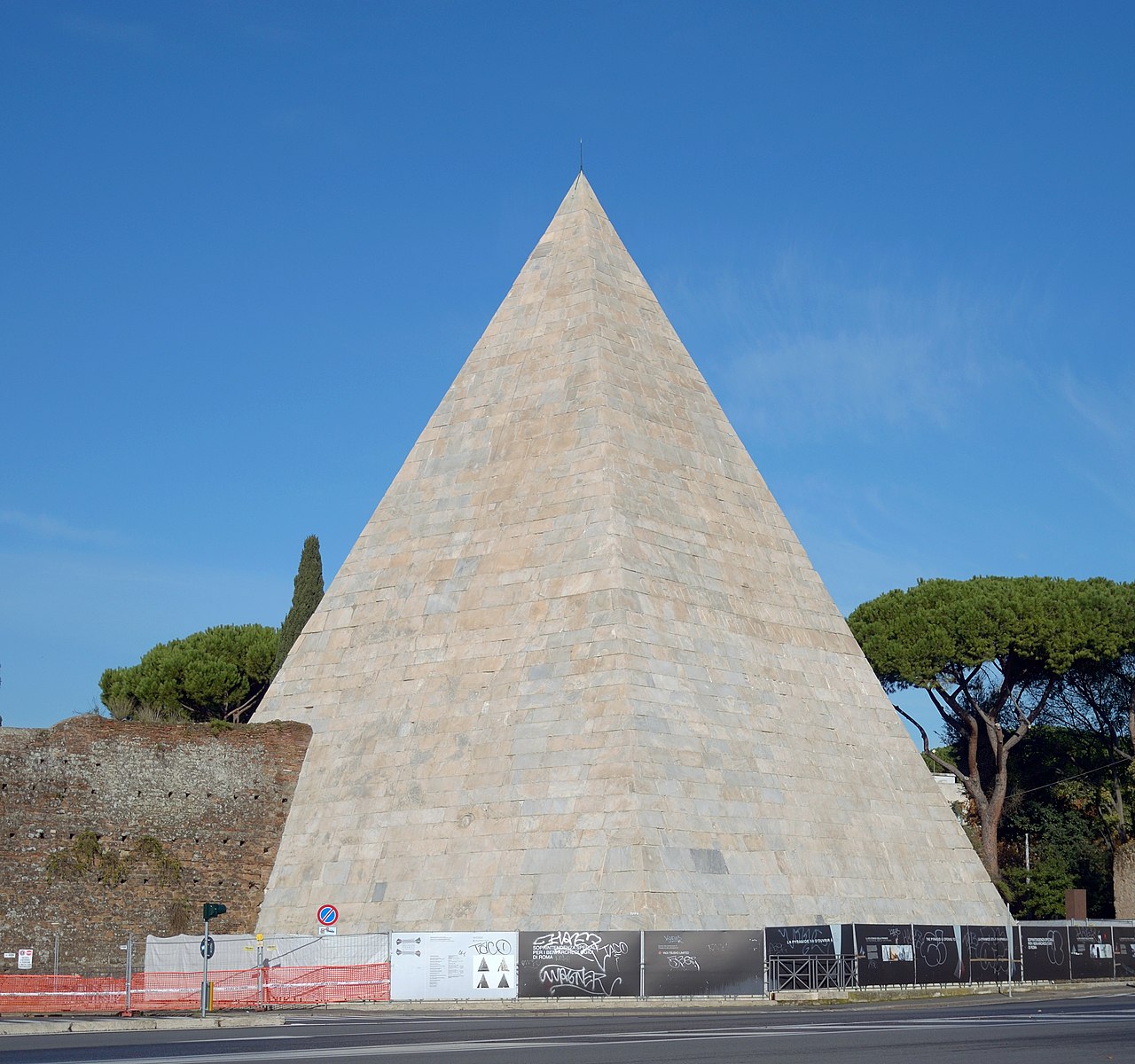
Photo: Livioandronico2013, CC BY-SA 4.0 · Wikimedia Commons
Archaeological site, 11 BC
Ancient pyramid in Rome, Italy, near the Porta San Paolo and the Protestant Cemetery
The pyramid of Cestius (in Italian, Piramide di Caio Cestio or Piramide Cestia) is an ancient Roman pyramid in Rome, Italy, near the Porta San Paolo and the Protestant Cemetery. It was built in the style of the Nubian pyramids as a tomb for Gaius Cestius, a member of the Epulones religious corporation. It stands at a fork between two ancient roads, the Via Ostiensis and another road that ran west to the Tiber along the approximate line of the modern Via Marmorata. Due to its incorporation into the city's fortifications, it is today one of the best-preserved ancient buildings in Rome.
The pyramid was built about 18–12 BC as a tomb for Gaius Cestius, a magistrate and member of one of the four great religious corporations in Rome, the Septemviri Epulonum. It is of brick-faced concrete covered with slabs of white marble standing on a travertine foundation. The pyramid measures 100 Roman feet (29.6 m) square at the base and stands 125 Roman feet (37 m) high.
In the interior is the burial chamber, a simple barrel-vaulted rectangular cavity measuring 5.95 metres long, 4.10 m wide and 4.80 m high. When opened in 1660, the chamber was found to be decorated with frescoes, which were recorded by Pietro Santo Bartoli. Only scant traces of these frescoes survive, and no trace of any other contents. The tomb had been sealed when it was built, with no exterior entrance, but had been plundered at some time thereafter, probably during antiquity. Until the end of restoration works in 2015, it was not possible for visitors to access the interior, except by special permission typically only granted to scholars. Since the beginning of May 2015, the pyramid is open to the public every second and fourth Saturday each month. Visitors must arrange their visit in advance.
A dedicatory inscription is carved on both northwestern and southeastern faces, so as to be visible from both sides. It reads:
Below the inscription only on the southeastern face is a second inscription recording the circumstances of the tomb's construction. This reads:
Another inscription on the east face is of modern origins, having been carved on the orders of Pope Alexander VII in 1663. Reading "INSTAVRATVM⸱AN⸱DOMINI⸱MDCLXIII", it commemorates excavation and restoration work carried out in and around the tomb between 1660–62.
At the time of its construction, the pyramid of Cestius would have stood in open countryside (tombs being forbidden within the city walls). Rome grew enormously during the imperial period, and, by the 3rd century AD, the pyramid would have been surrounded by buildings. It originally stood in a low-walled enclosure, flanked by statues, columns and other tombs. Two marble bases were found next to the pyramid during excavations in the 1660s, with fragments of the bronze statues that originally had stood upon them. The bases, now in the Capitoline Museums, carry identical inscriptions:
This identifies Cestius' heirs as Marcus Valerius Messala Corvinus, a famous general; Publius Rutilius Lupus, an orator whose father of the same name had been consul in 90 BC; and Lucius Junius Silanus, a member of the distinguished gens Junia. The heirs had set up the statues and bases using money raised from the sale of valuable cloths (attalici). Cestius had stated in his will that the cloths were to be deposited in the tomb, but this practice had been forbidden by a recent edict passed by the aediles.
The pyramid was built for Gaius Cestius Epulo, the son of Lucius, of the tribe of Pobilia. The inscription on it mentions that Cestius was a praetor, a tribune of the plebs, and a septemvir of the Epulones. The tomb was completed in 330 days and was one of two pyramid-shaped tombs in the city of Rome. Its construction was regulated by sumptuary laws, which limit extreme displays of wealth such as in feasts, clothing, funerals, and tombs. While these laws can be traced back to the mid-5th century BC, they were much more strictly passed and enforced around the time of Cestius’ death.
The sharply pointed shape of the pyramid is strongly reminiscent of the pyramids of Nubia, in particular of the kingdom of Meroë, which had been attacked by Rome in 23 BC. The similarity suggests that Cestius had possibly served in that campaign and perhaps intended the pyramid to serve as a commemoration. His pyramid was not the only one in Rome; a larger one—the "pyramid of Romulus" — of similar form but unknown origins stood between the Vatican and the Mausoleum of Hadrian but was dismantled in the 16th century by Pope Alexander VI and the marble was used for the steps of St. Peter's Basilica.
Some writers have questioned whether the Roman pyramids were modelled on the much less steeply pointed Egyptian pyramids exemplified by the famous pyramids of Giza. However, the relatively shallow Giza-type pyramids were not exclusively used by the Egyptians; steeper pyramids of the Nubian type were favored by the Ptolemaic dynasty of Egypt that had been brought to an end in the Roman conquest of 30 BC. The pyramid was, in any case, built during a period when Rome was going through a fad for all things Egyptian. The fusion of Roman and Egyptian styles is further highlighted by the fact that the exterior is distinctly "egyptianizing", while the interior displays classic Roman fresco paintings and a barrel vaulted ceiling. The Circus Maximus was adorned by Augustus with an Egyptian obelisk, and pyramids were built elsewhere in the Roman Empire around this time. …
Text from Wikipedia, the free encyclopedia, under CC BY-SA 4.0. Full article: «Pyramid of Cestius».
Events and people from Wikidata (CC0).
Distances are as the crow flies, not walking or driving.


Pyramid of Cestius is in Rome, in the province of Roma (Lazio), Italy. Address: via del Campo Boario, s.n.c. - Roma. GPS coordinates: 41.87649, 12.48090.
Wikidata dates it to 11 BC.
Nearby you’ll find: Porta San Paolo (100 m away), Museo della Via Ostiense (100 m away), Porta San Paolo Railway Museum (200 m away).
Text. Wikipedia, the free encyclopedia (CC BY-SA 4.0).
Data. Wikidata (CC0); opening hours and contacts OpenStreetMap (ODbL).
Photos. Wikimedia Commons, author and licence on every image.
Updated 28 October 2026. All sources and licences