


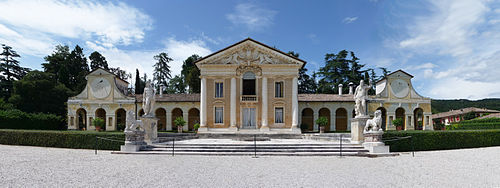
Photo: Sailko, CC BY-SA 4.0 · Wikimedia Commons
Historic villa / palace
Palazzo Grimani di Santa Maria Formosa
Palace and museum near Santa Maria Formosa, Castello, Venice
- Within the UNESCO World Heritage Site “Venice and its Lagoon”
At a glance
- Style
- Renaissance architecture
- Owner
- Giovanni Grimani
- Owner
- Antonio Grimani
- Protection
- Italian national heritage
- Coordinates
- 45°26′13″ N, 12°20′33″ E
- Address
- Ramo Grimani, 4858, 30122 Venezia
History and description
The Palazzo Grimani of Santa Maria Formosa is a State museum, located in Venice in the Castello district, near Campo Santa Maria Formosa.
History
The palace can be reached by land from Ruga Giuffa. The water entry, used in ancient times, is located on the San Severo canal. The original medieval building was built at the confluence of the canals of San Severo and Santa Maria Formosa, and purchased later by Antonio Grimani, who became a doge in 1521, and subsequently passed on as a legacy, in the third decade of the 16th century, to the grandsons Vettore Grimani, Procurator de Supra for the Venetian Republic, and Giovanni Grimani, Patriarch of Aquileia, who refurbished the old structure inspired by architectural models taken from classicism. The two brothers wanted to give "modern" forms to the building and had it decorated with fresco cycles and elegant stucco. In 1558, at the death of Vettore, Giovanni became the sole owner of the building: he added an extension of the palace. Decorating the rooms were many artists including Federico Zuccari, architect of the monumental staircase, and Camillo Mantovano. The patriarch Giovanni Grimani set up his refined collection of antiques, including sculptures, marbles, vases, bronzes and gems, in the rooms of the palace. In 1587 he donated the collection of sculptures and gems to the Serenissima: after his death the first ones were placed in the anti-room of the Marciana Library and today they are the founding nucleus of the National Archaeological Museum of Venice.
Until 1865, it was property of the Santa Maria Formosa branch of the Grimani family. But the palace had deteriorated and passed through several owners, until in 1981 it was acquired by the Superintendence for Architectural and Environmental Heritage of the city of Venice and became state property. Opened to the public on December 20, 2008, after a long restoration, it is currently a museum belonging to the Veneto Museum Pole …
Main rooms
The marble entrance portal leads into the large courtyard. The original medieval building, an L-shape plan, was restructured and redecorated between 1537 and 1540 by brothers Vettore and Giovanni Grimani, according to a style inspired by the ancient Roman domus. In 1558, Giovanni patronized the addition of a further wing, enclosing in a square the central courtyard. The loggias that were created were adorned with classical statues. The loggia in front of the entrance of the museum was entirely frescoed with plant motifs and completed by the wonderful stucco baskets filled with fruits and vegetables.
Between 1563 and 1565 the barrel vault of the staircase leading to the portego or passing salon of the main floor was sumptuously decorated by a young Federico Zuccari, who had trained in Rome, with allegorical frescoes referring to the virtues of his client Giovanni, completed by grotesques and stucco reliefs with mythological creatures. The stuccos reproduce some antique cameos from the Giovanni Grimani collection. Overall, the grand staircase bears comparing to the Scala d'Oro of Palazzo Ducale and with the entrance to the Marciana Library.
This room owes its name to the tapestries embellished with gold yarns that once covered the walls. Today we can admire some pieces from the collection of antiques by Giovanni Grimani, donated in 1587 to the Public Statuary of the Serenissima (now the National Archaeological Museum). The plaster statue of the Laocoon Group is an eighteenth-century plaster copy of an Ancient Roman sculpture in the Vatican museum; this plaster replica was collected by Cardinal Domenico Grimani.
The ceiling of the room, known as Sala a Fogliami or "Room of Foliage," was painted in the 1560s by Camillo Mantovano. It owes its name to a luxurious decoration of the ceiling with trees, plants and flowers: a forest inhabited by numerous animals, frequently with predatory attitudes, and rich in symbolic meanings. In the lunettes surmounted by grotesques, complex figurations in the form of a rebus possibly allude to the long and troubled heresy trial suffered by the patriarch Giovanni Grimani. …
DOMUS GRIMANI 1594 -2019
On 7 May 2019 the exhibition "DOMUS GRIMANI 1594 - 2019" was inaugurated. It celebrates the temporary return of many masterpieces of Greek, Roman and Renaissance art, belonging to Giovanni Grimani's collection and their relocation to the rooms where they found until the patriarch's death.
The exhibit itinerary develops in a row of rooms (Camaron d'Oro, Sala a Fogliami, Antitribuna) leading to the Tribuna, through the only original entrance to it.
In addition to the sculptures from the National Archaeological Museum of Venice, there are also exhibited some 16th-century furnishings from other Venetian museums and private collections, with the intention of recreating an aristocratic 16th century residence: one of the most noteworthy works, a tapestry of Medici manufacture based on a design by Francesco Salviati, two wooden cabinets, bronzes by Jacopo Sansovino and Tiziano Aspetti, two bronze firedogs by Girolamo Campagna and a table inlaid with ancient marbles and lapis lazuli belonged to the Grimani family.
Text from Wikipedia, the free encyclopedia, under CC BY-SA 4.0. Full article: «Palazzo Grimani di Santa Maria Formosa».
Timeline
- 2008Opened
Events and people from Wikidata (CC0).
Photos
Getting there
Venezia Santa LuciaTrain, nearest
1.7 km as the crow flies
Palazzo Grimani di Santa Maria FormosaRamo Grimani, 4858, 30122 Venezia
San Zaccaria - (Jolanda) "C"400 m
Aeroporto Marco Polo di Venezia7.4 km
Distances are as the crow flies, not walking or driving.
Loading map…
Nearby
See on the mapMore historic villas and palaces in Veneto

- Free 1st Sunday


- UNESCO

- UNESCO
- Free 1st Sunday
- UNESCO
Frequently asked questions
Where is Palazzo Grimani di Santa Maria Formosa?
Palazzo Grimani di Santa Maria Formosa is in Venice, in the province of Venezia (Veneto), Italy. Address: Ramo Grimani, 4858, 30122 Venezia. GPS coordinates: 45.43707, 12.34245.
What are the opening hours of Palazzo Grimani di Santa Maria Formosa?
According to OpenStreetMap the opening hours are: Tuesday to Sunday: 10:00–18:30; Monday: Closed; 1 January: Closed; 1 May: Closed; 25 December: Closed. Always check the official website before your visit.
What else is there to see near Palazzo Grimani di Santa Maria Formosa?
Nearby you’ll find: Palazzo Zorzi Bon (100 m away), Palazzo Malipiero-Trevisan (100 m away), Palazzo Vitturi (100 m away).
Sources and licences
Text. Wikipedia, the free encyclopedia (CC BY-SA 4.0).
Data. Wikidata (CC0); opening hours and contacts OpenStreetMap (ODbL).
Photos. Wikimedia Commons, author and licence on every image.
Credits for the 2 photos
- Palazzo grimani di s.m. formosa, ingresso attr. al sanmichelio con tre busti romani — Sailko, CC BY-SA 4.0
- Palazzo Grimani di San Luca Aug 2020 1 — Kasa Fue, CC BY-SA 4.0
Updated 28 October 2026. All sources and licences