


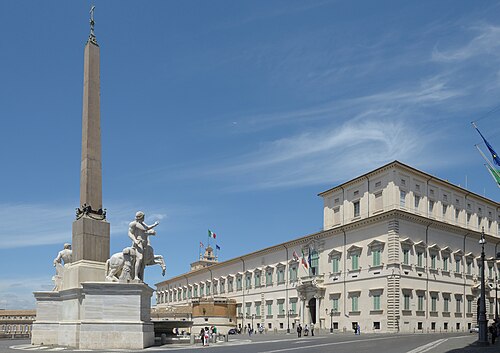
Photo: Jastrow, CC BY 2.5 · Wikimedia Commons
Historic villa / palace
Lateran Palace
Ancient palace in Rome
At a glance
- Architect
- Domenico Fontana
- Protection
- Italian national heritage
- UNESCO World Heritage
- Historic Centre of Rome, the Properties of the Holy See in that City Enjoying Extraterritorial Rights and San Paolo Fuori le Mura
- Coordinates
- 41°53′12″ N, 12°30′19″ E
History and description
The Apostolic Palace of the Lateran (Latin: Palatium Apostolicum Lateranense), informally the Lateran Palace (Latin: Palatium Lateranense; Italian: Palazzo del Laterano), is an ancient palace of the Roman Empire and later the main papal residence in Rome.
Located on Saint John's Square in Lateran on the Caelian Hill, the palace is adjacent to the Archbasilica of Saint John Lateran, the cathedral church of Rome. The wealthy Lateran (Laterani) family held the palace estate during the Roman Empire, and the estate eventually came into the hands of the Emperor Constantine the Great who gifted it to Pope Miltiades who was residing at the Basilica of Santa Pudenziana.
From the fourth century, the palace was the principal residence of the popes and continued so for about a thousand years until the Apostolic Residence ultimately moved to the nearby Vatican. The palace is now used by the Vatican Historical Museum, which illustrates the history of the Papal States. The palace also houses the offices of the Diocese of Rome, as well as the residential apartments of the Cardinal Vicar, the pope's delegate for the daily administration of the diocese.
History
The site on which the Basilica di San Giovanni in Laterano sits was occupied during the early Roman Empire by the domus of the Plautii Laterani family. The Laterani served as administrators for several emperors; their ancestor Lucius Sextius Lateranus is said to have been the first plebeian to attain the rank of consul, in 366 BC. One of the Laterani, Consul-designate Plautius Lateranus, became famous for being accused by Nero of conspiracy against the emperor. The accusation resulted in the confiscation and redistribution of his properties.
The Domus Laterani came into the possession of the emperor when Constantine I married his second wife Fausta, sister of Maxentius. Around 312, Constantine had razed the imperial horse-guards barracks adjoining the palace, which was known as Domus Faustae or "House of Fausta" by this time; the equites singulares Augusti had supported Maxentius against Constantine. He commissioned the construction of the Basilica di San Giovanni in Laterano on the site.
The Domus Laterani was eventually given to the Bishop of Rome by Constantine I. It is believed that this happened during the pontificate of Pope Miltiades, in time to host a synod of bishops in 313 that was convened to challenge the Donatists.
As Byzantium grew less able to help prevent Lombard incursions, the papacy became more independent of the Empire. Prior to the early eighth century, the residence of the bishops of Rome was not called a palace, but rather the "Lateran patriarchate" (patriarchium). The incentive to refurbish the Lateran patriarchate as a true palace was to create an imperial residence from which the pope could exercise not only spiritual but also temporal authority.
The pope's palace at the Lateran in Rome was extensively added to in the late eighth century by Pope Hadrian I (772–95) and Pope Leo III (795–816). Pope Hadrian I restructured the portico by the entrance staircase (Zaccaria's portico) and erected another tower next to it, which functioned as residential space. This portico was used to distribute alms and was also the location of the statue of the Capitoline Wolf and the Lex de imperio Vespasiani tables. …
Modern use
The Lateran remained in a suburban environment, surrounded by gardens and vineyards, until the growth of modern Rome in the later nineteenth century. Its site was considered unhealthy in Rome's malarial summers, however. In the late seventeenth century, Innocent XII located, in a part of it, a hospice for orphans who were set to work in a little silk manufactory. In the nineteenth century, Gregory XVI and Pius IX founded at the Lateran a museum of religious art and pagan culture for overflow from the Vatican galleries.
In 1925 Pius XI established an ethnographic museum devoted to artifacts sent back by missionaries. On 11 February 1929, the Lateran Treaty was signed here, at last regulating the relations between the Holy See and the Italian State. It established that both the basilica and the Lateran Palace were extraterritorial properties of the Holy See, enjoying privileges similar to foreign embassies on Italian soil.
During the Second World War, the Lateran and its related buildings provided a safe haven from the Nazis and Italian Fascists for numbers of Jews and other refugees. Among those who found shelter there were Alcide De Gasperi, Pietro Nenni, Ivanoe Bonomi and others. The Daughters of Charity of Saint Vincent de Paul and the sixty orphan refugees they cared for were ordered to leave their convent on the Via Carlo Emanuele. The Sisters of Maria Bambina, who staffed the kitchen at the Pontifical Major Roman Seminary at the Lateran offered a wing of their convent. The grounds also housed Italian soldiers.
Fathers Vincenzo Fagiolo and Pietro Palazzini, vice-rector of the seminary, were recognized by Yad Vashem for their efforts to assist Jews.
Pope John XXIII returned to the palace some pastoral functions by fixing here the seat of the vicariate and offices of the Diocese of Rome. He removed the collections of the Lateran Museum to the Vatican. Since 1987 the Lateran Palace has housed the Museo Storico Vaticano, which opened in 1991 and illustrates the history of the Papal States.
On 27 July 1993, a bomb explosion devastated the facade of the Rome Vicariate at the Archbasilica of Saint John Lateran. The attack is widely assumed to have been the work of the Italian Mafia, a warning against Pope John Paul II's frequent anti-Mafia statements. Repairs were completed in January 1996. …
Text from Wikipedia, the free encyclopedia, under CC BY-SA 4.0. Full article: «Lateran Palace».
People
Events and people from Wikidata (CC0).
Photos
Getting there
Roma TerminiTrain, nearest
1.6 km as the crow flies
Lateran Palace
Aeroporto di Roma-Ciampino12.1 km
Distances are as the crow flies, not walking or driving.
Loading map…
Nearby
See on the mapMore historic villas and palaces in Lazio

- Free 1st Sunday


Frequently asked questions
Where is Lateran Palace?
Lateran Palace is in Rome, in the province of Roma (Lazio), Italy. GPS coordinates: 41.88667, 12.50528.
What else is there to see near Lateran Palace?
Nearby you’ll find: Ospedale delle Donne (100 m away), Triclinium Leoninum (200 m away), Villa Giustiniani Massimo (200 m away).
Sources and licences
Text. Wikipedia, the free encyclopedia (CC BY-SA 4.0).
Data. Wikidata (CC0); opening hours and contacts OpenStreetMap (ODbL).
Photos. Wikimedia Commons, author and licence on every image.
Credits for the 9 photos
- Western facade Palazzo del Laterano 2006-09-07 — Jastrow, CC BY 2.5
- Palazzo laterano — Andre0007l, CC BY-SA 3.0
- Roma - palazzo del Laterano - 2026-09-24 14-41-49 001 — Albarubescens, CC BY-SA 4.0
- 01 Lateran Palace Courtyard — NateBergin, CC BY 4.0
- 02 Lateran Palace Courtyard — NateBergin, CC BY 4.0
- 03 Lateran Palace Interior — NateBergin, CC BY 4.0
- 04 Lateran Palace Interior — NateBergin, CC BY 4.0
- 05 Lateran Palace Interior ceiling — NateBergin, CC BY 4.0
- 06 Lateran Palace Interior Ceiling — NateBergin, CC BY 4.0
Updated 28 October 2026. All sources and licences