



- UNESCO
- Free 1st Sunday
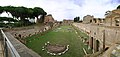
Photo: Vitold Muratov, CC BY-SA 3.0 · Wikimedia Commons
Archaeological site
Centremost of the seven hills of Rome, Italy
The Palatine Hill, which is the centremost of the seven hills of Rome, is one of the most ancient parts of the city; it has been called "the first nucleus of the Roman Empire". The site is now mainly a large open-air museum and the Palatine Museum houses many finds from the excavations here and from other ancient Italian sites.
Imperial palaces were built there, starting with Augustus. Before imperial times the hill was mostly occupied by the houses of the rich.
The hill originally had two summits separated by a depression: the higher summit was called Palatium; the lower Germalus (or Cermalus). Using the Forma Urbis its perimeter enclosed 63 acres (25 ha); while the Regionary Catalogues of the 4th century enclose 131 acres (53 ha).
According to Roman mythology, the Palatine Hill was the location of the cave, known as the Lupercal, where Romulus and Remus were found by the she-wolf Lupa that kept them alive. This is also the hill on which the adult Romulus chose to found the city, and where he murdered his brother Remus. This ritualistic murder on the Palatine formed an important part of Roman identity and the mythological origins of the Pomerium.
Another legend occurring on the Palatine is Hercules' defeat of Cacus after the monster had stolen some cattle. Hercules struck Cacus with his characteristic club so hard that it formed a cleft on the southeast corner of the hill, where later a staircase bearing the name of Cacus was constructed.
Rome has its origins on the Palatine. Excavations show that people have lived in the area since the 10th century BC. Excavations performed on the hill in 1907 and again in 1948 unearthed a collection of huts believed to have been used for funerary purposes between the 9th and 7th century BC approximating the time period when the city of Rome was founded.
Pallantium was an ancient city near the Tiber river on the Italian peninsula. Roman mythology, as recounted in Virgil's Aeneid for example, states that the city was founded by Evander of Pallene and other ancient Greeks sometime previous to the Trojan War. In addition, Dionysius of Halicarnassus writes that Romans say that the city was founded by Greeks from Pallantium of Arcadia, about sixty years before the Trojan war and the leader was Evander. The myth of the city's origin was significant in ancient Roman mythology because Pallantium became one of the cities that was merged later into ancient Rome, thereby tying Rome's origins to the ancient Greek heroes. Other cities in the area were founded by various Italic tribes.
Virgil states that Evander named the city in honor of his ancestor, Pallas, although Pausanias as well as Dionysius of Halicarnassus say that Evander's birth city was Pallantium, and thus he named the new city after the one in Arcadia. Dionysius of Halicarnassus also mention that some writers, including Polybius of Megalopolis, say that the town was named after Pallas, who was the son of Heracles and Lavinia, the daughter of Evander, and when he died his grandfather raised a tomb to him on the hill and called the place Pallantium, after him.
According to Livy, after the immigration of the Sabines and the Albans to Rome, the original Romans lived on the Palatine. The Palatine Hill was also the site of the ancient festival of the Lupercalia.
Many affluent Romans of the Republican period (c. 509 BC – 44 BC) had their residences there.
From the start of the Empire (27 BC) Augustus built his palace there and the hill gradually became the exclusive domain of emperors; the ruins of the palaces of at least Augustus (27 BC – 14 AD), Tiberius (14–37 AD) and Domitian (81–96 AD) can still be seen.
Augustus also built a temple to Apollo here. …
Dominating the site is the Palace of Domitian which was rebuilt largely during the reign of Domitian over earlier buildings of Nero. Later emperors, particularly those of the Severan Dynasty, made significant additions to the buildings, notably the Domus Severiana.
The House of Livia, the wife of Augustus, is conventionally attributed to her based only on the generic name on a lead pipe and circumstantial factors such as proximity to the House of Augustus.
The building is located near the Temple of Magna Mater at the western end of the hill, on a lower terrace from the temple. It is notable for its frescoes.
Known as the Domus Tiberiana because the original house was built by Tiberius, he spent much of his time in his palaces in Campania and Capri. It was later incorporated into Nero's Domus Transitoria. Part of its remains lie in the current Farnese Gardens.
Text from Wikipedia, the free encyclopedia, under CC BY-SA 4.0. Full article: «Palatine Hill».
Distances are as the crow flies, not walking or driving.


Palatine Hill is in Rome, in the province of Roma (Lazio), Italy. GPS coordinates: 41.88833, 12.48694.
Nearby you’ll find: Flavian Palace (0 m away), Cenatio Iovis (100 m away), Palace of Domitian (100 m away).
Text. Wikipedia, the free encyclopedia (CC BY-SA 4.0).
Data. Wikidata (CC0); opening hours and contacts OpenStreetMap (ODbL).
Photos. Wikimedia Commons, author and licence on every image.
Updated 28 October 2026. All sources and licences