




Photo: Conradi Millieri, Public domain · Wikimedia Commons
At a glance
- Type
- Archaeological site
- Coordinates
- 40°44′35″ N, 14°40′26″ E
History and description
Nocera Superiore (Neapolitan: Nucèrë or Nucèrä Superiórë) is a town and comune in the province of Salerno in the Campania region of south-western Italy.
It was the core of the ancient city of Nuceria Alfaterna, later known as Nuceria Constantia, Nuceria Christianorum and then Nuceria Paganorum (Italian: Nocera dei Pagani), which also included the nowadays territories of Nocera Inferiore, Pagani and smaller towns.
In other respects, its history up until 1851 is held in common with the adjacent Nocera Inferiore: the two towns share a common origin.
History
Archaeological evidence from the necropoli shows that at the end of the 7th century BC the native Oscan populations of the valley went to settle towards the sea for mainly strategic reasons, some founding Pompeii, others towards the interior, giving life to Nuvkrinum. The city was founded by the union of several scattered villages, colonising a strategic well-defended place guarding a fertile valley and a route between the gulfs of Naples and Salerno. It was centred on the suburb of Pareti.
It became an Etruscan settlement and possibly part of the dodecapolis (the twelve most important cities) of the Etruscan colonisation in Campania to block the Greek expansion towards the north.
After the defeat of 474 BC at the Battle of Cumae the Etruscans abandoned the region and Nuvkrinum passed to the Samnites. In the 5th century BC the city changed its name by adding Alfaternum from the name of the Samnite tribe of the Alfaterni.
Around the 6th century BC the Osci, an Italic people of Campania, probably gave rise to the original settlement of Nuceria Alfaterna, located in Nocera Superiore, between the current Pareti and Pucciano districts. This site was chosen due to its favourable geographic position with water sources and a very fertile hinterland protected from winds.
It became one of the most important cities of ancient Campania and the capital of a confederation (Lega nucerina) which included Pompeii, Herculaneum, Stabiae and Sorrento. It minted its own money on which the expression Nuvkrinum Al (a) faternum was engraved using a particular alphabet (Nucerian alphabet) based on the Greek and Etruscan alphabets.
Nuceria's first mention in history is in 315 BC when, during the Second Samnite War, it was an ally of the Romans but was persuaded to abandon the alliance and join the Samnite cause. In 310 BC the Romans ravaged the territory of Nuceria but in the end it obtained favourable treatment and entered into an alliance with Rome as a civitas foederata. …
Main sights
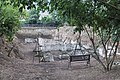
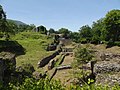
The Hellenistic-Roman Theatre was identified between Pareti and Pucciano and brought to light in the 1970-80s.
It was one of the largest in Campania (96 m diameter in the Roman phase). The Scaenae frons consisted of a wall with three niches (the central one semicircular and the two lateral ones rectangular). The pulpitum, the low front wall that supported the stage made of wooden boards in front of the scaenae frons, was also decorated with alternate semicircular and rectangular niches.
The orchestra preserves the remains of a rich pavement in polychrome marble. The euripus, a channel for the drainage of water, flowed around the orchestra. The steps of cavea are still preserved, from which the tuff cladding blocks have been largely removed. In the western parodos there are frescoes in the third Pompeian style.
The oinochoe in bucchero with the inscription Bruties Esum in the Nucerino alphabet comes from a burial in the necropolis of the 6th century BC adjacent to the theatre.
Built in the 2nd c. BC against the city walls, it was located along the axis of the north–south road in front of the gate called Porta Romana.
The theatre used the slope of the ground. The remains of the oldest part made with large rectangular blocks dates to the Samnite era. There was an integral school and gymnasium.
The theatre was then restored in the Augustan age which transformed it into Roman form. It was restored after the damage of the earthquake of 62 and the eruption of Vesuvius in 79. Abandoned since the 4th century, it was used as a stone quarry and then progressively buried during the Middle Ages. The cavities in the walls were used as prisons where prisoners were lowered from above, hence this was commonly called the prisons.
Parts of the amphitheatre were discovered in 1926 incorporated in more recent houses. The visible structures seem to date from around the middle of the 1st century BC with renovations from the end of the 1st century AD. …
Text from Wikipedia, the free encyclopedia, under CC BY-SA 4.0. Full article: «Nuceria».
Photos
Getting there
Nocera SuperioreTrain, nearest
100 m as the crow flies
Nuceria
Port9.9 km
Aeroporto di Salerno - Costa d'Amalfi24.2 km
Distances are as the crow flies, not walking or driving.
Loading map…
Nearby
See on the mapMore archaeological sites in Campania

- UNESCO
- Free 1st Sunday

- UNESCO

- UNESCO

- UNESCO
- Free 1st Sunday

- Free 1st Sunday
Frequently asked questions
Where is Nuceria?
Nuceria is in Nocera Superiore, in the province of Salerno (Campania), Italy. GPS coordinates: 40.74313, 14.67393.
What else is there to see near Nuceria?
Nearby you’ll find: Baptistry of Santa Maria Maggiore (500 m away), Domus del decumano (500 m away), Hellenistic necropolis of Pizzone (600 m away).
Sources and licences
Text. Wikipedia, the free encyclopedia (CC BY-SA 4.0).
Data. Wikidata (CC0); opening hours and contacts OpenStreetMap (ODbL).
Photos. Wikimedia Commons, author and licence on every image.
Credits for the 9 photos
- TabulaNuceria — Conradi Millieri, Public domain
- Anfiteatro Nuceria Alf 08 dic 2021 — Mariano2397, CC BY-SA 4.0
- Athena promachos nuceria — Mariano2397, CC BY-SA 4.0
- Acquedottonocerasuperiore1 — Mariano2397, CC BY-SA 4.0
- Campanile dell'Orco 2024-06-23 15-51-08 — Mariano2397, CC0
- Columelle — opera propria, Public domain
- FontanaRomanaVescovado — Nuceria, Public domain
- Il Parco Urbano "Alfonso e Matteo Fresa" — Nucerino, CC0
- Murapetraropucciano — Mariano Rocco ( Mariano2397 at Italian Wikipedia ), CC BY-SA 4.0
Updated 28 October 2026. All sources and licences