


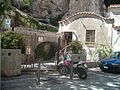


Photo: Arnoldius, CC BY-SA 3.0 · Wikimedia Commons
Museum
Diocesan Museum of Amalfi
Museum in Italy
- Within the UNESCO World Heritage Site “Costiera Amalfitana”
At a glance
- Type
- Museum
- Style
- Romanesque architecture
- Protection
- Italian national heritage
- Coordinates
- 40°38′05″ N, 14°36′11″ E
- Address
- Salita Episcopio 3, Amalfi
History and description
The Diocesan Museum of Amalfi (Museo Diocesano di Amalfi) is an art museum housed in the 9th century Basilica del Crocifisso di Amalfi (Basilica of the Crucifix) in Amalfi. It displays many of the treasures of the Archdiocese of Amalfi-Cava de' Tirreni and is centrally located close to Amalfi Cathedral in Via Salita Episcopio.
History
The Museum is housed in the Basilica of the Crucifix – originally the Cathedral Church – whose origin dates back to the year 596. In 1100, the new cathedral was built next to it and together formed a single church of Romanesque style with six aisles. Later, in the Baroque period, they were covered with marble and stucco and restored as two separate and distinct churches. The restoration of the Basilica of the Crucifix, which was completed in 1994, eliminated the Baroque style, bringing out a very considerable portion of the medieval structure with the gallery of single and double windows that filter and distribute a magnificent light. The museum opened in 1996.
Organisation
The museum's itinerary is developed in four sections:
The Cloister (built between the 1266 and 1268);
The Wall paintings (mural paintings and frescoes, dating from the 13th century to the 14th century);
The Cathedral Treasury (precious liturgical objects and sacred paraments, belonging to the Treasure of the Cathedral);
The Paintings and sculptures (preserves valuable paintings and sculptures).
Along the galleries of the cloister, works from the cathedral are preserved, including:
Greek sarcophagus with Rape of Proserpine (first half of 2nd century AD).
Roman sarcophagus with Marriage of Peleus and Thetis (second half of the 2nd century AD), reused in the early Middle Ages as the tomb of Archbishop Cesarius de Alanio.
Remains of Romanesque ambon (1174 –1202) decorated with mosaics of the Cosmatesque school.
Text from Wikipedia, the free encyclopedia, under CC BY-SA 4.0. Full article: «Diocesan Museum of Amalfi».
Timeline
- 1995Opened
Events and people from Wikidata (CC0).
Photos
Getting there
Vietri sul Mare-AmalfiTrain, nearest
11.4 km as the crow flies
Diocesan Museum of AmalfiSalita Episcopio 3, Amalfi
Molo Pennello200 m
Aeroporto di Salerno - Costa d'Amalfi25.9 km
Distances are as the crow flies, not walking or driving.
Loading map…
Nearby
See on the mapMore museums in Campania

- Free 1st Sunday


- Free 1st Sunday

Frequently asked questions
Where is Diocesan Museum of Amalfi?
Diocesan Museum of Amalfi is in Amalfi, in the province of Salerno (Campania), Italy. Address: Salita Episcopio 3, Amalfi. GPS coordinates: 40.63461, 14.60305.
What are the opening hours of Diocesan Museum of Amalfi?
According to OpenStreetMap the opening hours are: Every day, public holidays: 7:30–10:00, 17:00–19:30. Always check the official website before your visit.
How much does it cost to visit Diocesan Museum of Amalfi?
There is an admission charge. Up-to-date prices are on the official website.
What else is there to see near Diocesan Museum of Amalfi?
Nearby you’ll find: City museum of Amalfi (200 m away), Torre dello Ziro (300 m away), Atrani (500 m away).
Sources and licences
Text. Wikipedia, the free encyclopedia (CC BY-SA 4.0).
Data. Wikidata (CC0); opening hours and contacts OpenStreetMap (ODbL).
Photos. Wikimedia Commons, author and licence on every image.
Credits for the 3 photos
- Church Museum Amalfi 13 — Arnoldius, CC BY-SA 3.0
- Amalfi - Museo diocesano di Amalfi 002 — Cristina Morettini 95, CC BY-SA 4.0
- Mask in Amalfi — Bernard Gagnon, CC BY 4.0
Updated 28 October 2026. All sources and licences