




- Most beautiful villages
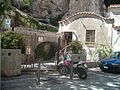
Photo: Donar Reiskoffer, CC BY 3.0 · Wikimedia Commons
Historic village
Italian comune
Atrani is a village and comune on the Amalfi Coast in the province of Salerno in the Campania region of south-western Italy. It is located to the east of Amalfi, several minutes' drive down the coast of the Tyrrhenian Sea.
The municipality of Atrani has a land area of 12 ha (30 acres), making it the smallest in Italy. Its population was 832 in 2020. It is one of I Borghi più belli d'Italia ("The most beautiful villages of Italy").
The origins of Atrani are still unknown. Archeological research discovered ruins remaining from the 1st century AD. Roman villas existed along the Amalfi Coast and were covered in debris from the eruption of Vesuvius in 79 AD. The debris was deposited on the mountains encircling Atrani and from there it was dumped into the valley. In the 5th century AD, barbarians attacked and numerous Romans escaped from the cities. They fled onto Monti Lattari and created stable settlements. The first documented proof of the existence of Atrani is represented by a letter by the Pope Gregory I to Bishop Pimenio of Amalfi dated 596 AD.
The Duchy of Amalfi extended from Positano to Cetara and also included Agerola, Pimonte, Lettere, Capri and the archipelago of Sirenuse (Li Galli). Within this territory Atrani was a village that boasted the title of city, the twin city of Amalfi was seat of the aristocracy. The Pantaleoni, the richest and most powerful family of Amalfi, the Alagno, the Mauro Comite, the Comite Iane, the Augustariccio, and the Viarecta families resided there. Its inhabitants preserved their identity as Atranese (from Atrani), unlike all the other inhabitants of the duchy, who were merely called Amalfitani.
Only Amalfi and Atrani had the right to elect or depose the leaders of the towns. Amalfi was first ruled by counts, then by prefects, judges, and then finally by the Dukes (not doges, as is sometimes erroneously said). The Duke concentrated in his person both civil and military power. The symbol of his power was a hat, the "birecto", which the dukes were awarded in a coronation in the palatine chapel of S. Salvatore de Birecto of Atrani. …
Built in the 10th century, the church has a square plan with front porch and is divided into three naves with barrel vaults. It was originally facing west (entrance in Via Arte della Lana). In the Baroque period the current facade was built with the clock, the staircase and atrium. At the time of the Amalfi Republic, the church was the palace chapel where they were crowned the dukes and where they deposited their ashes.
The oldest pieces in the church are a tombstone of the 14th century, depicting the noble lady Atranese Filippa Napolitano and a marble slab of the 12th century, depicting two peacocks. The peacock, sacred to Juno, was revered by many Eastern peoples as a symbol of vanity and pride, well represented by the people and goods of Amalfi. The peacocks are also a symbol of resurrection. Doors of bronze, made in 1087, were donated to the church by Pantaleone III, a nobleman from Amalfi. The door is divided into tiles of depicted scenes, containing the image of Christ, the Madonna and some saints. It is now housed in the church of Santa Maria Maddalena.
Located next to the church of San Salvatore de' Birecto, it consists of a single nave with a barrel vault. Curiously, the main altar in polychrome marble is facing west, in contrast to the medieval model. Embedded in the wall there is a Roman cinerary urn used as a water reservoir. Originally the bronze doors of the church of San Salvatore de' Birecto were destined for this church.
The Collegiate Church of St Mary Magdalene was founded in 1274 on the ruins of a medieval fortress on the initiative of Atrani. Over time the church has undergone considerable restoration. In 1570, near collapse, funds were raised by special taxes on wheat and export of manufactured goods to restore the church.
The building underwent a second operation almost a century later, in 1669. On that occasion it also repaired the sacristy which was equipped with an external counter. In 1753, as the population grew the church was enlarged and expanded by donations from private citizens in addition to the contribution of municipal regiment. It was during this work that the fortress was finally demolished in order to free up additional space enlargement. In recent times, it was renovated by the architect Lorenzo Casalbore of Salerno. …
Text from Wikipedia, the free encyclopedia, under CC BY-SA 4.0. Full article: «Atrani».
Distances are as the crow flies, not walking or driving.


Atrani is in Atrani, in the province of Salerno (Campania), Italy. GPS coordinates: 40.63690, 14.60754.
Nearby you’ll find: Torre dello Ziro (200 m away), City museum of Amalfi (400 m away), Diocesan Museum of Amalfi (500 m away).
Text. Wikipedia, the free encyclopedia (CC BY-SA 4.0).
Data. Wikidata (CC0); opening hours and contacts OpenStreetMap (ODbL).
Photos. Wikimedia Commons, author and licence on every image.
Updated 28 October 2026. All sources and licences