


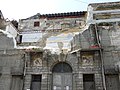

Photo: Reinhard Dietrich, Public domain · Wikimedia Commons
Museum, 1989
Pietrarsa railway museum
An Italian museum near Naples, devoted to the history of trains in Italy
At a glance
- Type
- Museum
- Period
- Modern era, 1989
- Area
- 36,000 m²
- Protection
- Italian national heritage
- Coordinates
- 40°49′18″ N, 14°19′14″ E
- Address
- Via Pietrarsa, 80146 Napoli
History and description
The National Railway Museum of Pietrarsa (Italian: Museo Nazionale Ferroviario di Pietrarsa) is close to the Naples–Portici railway.
The museum is housed in what was originally the 'Bourbon works' Officine di Pietrarsa, founded in 1840 on the orders of Ferdinand II of Bourbon to build steam engines for ships and boilers for locomotives. The factory was organized into pavilions which housed the different production steps.
Overview
In 1830, Ferdinand became king of the Kingdom of the two Sicilies. He had a small factory built in Torre Annunziata to produce steam engines for ships and ammunition for military use. This factory was part of Ferdinand's strategy to emancipate his Kingdom from foreign industrial and technological supremacy.
For closer supervision, he decided to relocate the factory next to the Royal Palace of Naples in 1937. The King met the French engineer Armand Bayard, who proposed to build Italy's first railway line from Naples to Nocera. On 3 October 1839, the first section of the line, from Naples to Portici, was inaugurated. Two locomotives arrived from England on this occasion: the 'Longridge' and the 'Vesuvio'. Another locomotive called 'Bayard' arrived in December.
The development of the railways was so significant that the King soon faced the problem of finding space to build a bigger workshop. He opted for Pietrarsa where, in 1842, the Royal Workshop for Mechanical works, nautical and locomotive production was founded. The workshop ran flat out. By the middle of the 19th century, it employed 1,100 workers and it became the largest industrial centre in Italy.
With the unification of Italy, the production was taken over by industry in the north, the Bourbon realm fell and Pietrarsa was first nationalized then reprivatized. and to private companies later. The new private owners restricted production and leading to worker protests.
After World War II, the emergence of diesel and electric traction resulted in the rapid decline of steam locomotives and consequently the decline of the Pietrarsa works. In 1975, the Pietrarsa Works were closed because it didn’t meet the new technical needs. The location underwent some restoration and, on 7 October 1989, the National Railway Museum of Pietrarsa was officially inaugurated.
Structure
The Museum of Pietrarsa is among the biggest in the world by area (36,000 m2, 360 000ft2) and number of vehicles exhibited.
In the A pavilion, once used for assembly and repair of locomotives, 26 steam locomotives and 4 three-phase electric locomotives are on display. The most famous item is a replica of the Bayard locomotive, the twin of Vesuvio. It was built in 1939 for the 100th Anniversary of the Naples-Portici line. Along the walls the steam locomotives are displayed following The evolution of steam traction technology is displayed on the walls, including notable Italians inventions such as, the 910 and 740 series “Franco-Crosti”locomotives.
The B and C pavilions housed the furnaces and now display many carriages (a Centoporte wagon, three Littorine, the E.623 and E.626) One important example is the n.10 of the Royal Train built by Fiat for the marriage of Umberto II of Savoy and Maria José of Belgium. It was one of 11 carriages and is renowned for its internal furnishing.
Diesel locomotives and railcars are exhibited in the D Pavilion (formerly used for forging', while the E Pavilion is used for a cinema hall and the F pavilion showcases a selection of giant machinery from the old factory.
The last Pavilion is the oldest one, built in 1840. It is known as “Cathedral” because of its arches. It displays train models and railway memorabilia as the famous Trecentotreni model.
Text from Wikipedia, the free encyclopedia, under CC BY-SA 4.0. Full article: «Pietrarsa railway museum».
Timeline
- 1989Founded and opened
Events and people from Wikidata (CC0).
Photos
Getting there
Pietrarsa-San Giorgio a CremanoTrain, nearest
100 m as the crow flies
Pietrarsa railway museumVia Pietrarsa, 80146 Napoli
Port5.3 km
Aeroporto di Napoli Capodichino7.4 km
Distances are as the crow flies, not walking or driving.
Loading map…
Nearby
See on the mapMore museums in Campania

- Free 1st Sunday


- Free 1st Sunday

Frequently asked questions
Where is Pietrarsa railway museum?
Pietrarsa railway museum is in Naples, in the province of Napoli (Campania), Italy. Address: Via Pietrarsa, 80146 Napoli. GPS coordinates: 40.82170, 14.32050.
What are the opening hours of Pietrarsa railway museum?
According to OpenStreetMap the opening hours are: Mo,Tu off; We "by appointment"; Th 14:00-20:00; Fr 09:00-16:30; Sa-Su, PH 09:30-19:30. Always check the official website before your visit.
How much does it cost to visit Pietrarsa railway museum?
There is an admission charge. Up-to-date prices are on the official website.
How old is Pietrarsa railway museum?
Wikidata dates it to 1989.
What else is there to see near Pietrarsa railway museum?
Nearby you’ll find: Villa Cristina (200 m away), Villa Papa (200 m away), Villa Paudice (200 m away).
Sources and licences
Text. Wikipedia, the free encyclopedia (CC BY-SA 4.0).
Data. Wikidata (CC0); opening hours and contacts OpenStreetMap (ODbL).
Photos. Wikimedia Commons, author and licence on every image.
Credits for the 9 photos
- Haupthalle Eisenbahnmuseum Pietrarsa — Reinhard Dietrich, Public domain
- Colonna idrica per il rifornimento di acqua per le locomotive a vapore- Museo di Pietrarsa (Na) — it:GiovAngri;, CC BY-SA 4.0
- Cruscotto RSC tipo Westinghouse — Claudio Dario, CC BY-SA 4.0
- Entrance National Railway museum Naples — Abderrahman Ait Ali from Stockholm, CC BY-SA 2.0
- Museo Nazionale Ferroviario di Pietrarsa — Corvettec6r, CC BY 4.0
- Pietrarsa - panoramio — Francesco Boggia, CC BY 3.0
- Pietrarsa railway museum 07 — B.Zsolt, CC BY-SA 3.0
- Possibile ricostruzione prospetto di Villa Schisano (Naples) — Baobab111, CC BY-SA 4.0
- Presentation Pietrarsa railway museum — Abderrahman Ait Ali from Stockholm, CC BY-SA 2.0
Updated 28 October 2026. All sources and licences