




- Free 1st Sunday
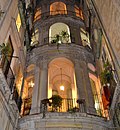
Photo: David Sivyer, CC BY-SA 2.0 · Wikimedia Commons
Museum, 1593
Church
The Cappella Sansevero (also known as the Cappella Sansevero de' Sangri or Pietatella) is a chapel located on Via Francesco de Sanctis 19, just northeast of the church of San Domenico Maggiore, in the historic center of Naples, Italy. The chapel is more properly named the Chapel of Santa Maria della Pietà. It contains works of Rococo art by some of the leading Italian artists of the 18th century.
Its origin dates to 1590 when John Francesco di Sangro, Duke of Torremaggiore, after recovering from a serious illness, had a private chapel built in what were then the gardens of the nearby Sansevero family residence, the Palazzo Sansevero. The building was converted into a family burial chapel by Alessandro di Sangro in 1613 (as inscribed on the marble plinth over the entrance to the chapel). Definitive form was given to the chapel by Raimondo di Sangro, Prince of Sansevero, who also included Masonic symbols in its reconstruction.
Until 1888 a passageway connected the Sansevero palace with the chapel.
The chapel received its alternative name of Pietatella from a painting of the Virgin Mary (La Pietà), spotted there by an unjustly arrested prisoner, as reported in the book Napoli Sacra by Cesare d'Engenio Caracciolo in 1623. When the chapel was constructed it was originally dedicated to Santa Maria della Pietà, after the painting.
The chapel houses almost thirty works of art, among which are three particular sculptures of note. These marble statues are emblematic of the love of decoration in the Rococo period and their depiction of translucent veils and a fisherman's net represent remarkable artistic achievement. The Veiled Truth (Pudicizia, also called Modesty or Chastity) was completed by Antonio Corradini in 1752 as a tomb monument dedicated to Cecilia Gaetani dell'Aquila d'Aragona, mother of Raimondo. The 1753 Christ Veiled under a Shroud (also called Veiled Christ), by Giuseppe Sanmartino, shows the influence of the veiled Modesty. The Release from Deception (Disinganno) completed in 1753–54 by Francesco Queirolo of Genoa serves as a monument to Raimondo's father.
The ceiling, the Glory of Paradise, was painted by Francesco Maria Russo in 1749. The original floor (most of the present one dates from 1901) was in black and white (said to symbolize good/evil) in the design of a labyrinth (a masonic symbol for "initiation"). …
The chapel also displays two early examples of what was long thought to be a form of plastination in its basement. These "anatomical machines" (macchine anatomiche) were thought to be examples of the process of "human metallization" (metallizzazione umana) as implemented by anatomist Giuseppe Salerno ca. 1760 from a commission by Raimondo di Sangro. The exhibit consists of a mature male and a pregnant woman. Their skeletons are encased in the hardened arteries and veins which are colored red and blue respectively. Previously, historians have surmised that the corpses could have been created by injecting the hardening substances directly into the veins of living subjects. However, recent analysis shows no evidence of techniques involving injection. Analysis of the "blood vessels" indicate they are constructed of beeswax, iron wire, and silk.
Text from Wikipedia, the free encyclopedia, under CC BY-SA 4.0. Full article: «Sansevero Chapel».
Events and people from Wikidata (CC0).
Distances are as the crow flies, not walking or driving.


Sansevero Chapel is in Naples, in the province of Napoli (Campania), Italy. Address: Via Francesco de Sanctis, 19;21, 80134. GPS coordinates: 40.84919, 14.25488.
According to OpenStreetMap the opening hours are: Wednesday to Monday: 9:00–19:00. Always check the official website before your visit.
There is an admission charge. Up-to-date prices are on the official website.
According to OpenStreetMap data, the site is wheelchair accessible.
Wikidata dates it to 1593.
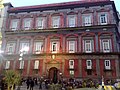
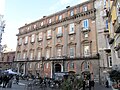
Nearby you’ll find: Palazzo di Sangro (0 m away), Palazzo d'Afflitto (100 m away), Palazzo Corigliano (100 m away).
Text. Wikipedia, the free encyclopedia (CC BY-SA 4.0).
Data. Wikidata (CC0); opening hours and contacts OpenStreetMap (ODbL).
Photos. Wikimedia Commons, author and licence on every image.
Updated 28 October 2026. All sources and licences