




- UNESCO
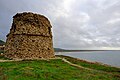
Photo: Sailko, CC BY 3.0 · Wikimedia Commons
Archaeological site, 10th century BC
Archaeological site in the Italian municipality of Cabras (OR) where Nuragic age sculptures were found
The Giants of Mont'e Prama are ancient stone sculptures created by the Nuragic civilization of Sardinia, Italy. Fragmented into numerous pieces, they were discovered in March 1974 on farmland near Mont'e Prama, in the comune of Cabras, province of Oristano, in central-western Sardinia. The statues are carved in local sandstone and their height varies between 2 and 2.6 meters.
After four excavation campaigns carried out between 1975 and 1979, the roughly five thousand pieces recovered – including fifteen heads and twenty two torsos – were stored for thirty years in the repositories of the National Archaeological Museum of Cagliari, while a few of the most important pieces were exhibited in the museum itself. Along with the statues, other sculptures recovered at the site include large models of nuraghe buildings and several baetyl sacred stones of the "oragiana" type, used by Nuragic Sardinians in the making of "giants' graves".
The first attestations of sculpture in Sardinia are much more ancient than the statues of Mont'e Prama. The oldest example is the figurine that is referred to as, the Venus of Macomer, in non finito technique, dated to 3750–3300 BC by the archaeologist Giovanni Lilliu, however, the archaeologist Enrico Atzeni has suggested that the statuette likely dates back to Early Neolithic (6000–4000 BC). More recent studies have stressed the similarities to the Venus figurines, already noticed by Giovanni Lilliu, and hypothesized a retro-dating to Upper Palaeolithic or Mesolithic Age.
Statuettes later than this one – but still pertaining to the Mother Goddess iconography – are many volumetric figurines produced by the Ozieri culture, among which is the idol of Perfugas, representing a goddess suckling her child. The same symbolism was later used by the Nuragic civilization with the so-called "Nuragic pietà".
After the three-dimensional figurines of the goddess – but still belonging to the Neolithic Age – are the idols in flat geometric style, that could represent the goddess in her chthonic aspect, in that all examples of this type of idol have been found inside graves.
Investigations carried out after the fortuitous discovery of a prehistoric altar at Monte d'Accoddi (Sassari), have revealed that – alongside the production of geometric figurines – the great statuary was already present at that time in Sardinia, given that at the "temple of Accoddi" several stelae and menhirs were recovered. Beside the ramp leading to the top of the main building, excavations revealed the presence of a great menhir, with several others positioned around it. A sculpted face, engraved with spiraliform patterns and probably belonging to a statue-stele, has been assigned to the earliest phase of the site – called the "red-temple". A large granite stele with a female figure in relief, has been attributed to the second phase – called the "great-temple". …
During the Early Bronze Age the "epicampaniform style", a late expression of the Bell-Beaker culture, became spread both in Sardinia and Corsica. From this cultural period the Nuragic civilization would arise, paralleling similar architectural developments in southern Corsica, in such a way that the Gallura Nuragic facies shows a synchronic evolution with the Nuragic torrean civilization.
However, while common architectonic traditions of Central-Western Mediterranean evidence the close relationships between islands, it is exactly the sculpture tradition that begins to diversify. In fact, while Early Bronze Age Sardinia abandoned the traditions of Eneolithic statue-stelae, in Corsica the production of menhirs continued without interruption, eventually originating the Torrean statue-stelae during the Middle and Late Bronze Age.
An intermediate stage of this process could be represented by the appearance of hammered relief sculptures during the Middle Bronze Age – in both Sardinia and Corsica: in the former country, baetyls were engraved with male or female gender characters in relief, while in the latter – perhaps due to the greater presence of metal implements – relief sculpture was applied for the first time to menhirs. In both islands, anthropomorphic statuary in the strict sense of the word would not exist between 1600 and 1250 BC, but gender characteristics and weapons were represented in Sardinia and Corsica respectively. In a successive evolution stage, the relief technique was employed in Sardinia – for the first time after Eneolithic sculptures – to represent a human face, as shown in the famous baetyl of "San Pietro di Golgo" (Baunei). …
The majority of the sculptures were thrown in pieces upon the necropolis found at Mont'e Prama, a low hill 50 m AMSL and strategically located in the very center of the Sinis Peninsula. Just one other fragmented sculpture – a human head – had been found elsewhere, near the sacred well of Banatou (Narbolia, OR). This site is ca. 2 km away from the nuraghe S'Uraki, and the head was found together with various ceramics finds, either Punic or Nuragic.
Given the location of the numerous fragments at Mont'e Prama and of the unique one at Narbolia, it is speculated that the statues were originally erected near the necropolis itself or in a still unidentified place within the Sinis Peninsula, a region extending north from the Gulf of Oristano, between the Sea of Sardinia and the pond of Cabras.
The Sinis Peninsula was inhabited as far back as the Neolithic age – as attested by the remarkable archaeological area of Cuccuru s'Arriu. This site is well known for a necropolis dating back to Middle Neolithic (3.800–3200 B.C), where in the graves, a female idol in volumetric style was normally placed. Subsequently, all the cultural shifts that took place on the Island during the millennia, are attested in the Sinis region. Among these, particularly relevant is the Bell beaker culture, preluding the Bonnanaro culture (c. 1800 BC) that would eventually lead to the Nuragic civilization.
Due to its fortunate geographic position and the considerable number of important settlements, such as Tharros, the Sinis Peninsula was a bridgehead for the routes toward the Balearic Islands and the Iberian Peninsula, related from time immemorial to Sardinia. The Balearic Islands were in fact home to the Talaiotic culture, similar under many aspects to the Nuragic and Torrean civilizations. The Sinis Peninsula is furthermore favoured by the proximity of Montiferru, a region that hosts an ancient volcano, site of important iron and coppers mines. The territory of Montiferru is also strictly controlled by a system of numerous nuraghes.
A statue similar to those ones of Mont'e Prama was found at the Crabonaxia site, in San Giovanni Suergiu, Sulcis, located in Southern Sardinia.
The first find most probably belonging to the monumental complex of Mont'e Prama was recovered in 1965. It is a fragmented head in sandstone, found at the bottom of the sacred well of Banatou (Narbolia). Originally, the fragment of Banatou was held as Punic, given the large presence of Punic artifacts and the alleged absence of Nuragic statuary. The uncovering of the statues at the necropolis of Monti Prama had to wait almost ten more years.
According to the account of the two finders, Sisinnio Poddi and Battista Meli, the finding took place by chance in March 1974, while they were preparing the sowing of two adjacent lots that they rented yearly from the "Confraternity of Santo Rosario" of Cabras. Although the ground was sandy, it was rich in stony artifacts and column fragments, regularly brought to light by the plough. The two farmers continued to accumulate the pieces aside, not understanding their archaeological value.
At the beginning of every sowing season the two finders noticed that the fragments of the previous year had considerably diminished, because they were removed from people aware of their historical value or employed as building material. It was the land's owner, Giovanni Corrias, that in front of a pile of stones and earth bearing the remains of a giant head, realized together with Sisinnio Poddi, that the head belonged to a statue. Corrias immediately informed the archaeologist Giuseppe Pau (Oristano), who in turn alerted the superintendence of Cultural Heritage for Cagliari and Oristano.
During the early stages of discovery, the archaeologist Giuseppe Atzori insistently pointed out to the authorities the failure to fence the site. Most of the sculptures at the Center for Restoration and Conservation of Li Punti (Sassari) are missing their heads and the cause lies in the fact that the site was unattended and was plundered for a long time. The looting was focused on the best parts of the sculptures, principally the head with the enigmatic eyes. Only later the area was purchased and excavation campaigns began.
According to the archaeologist Marco Rendeli, the history of the early researches is fragmented and defective and involves several archaeologists. Some of them performed short-term excavations (Atzori, 1974; Pau 1977), other researchers later carried out programmed investigations (Bedini 1975; Lilliu, Tore, Atzeni 1977; Ferrarese Ceruti-Tronchetti 1977).
Text from Wikipedia, the free encyclopedia, under CC BY-SA 4.0. Full article: «Giants of Mont'e Prama».
Events and people from Wikidata (CC0).
Distances are as the crow flies, not walking or driving.


Giants of Mont'e Prama is in Cabras, in the province of Oristano (Sardinia), Italy. GPS coordinates: 39.96578, 8.44828.
Wikidata dates it to the 10th century BC.
Nearby you’ll find: San Salvatore (5 km away), Castello di Casa di Regno (7.7 km away), Museo civico di Cabras (8.2 km away).
Text. Wikipedia, the free encyclopedia (CC BY-SA 4.0).
Data. Wikidata (CC0); opening hours and contacts OpenStreetMap (ODbL).
Photos. Wikimedia Commons, author and licence on every image.
Updated 28 October 2026. All sources and licences