


- UNESCO
- Free 1st Sunday
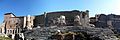
Photo: Chabe01, CC BY-SA 4.0 · Wikimedia Commons
Archaeological site
Second of the so-called imperial fora at Rome, built by Augustus
The Forum of Augustus (Latin: Forum Augustum; Italian: Foro di Augusto) is one of the Imperial fora of Rome, Italy, built by Augustus (r. 27 BC – AD 14). It includes the Temple of Mars Ultor. The incomplete forum and its temple were inaugurated in 2 BC, 40 years after they were first vowed.
The triumvir Octavian vowed to build a temple honoring Mars, the Roman God of War, during the battle of Philippi in 42 BC. After winning the battle, with the help of Mark Antony and Lepidus, Octavian had avenged the assassination of his adoptive father Julius Caesar. He became the Princeps of Rome in 27 BC under the name Augustus, and planned for the temple to be built in a new forum named after himself. Augustus used social propaganda by continuing Julius Caesar's will to create a Temple to Mars Ultor "the avenger," by placing it within the Temple, linking himself to his divine adopted father, obtaining a strong link to the Roman population through their love for the deceased dictator.
The majority of the land that the Forum was to be built on was already owned by Augustus himself. However, the initial plans called for more space than he had and would have required him to purchase or expropriate further land. Instead, the plans were altered slightly, so some asymmetry is apparent, especially in the Eastern corner of the precinct. Suetonius states that Augustus did not want to take the houses of the nearby owners by force. These land issues, as well as numerous architectural mishaps, prolonged construction. The incomplete forum and its temple were inaugurated, 40 years after they were first vowed, in 2 BC. In 19 AD Tiberius added two triumphal arches either side of the temple in honour of Drusus the Younger and Germanicus and their victories in Germania.
With the dedication of the Forum of Trajan in 112 AD, the number of inscriptions found in the Forum of Augustus decline, which suggests that many of its functions were transferred to the new venue, although Hadrian made some repairs. The educational and cultural use of the exedrae were recorded in the late antiquity. The last reference to the forum dates to 395 AD. Archaeological data indicates that the structures were systematically dismantled in the first half of the 6th century, probably because it was seriously damaged in an earthquake or during the wars. The Forum of Augustus was among the first of the great public buildings of Rome which disappeared that also explains the rapid loss of the memory of its original name. In the 9th century a Basilian monastery was erected on the podium of the ruined temple. By the 10th century, the forum had become so congested with ruins and vegetation, that the locals had given it the name Hortus mirabilis (the wonderful garden).
The Forum of Augustus was built to both house a temple honouring Mars Ultor, and to provide another space for legal proceedings, as the Roman Forum was very crowded. Before battle, generals set off from the Temple of Mars, after attending an inaugural ceremony. Other ceremonies took place in the temple including the assumption of the toga virilis by young men. The Senate met at the Temple when discussing war and the victorious generals dedicated their spoils from their triumphs to Mars at the altar. Arms or treasure recovered from battle were often stored in the Forum as well. Another use that Augustus made of the Temple was to store the standards taken by the Parthians from Crassus during his failed campaign, after their retrieval through Augustus' diplomacy in 20 BC, as depicted by the Augustus of Prima Porta. Three Aquilae were lost in 9 AD in the Battle of the Teutoburg Forest of the Legions Legio XVII, Legio XVIII and Legio XIX; all three were recovered-one in 14 AD from the Marsi and one in 15 AD from the Bructeri; the 3rd was recovered in 41 AD from the Chauci-and all three placed within the Temple of Mars the Avenger.
The Forum was filled with a rich variety of different statues. Most notable were the statues of Augustus in full military outfit in the center of the Forum, and of Mars and Venus in the Temple. In total, there were 108 portrait statues with inscriptions of each individual's achievements, providing an important idea of how Augustus viewed his role within Roman history. The inscriptions are called elogia by modern scholars. In addition to statues of all the Roman triumphatores, which were either made of bronze or marble and were placed along the left side of the Forum and in the left exedrae, the entire right side and right exedrae were full of statues of men in the Julian-Claudian family. They trace Augustus's lineage back through the fourteen Alban kings to the founding ancestors Aeneas and Romulus. These figures reinforced the importance of both Roman lineage and also of the prestigious lineage that Augustus himself held. By advertising this lineage, he reinforced his power and authorities as a leader. Also, by placing himself amongst great figures and heroes, he further portrayed himself and his own importance. He paints himself as one of ‘the greats’ worthy of the power he held. Whilst all the elogia record the deeds of these great men, Augustus's Res Gestae Divi Augusti acts as a direct parallel.
The statues in the forum provided excellent reasoning for Augustus to claim his restoration of the Republic. Not only were the great men of Rome's past being honored through their busts, but Augustus was also establishing his ancestry to these men, either by blood or by spirit. This provided Augustus with another connection between himself and the old Republic, an era of Roman history he continuously tried to invoke during his reign.
The statues of the famous men of the Republic for which an inscription has survived are:
Aulus Postumius Albus Regillensis, consul in 496 BC, won the Battle of Lake Regillus.
Manius Valerius Maximus, dictator in 494 BC, allegedly the first princeps Senatus.
Aulus Cornelius Cossus, consul in 428 BC, was awarded the spolia opima for killing the Etruscan king Lars Tolumnius during the Battle of Fidenae in 437 BC.
Marcus Furius Camillus, five times dictator between 396 and 367 BC, who saved Rome after the Sack by the Gauls in 390 BC.
Marcus Valerius Corvus, six times consul between 346 and 299 BC, triumphed three times. …
Text from Wikipedia, the free encyclopedia, under CC BY-SA 4.0. Full article: «Forum of Augustus».
Distances are as the crow flies, not walking or driving.


Forum of Augustus is in Rome, in the province of Roma (Lazio), Italy. GPS coordinates: 41.89417, 12.48667.
Nearby you’ll find: Temple of Mars Ultor (0 m away), Casa dei Cavalieri di Rodi (100 m away), Temple of Minerva (100 m away).
Text. Wikipedia, the free encyclopedia (CC BY-SA 4.0).
Data. Wikidata (CC0); opening hours and contacts OpenStreetMap (ODbL).
Photos. Wikimedia Commons, author and licence on every image.
Updated 28 October 2026. All sources and licences