



- UNESCO
- Free 1st Sunday
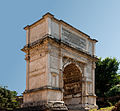
Photo: TcfkaPanairjdde, Public domain · Wikimedia Commons
Archaeological site, 221
Temple built by the Roman emperor Elagabalus
The Elagabalium was a temple built by the Roman emperor Elagabalus, located on the north-east corner of the Palatine Hill. During Elagabalus' reign from 218 until 222, the Elagabalium was the center of a controversial religious cult, dedicated to Elagabalus, of which the emperor himself was the high priest.
The temple was a colonnaded structure some 70 metres by 40 metres, in front of the Colosseum, within a colonnaded enclosure. The temple platform was originally built under Domitian between 81 and 96, and may have been a place of worship to Jupiter. The remnants of this terrace are still visible today at the north-east corner of the Palatine Hill.
When Elagabalus became emperor in 218 the temple was expanded and rededicated to the god Elagabal, the patron deity of his homeplace Emesa in Syria. Elagabal was personified by a conical black stone, which has been suggested to have been a piece of meteorite rock.
After Elagabalus' death the temple was again dedicated to Jupiter by Severus Alexander. A second, smaller temple to the god Elagabal was built where the church of Santa Croce in Gerusalemme now stands. If still in use by the 4th-century, it would have been closed during the persecution of pagans in the late Roman Empire.
Since the reign of Septimius Severus, sun worship had increased throughout the Empire. Elagabalus saw this as an opportunity to set up his god, El-Gabal or Elagabal, as the chief deity of the Roman pantheon. Elagabal was placed over even Jupiter. As a sign of the union between the two religions, Elagabalus gave either Astarte, Minerva, Urania, or some combination of the three, to Elagabal as a wife. Herodian writes that Elagabalus forced senators to watch while he danced around the altar of Elagabal to the sound of drums and cymbals, and that each summer solstice became a great festival to Elagabal popular with the masses because of its widely distributed food. During this festival, Elagabalus (also known as Heliogabalus, syncretised with Greek hēlios, the sun) placed Elagabal on a chariot adorned with gold and jewels, which he paraded through the city, after which he threw gifts into the Roman crowds:
After thus bringing the god out and placing him in the temple, Heliogabalus performed the rites and sacrifices described above; then, climbing to the huge, lofty towers which he had erected, he threw down, indiscriminately, cups of gold and silver, clothing, and cloth of every type to the mob below.
The most sacred relics from the Roman religion were transferred from their respective shrines to the Elagabalium, including the Great Mother, the fire of Vesta, the Shields of the Salii and the Palladium. Ancient history records lurid tales of human sacrifice taking place inside the temple, involving children which were collected all over Italy from the richest and noblest families. The religious excesses of Elagabalus' reign eventually contributed to his demise. On March 11, 222, Elagabalus was killed by members of the Praetorian Guard, and replaced by his cousin Severus Alexander. Elagabalus' religious edicts were reversed, and the statues which had been moved to the Elagabalium were restored to their original shrines.
Text from Wikipedia, the free encyclopedia, under CC BY-SA 4.0. Full article: «Elagabalium».
Events and people from Wikidata (CC0).
Distances are as the crow flies, not walking or driving.


Elagabalium is in Rome, in the province of Roma (Lazio), Italy. GPS coordinates: 41.88962, 12.48868.
Wikidata dates it to 221.
Nearby you’ll find: Baths of Elagabalus (100 m away), Archaeological park of Colosseum (100 m away), Arch of Titus (100 m away).
Text. Wikipedia, the free encyclopedia (CC BY-SA 4.0).
Data. Wikidata (CC0); opening hours and contacts OpenStreetMap (ODbL).
Photos. Wikimedia Commons, author and licence on every image.
Updated 28 October 2026. All sources and licences