




- UNESCO
- Free 1st Sunday
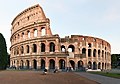
Photo: NikonZ7II (Paris Orlando), CC BY-SA 4.0 · Wikimedia Commons
Archaeological site
Triumphal arch in Rome
The Arch of Constantine (Italian: Arco di Costantino) is a triumphal arch in Rome dedicated to the emperor Constantine the Great. The arch was commissioned by the Roman Senate to commemorate Constantine's victory over Maxentius at the Battle of the Milvian Bridge in AD 312. Situated between the Colosseum and the Palatine Hill, the arch spans the Via Triumphalis, the route taken by victorious military leaders when they entered the city in a triumphal procession. Dedicated in 315, it is the largest Roman triumphal arch, with overall dimensions of 21 m (69 ft) high, 25.9 m (85 ft) wide and 7.4 m (24 ft) deep. It has three bays, the central one being 11.5 m (38 ft) high and 6.5 m (21 ft) wide and the laterals 7.4 m (24 ft) by 3.4 m (11 ft) each. The arch is constructed of brick-faced concrete covered in marble.
The three-bay design with detached columns was first used for the Arch of Septimius Severus in the Roman Forum (which stands at the end of the triumph route) and repeated in several other arches now lost.
The arch, which was constructed between 312 and 315, was dedicated by the Senate to commemorate ten years (a decennia) of Constantine's reign (306–337) and his victory over the then reigning emperor Maxentius (306–312) at the Battle of the Milvian Bridge on 28 October 312, as described on its attic inscription, and officially opened on 25 July 315. Not only did the Roman senate give the arch for Constantine's victory, they also were celebrating decennalia: a series of games that happened every decade during the Roman Empire. On these occasions they also said many prayers and renewed both spiritual and mundane vows. However, Constantine had actually entered Rome on 29 October 312, amidst great rejoicing, and the Senate then commissioned the monument. Constantine then left Rome within two months and did not return until 326.
The location, between the Palatine Hill and the Caelian Hill, spanned the ancient route of Roman triumphs (Via triumphalis) at its origin, where it diverged from the Via sacra. This was the route taken by the emperors entering the city in triumph: it started at the Campus Martius, led through the Circus Maximus, and around the Palatine Hill; immediately after the Arch of Constantine, the procession would turn left at the Meta Sudans and march along the Via sacra to the Forum Romanum and on to the Capitoline Hill, passing through both the Arches of Titus and Septimius Severus. Jones argues that its placement in relation to the Circus Maximus, the Temple of Venus and Rome, and the base of the Colossus indicates a deliberate Constantinian urban design concept, rather than reuse of an earlier arch on that spot.
During the Middle Ages, the Arch of Constantine was incorporated into one of the family strongholds of ancient Rome, as shown in the painting by Herman van Swanevelt, here. In 1534 Lorenzino de' Medici mutilated the heads of some of the statues. Works of restoration were first carried out in the 18th century, with the latest excavations in the late 1990s, just before the Great Jubilee of 2000. The arch served as the finish line for the marathon athletic event for the 1960 Summer Olympics.
The arch was damaged after a direct lightning strike on 3 September 2024. …
Constantine's Arch is an important example, frequently cited in surveys of art history, of the stylistic changes of the 4th century, and the "collapse of the classical Greek canon of forms during the late Roman period", a sign the city was in decline, and would soon be eclipsed by Constantine's founding of a new capital at Constantinople in 324.
The supposed aesthetic deficiencies of the work were lamented by Edward Gibbon in his seminal Decline and Fall of the Roman Empire: “The triumphal arch of Constantine still remains a melancholy proof of the decline of the arts, and a singular testimony of the meanest vanity.” Gibbon describes how elements from earlier constructions were stripped and repurposed without regard to artistic coherence, and criticises the freshly sculpted pieces as being “executed in the rudest and most unskilful manner.”
Later art historians have echoed Gibbon’s dim assessment. The contrast between the styles of the re-used Imperial reliefs of Trajan, Hadrian and Marcus Aurelius and those newly made for the arch is dramatic and, according to Ernst Kitzinger, "violent", that where the head of an earlier emperor was replaced by that of Constantine the artist was still able to achieve a "soft, delicate rendering of the face of Constantine" that was "a far cry from the dominant style of the workshop". It remains the most impressive surviving civic monument from Rome in Late Antiquity, but is also one of the most controversial with regards to its origins and meanings. …
The arch is heavily decorated with parts of older monuments, which assume a new meaning in the context of the Constantinian building. As it celebrates the victory of Constantine, the new "historic" friezes illustrating his campaign in Italy convey the central meaning: the praise of the emperor, both in battle and in his civilian duties. The other imagery supports this purpose: decoration taken from the "golden times" of the Empire under the 2nd century emperors whose reliefs were re-used places Constantine next to these "good emperors", and the content of the pieces evokes images of the victorious and pious ruler. Jones has argued that the overall design concept of the arch was conceived as a deliberate synthesis of earlier imperial monuments, presenting past architectural models within a single unified composition as part of its original conception.
Another explanation given for the re-use is the short time between the start of construction (late 312 at the earliest) and the dedication (summer 315), so the architects used existing artwork to make up for the lack of time to create new art. It could be that so many old parts were used because the builders themselves did not feel the artists of their time could do better than what had already been done by different people. As yet another possible reason, it has often been suggested that the Romans of the 4th century truly did lack the artistic skill to produce acceptable artwork, and were aware of it, and therefore plundered the ancient buildings to adorn their contemporary monuments. This interpretation has become less prominent in more recent times, as the art of Late Antiquity has been appreciated in its own right. It is possible that a combination of those explanations is correct. …
Text from Wikipedia, the free encyclopedia, under CC BY-SA 4.0. Full article: «Arch of Constantine».
Events and people from Wikidata (CC0).
Distances are as the crow flies, not walking or driving.


Arch of Constantine is in Rome, in the province of Roma (Lazio), Italy. Address: via di San Greogrio, s.n.c. - Roma. GPS coordinates: 41.88983, 12.49061.
Yes: entry is free on the first Sunday of every month, under the Italian “Domenica al museo” scheme.
Nearby you’ll find: Meta Sudans (0 m away), Baths of Elagabalus (100 m away), Temple of Venus and Roma (100 m away).
Text. Wikipedia, the free encyclopedia (CC BY-SA 4.0).
Data. Wikidata (CC0); opening hours and contacts OpenStreetMap (ODbL).
Photos. Wikimedia Commons, author and licence on every image.
Updated 28 October 2026. All sources and licences