



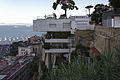




Photo: Armando Mancini, CC BY-SA 2.0 · Wikimedia Commons
Archaeological site, 36 BC
Crypta Neapolitana
Building in Naples, Italy
At a glance
- Type
- Archaeological site
- Period
- Antiquity, 36 BC
- Architect
- Lucio Cocceio Aucto
- Commissioned by
- Marcus Vipsanius Agrippa
- Protection
- Italian national heritage
- Coordinates
- 40°49′52″ N, 14°13′03″ E
- Address
- Salita della grotta, 20 - Napoli
History and description
The Crypta Neapolitana (Latin for "Neapolitan crypt") is an ancient Roman road tunnel near Naples, Italy. It was built in 37 BC and is over 700 metres long.
The tunnel connected Naples with the so-called Phlegrean Fields and the town of Pozzuoli along the road known as the via Domiziana.
History
Naples and Pozzuoli were separated by a great impenetrable marsh: the first road between the two cities was probably built by the Greeks and was narrow and indirect.
The first Roman road connecting Neapolis and the Phlegrean fields, the via (Antiniana) per colles, was built at the beginning of the 1st century BC and followed the easiest route but it was nevertheless still long, difficult, tortuous and traversed steep hills. It climbed the hills of Vomero and came back down towards Fuorigrotta arriving at the modern Via Terracina from where it continued to the ports of Puteoli and Cumae. As Puteoli and associated trade between the two cities grew, the old road needed to be improved, so the tunnel shortened the route and avoided several hills.
The tunnel was first built by the architect Lucius Cocceius Auctus for Agrippa during the civil war between Octavian and Sextus Pompeius in c. 37 BC. The new road, called via per cryptam, turned north at the west end of the tunnel, heading towards Via Leopardi and reconnecting with the old road, the via Neapolis-Puteoli, at the top of Via Terracina where a way-station (tabernae) and adjoining thermal spa complex has been excavated.
The tunnel is one of four road tunnels built in the area by Cocceius: others are the Grotta di Seiano (tunnel of Sejanus) in Posillipo, the Grotta di Cocceio from Lake Avernus to Cumae, and the Crypta Romana from Cumae to its port, as part of a network of military infrastructures including construction of the Portus Julius.
The Aqua Augusta (Serino) aqueduct was built later in parallel to the road tunnel.
The tunnel was still in use as a roadway until superseded by two modern tunnels in the early 20th century, and shows extensive restoration done by the architects of the Bourbon dynasty of Naples. During the Second World War it was used as a bomb shelter for the inhabitants of Bagnoli; the war and some landslides during the fifties put it back into a state of neglect. Today it has been restored as an archaeological site.
According to mediaeval legend, the tunnel was built by the poet Virgil in a single night.
Text from Wikipedia, the free encyclopedia, under CC BY-SA 4.0. Full article: «Crypta Neapolitana».
Timeline
- 36 BCBuilt
Events and people from Wikidata (CC0).
Photos
Getting there
Napoli MergellinaTrain, nearest
100 m as the crow flies
Crypta NeapolitanaSalita della grotta, 20 - Napoli
Molo Mergelina500 m
Aeroporto di Napoli Capodichino8.4 km
Distances are as the crow flies, not walking or driving.
Loading map…
Nearby
See on the mapMore archaeological sites in Campania

- UNESCO
- Free 1st Sunday

- UNESCO

- UNESCO

- UNESCO
- Free 1st Sunday

- Free 1st Sunday
Frequently asked questions
Where is Crypta Neapolitana?
Crypta Neapolitana is in Naples, in the province of Napoli (Campania), Italy. Address: Salita della grotta, 20 - Napoli. GPS coordinates: 40.83105, 14.21756.
Can I visit Crypta Neapolitana for free?
Yes: entry is free on the first Sunday of every month, under the Italian “Domenica al museo” scheme.
How old is Crypta Neapolitana?
Wikidata dates it to 36 BC.
What else is there to see near Crypta Neapolitana?
Nearby you’ll find: Parco Virgiliano (100 m away), Palazzo in piazza Piedigrotta (200 m away), Villino Adriana (300 m away).
Sources and licences
Text. Wikipedia, the free encyclopedia (CC BY-SA 4.0).
Data. Wikidata (CC0); opening hours and contacts OpenStreetMap (ODbL).
Photos. Wikimedia Commons, author and licence on every image.
Credits for the 6 photos
- Parco della Grotta di Posillipo6 — Armando Mancini, CC BY-SA 2.0
- Crypta Neapolitana - Fuorigrotta's side — Cristianrodenas, CC BY-SA 3.0
- Crypta Neapolitana – Parco Vergiliano a Napoli — Gianfranco Vitolo, CC BY 2.0
- Crypta Neapolitana (Vergiliano) 1 — Mentnafunangann, CC BY-SA 3.0
- Crypta Neapolitana 01 — Miguel Hermoso Cuesta, CC BY-SA 4.0
- Parco della Grotta di Posillipo10 — Armando Mancini, CC BY-SA 2.0
Updated 28 October 2026. All sources and licences