


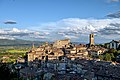

- Most beautiful villages
Photo: Ceccomaster, CC BY-SA 3.0 · Wikimedia Commons
Historic village
Italian comune
Citerna is a comune (municipality) in the Province of Perugia in the Italian region Umbria, located about 50 km northwest of Perugia.
It is one of I Borghi più belli d'Italia ("The most beautiful villages of Italy").
According to local tradition, the present settlement was founded by populations fleeing their enemies. Having first settled near the river Sovara, they later chose a higher position, which they called Civitas Sobarie.
The castle of Citerna is recorded in the 11th–12th century, when it was held by the Marquises del Colle, later known as the Marquises of Monte Santa Maria, among whom were Guidone and Uguccione da Citerna, lords of numerous fiefs and castles in the territory of Perugia.
From 1215 it was repeatedly compelled to submit to Città di Castello and became involved in ongoing military struggles. In the early 13th century it was seized by the forces of Monteauto. Control later passed, in the late 13th and early 14th centuries, to the Tarlati di Pietramala of Arezzo.
During the early 15th century rule shifted to the Malatesta family of Rimini. By 1447 it was under Sigismondo Malatesta, former commander of the papal army. In the mid-15th century Sigismondo relinquished it, and the territory was incorporated into the Papal State. From 1464 it was subject to the Governor of Città di Castello through a commissioner.
The Vitelli family took control in 1482 after their exile from Città di Castello. In 1519 Pope Leo X granted the territory to the Vitelli as a marquisate, and their rule continued until 1584. A papal privilege of 1543 confirmed the judicial authority of the local commissioner. In the late 16th century the community statutes were revised and updated on the basis of a 1518 model; these statutes received formal approval from Pope Clement VIII on 6 February 1603.
The First War of Castro (1643–1644) caused severe damage to the population and territory.
In the late 18th century, under French rule, the community was established as an autonomous municipality within the Department of Trasimeno. Papal authority was restored in 1814, and jurisdiction returned to Città di Castello. In 1817 the community was recognized as a municipality attached to the governor's residence of Città di Castello. Judicial powers were transferred on 21 December 1827 to locally appointed magistrates, but the office of magistrate was suppressed on 5 July 1831 following uprisings. …
The Church of San Francesco was built in the second half of the 15th century. The church was constructed on the foundations of an earlier building visible in the lower part of the façade. It has a Renaissance façade and a Latin-cross plan. Along the nave are four altars of sandstone and wood, painted and gilded, with painted panels.
Above the first altar on the left is a 17th-century oil painting of the Annunciation by an unknown artist. The second altar holds a painting from the same century depicting a Franciscan supporting Saint John, the Immaculate Conception and the prophet Isaiah. On the right wall, the first altar contains a panel of the Madonna with Saints and the second a depiction of Saint Anthony of Padua showing a view of Citerna in the 16th century; both works are by Simeone Ciburri.
On the same wall is a niche with a fresco of the Virgin and Child with Saint Michael the Archangel and Saint Bernardino of Siena, attributed to the school of Luca Signorelli and possibly to Tommaso Barnabei. On the back wall of the left transept is a wooden altar dedicated to the Most Holy Crucifix, bearing a wooden crucifix in a Byzantine-influenced style. The altar also includes a panel of the Madonna and Saint John and two other paintings attributed to Raffaellino del Colle. In the same transept is an altar dedicated to Mary Magdalene with a painting of the Deposition by Niccolò Circignani, dated 1570. In the right transept are two further altars, one with a panel titled Christ in Glory by Raffaellino del Colle and another with a 16th-century painting of the Madonna enthroned.
The church also contains a polychrome terracotta Madonna and Child dated to around 1415 and attributed to the young Donatello, as well as a glazed terracotta work with fruit and cherubs and other paintings attributed to Raffaellino del Colle. The wooden choir dates to 1550.
The Church of San Michele Arcangelo, dedicated to the patron saint of the town, has a gabled façade with a central rose window and a Latin-cross plan with a single nave containing six chapels. The choir is square and covered by a barrel vault. Inside the church is a painted panel of the Crucifixion by Niccolò Circignani, dated 1570, and a terracotta sculpture of the Madonna and Child from the school of Giovanni della Robbia. …
Text from Wikipedia, the free encyclopedia, under CC BY-SA 4.0. Full article: «Citerna».
Distances are as the crow flies, not walking or driving.


Citerna is in Citerna, in the province of Perugia (Umbria), Italy. GPS coordinates: 43.49814, 12.11646.
Nearby you’ll find: Museo della Madonna del Parto (1.5 km away), Castello di Sorci (3.7 km away), Palazzo Pretorio of Anghiari (6.7 km away).
Text. Wikipedia, the free encyclopedia (CC BY-SA 4.0).
Data. Wikidata (CC0); opening hours and contacts OpenStreetMap (ODbL).
Photos. Wikimedia Commons, author and licence on every image.
Updated 28 October 2026. All sources and licences