

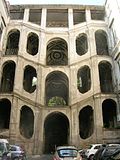


Photo: Mentnafunangann, CC BY-SA 3.0 · Wikimedia Commons
Archaeological site
Catacombs of Saint Gaudiosus
Catacombs in Santa Maria della Sanità, Naples, Italy
- Within the UNESCO World Heritage Site “Historic Centre of Naples”
At a glance
- Type
- Archaeological site
- Coordinates
- 40°51′36″ N, 14°14′56″ E
History and description
The Catacombs of Saint Gaudiosus are underground paleo-Christian burial sites (4th–5th century AD), located in the northern area of the city of Naples (now Stella district).
History
The catacombs were probably occupied on a pre-existing Greek-Roman necropolis in the district known nowadays as Rione Sanità, that was uninhabited at that time. According to tradition, it was the burial site of St Gaudiosus, a bishop arrived in Naples from North Africa, due to a shipwreck.
His burial took place between 451 and 453 and the place, although was already the tomb of another bishop, St Nostriano, became an object of veneration.
The entire area of Rione Sanità was uninhabited throughout the Middle Ages because of the numerous mudslides from the hill of Capodimonte which buried the area. The urbanisation of Rione Sanità began only around the sixteenth century and the catacombs returned to their original burial function. During the seventeenth century, with the construction of the basilica of Santa Maria della Sanità just above the ancient church or chapel of St Gaudioso, the underground cemetery was "modernized" with profound changes in its original structure and the destruction of some of it.
After the outbreak of plague in 1656, the vast limestone caves in the valley became a huge open-air graveyard, and in the early 19th-century at the time of Joachim Murat, numerous bones from the "mummification rooms" were moved as well as later to make space for victims of other epidemics, such as cholera of 1836.
Nowadays, only a small portion remains of the original catacombs.
Description
Access to the catacombs is in the crypt, under the raised presbytery of the church of Santa Maria della Sanità. Her depiction is represented in a faint paleochristian fresco detached by a wall of the old church, due to a mud slide.
The icon of the Lady of Health (Santa Maria della Sanità) venerated since the 5th – 6th century, is the most ancient Marian icon in Naples, is now kept in the first right side chapel of the basilica. Many inhabitants of the neighborhood, however, believe that the church is dedicated to St. Vincent Ferrer, because of the popular devotion to this holy Dominican and of the beautiful wooden statue of him, placed at the left of the altar.
The crypt, once a long corridor catacomb, clearly contains on the vault and on the walls, visible frescoes by Bernardino Fera representing stories of martyrs. The arcosolium, placed at the entrance, guards the Tomb of San Gaudioso, with a sixth-century mosaic decoration.
In the various cubicles that open along the arms of the catacombs, were located 5th – 6th century frescoes (St. Peter, among others, and San Sossio, deacon of Pozzuoli) and a mosaic dating before the late 5th century. The tufa sculpture of the dead Christ to the left of the entrance dates back at the end of the 17th century. The 17th century was for the catacombs a new period of use, especially by the Dominican friars. In this era it was, in fact, still widespread the use of the drainers: stone cavities in which corpse were leaned into a fetal position, to make them lose the fluids.
The Dominican friars thought that the head was the most important part of the body as the seat of thoughts; that way, after drying, the heads were preserved, while the rest of the body was amassed in the charnel house. …
Curiosities
The dead were buried in small openings in the walls, but now only the skulls survived, due to the fact that the surface had been deteriorated by the humidity. Most of that skullcaps are smaller than modern human ones, maybe because of the different nutrition and the healthier way of life.
The Neapolitan actor Antonio De Curtis, known as Totò, was a native of the Rione Sanità and he was used to frequent its catacombs, where there is a fresco representing the victory of Death. This image has probably inspired Toto's poem “A’ livella”.
By the late twentieth century, the Dominican cloister adjacent to the Basilica, had become an inn that sponsors visits to the catacombs of San Gaudioso and San Gennaro. To see even the part illuminated not by the lights, during the visit, it is advisable to bring a flashlight.
Text from Wikipedia, the free encyclopedia, under CC BY-SA 4.0. Full article: «Catacombs of Saint Gaudiosus».
Photos
Getting there
Napoli Piazza CavourTrain, nearest
700 m as the crow flies
Catacombs of Saint Gaudiosus
Porta di Massa2.1 km
Aeroporto di Napoli Capodichino4.3 km
Distances are as the crow flies, not walking or driving.
Loading map…
Nearby
See on the mapMore archaeological sites in Campania

- UNESCO
- Free 1st Sunday

- UNESCO

- UNESCO

- UNESCO
- Free 1st Sunday

- Free 1st Sunday
Frequently asked questions
Where is Catacombs of Saint Gaudiosus?
Catacombs of Saint Gaudiosus is in Naples, in the province of Napoli (Campania), Italy. GPS coordinates: 40.85990, 14.24900.
How much does it cost to visit Catacombs of Saint Gaudiosus?
There is an admission charge. Up-to-date prices are on the official website.
Is Catacombs of Saint Gaudiosus wheelchair accessible?
According to OpenStreetMap data, the site is not wheelchair accessible.
What else is there to see near Catacombs of Saint Gaudiosus?
Nearby you’ll find: Palazzo Fasulo (200 m away), Complesso dei Cinesi (200 m away), Palazzo Terralavoro alla Sanità (200 m away).
Sources and licences
Text. Wikipedia, the free encyclopedia (CC BY-SA 4.0).
Data. Wikidata (CC0); opening hours and contacts OpenStreetMap (ODbL).
Photos. Wikimedia Commons, author and licence on every image.
Credits for the 9 photos
- Basilica di Santa Maria della Sanità 8 — Mentnafunangann, CC BY-SA 3.0
- Catacombe di San Gaudioso (Napoli) 01 — Fabien Bièvre-Perrin, CC BY-SA 4.0
- Catacombe di San Gaudioso WLM23 001 — Mentnafunangann, CC BY-SA 4.0
- Catacombe di San Gaudioso. 002 — Peppe Guida, CC BY-SA 4.0
- Catherine of Siena in San Gaudioso catacombs — Sibeaster, Public domain
- Catacombe Sanità — Baku, CC BY-SA 3.0
- Mosaic over San Gaudioso's arcosolium — Sibeaster, Public domain
- Cripta di Santa Maria della Sanità — Giuseppe Guida, CC BY-SA 2.0
- Icona — NatalyaSole, CC BY-SA 3.0
Updated 28 October 2026. All sources and licences