



Photo: Giuseppe Guida, CC BY-SA 4.0 · Wikimedia Commons
At a glance
- Type
- Museum
- Area
- 134,000 m²
- Protection
- Italian national heritage
- Coordinates
- 40°52′10″ N, 14°15′07″ E
- Address
- via Lucio Amelio 2
History and description
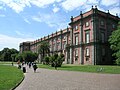
The Royal Park of Capodimonte (Italian: Real Bosco di Capodimonte, lit. 'Royal Wood of Capodimonte') is a public urban park in Naples, in the Capodimonte quarter and surrounding the Palace of Capodimonte.
History
Used as early as 1735 for hunting activities by Charles III of Spain, a great passion of his, the construction of the Park of Capodimonte began in 1742 and was completed the following year under the direction of the architect Ferdinando Sanfelice. He created, over an area of one hundred and twenty-four hectares, which also included the Royal Palace of Capodimonte then under construction, a park of great visual and perspectival impact, typical of Enlightenment vision, yet at the same time scenographic, reflecting influences of the late Baroque period. The park featured panoramic areas with views over Posillipo, the hill of San Martino, and Mount Vesuvius; restoration works were also carried out on all the structures within the park, used as residences, churches, workshops, or farms.
Following the return to the throne of the Kingdom of the Two Sicilies by Ferdinand I of the Two Sicilies after the brief French decade, the park was opened to the public twice a year, on the occasion of religious festivities, to allow access to the Hermitage of the Capuchins, located at the edge of the woods.
Between 1836 and 1837, redevelopment works were carried out under the supervision of the botanist Friedrich Dehnhardt: he introduced the typical English landscape garden, particularly in the flowerbeds surrounding the palace, and planted tree species, some of which were rare and exotic, such as Thuja and eucalyptus. He also arranged the belvederes, clearing the view towards Mount Vesuvius and the Gulf of Naples.
After the Italian unification, the House of Savoy also used the park mainly for hunting expeditions: the main innovations in this period, between 1878 and 1900, were the introduction of palms, typical of the Oriental taste of the time, and the arrangement of the belvedere overlooking Naples, with the creation of a fountain reusing statues previously placed along the park avenues, particularly from the Torre garden area.
Severely damaged during World War II, the park was reopened to the public on 3 March 1951. Between 1966 and 1967 it was restored on the occasion of the inauguration of the National Museum of Capodimonte, and opened as a public park, followed by further restoration works between 1990 and 2000.
Description
The Park of Capodimonte extends over an area of 124 hectares, partially enclosed by a boundary wall built in the 1820s: from the same period date two entrance gates, Porta Grande, along Via Ponti Rossi, with two lateral guardhouses, and Porta Piccola, whose guardhouses were constructed in 1835 and heavily modified over time. A third gate, Porta Caccetta, was created in 1816, enlarged in 1834, demolished during the mid-20th century, and restored in the early 2000s.
Before entering the central core of the park, visitors pass the palace gardens, so called because they surround the building that houses the National Museum of Capodimonte, also known as the Spianato. These consist of large grassy flowerbeds laid out at the end of the 18th century, later enriched from the late nineteenth century with Canary Island date palms, Washingtonia, groups of Phoenix reclinata, Chamaerops humilis, Cycas revoluta and Livistona chinensis; the original flowerbed borders, particularly composed of roses, have instead been lost.
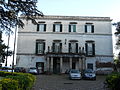
Access to the wooded part of the park is provided by three gates: the main one is Porta di Mezzo, featuring a wrought iron gate considered one of the most elegant examples of Rococo works in Naples, completed in 1736 and originally decorated with Bourbon coats of arms and effigies. It is flanked by guardhouses and the custodian's residence, designed by Antonio Canevari and completed by Ferdinando Fuga. The other entrances are Porta di Miano, built between 1837 and 1840, and Porta di Santa Maria dei Monti, constructed either at the end of the eighteenth century or by the French, later falling into disuse and named after a nearby ancient monastery.
The park contains more than four hundred varieties of ancient trees, including oaks, holm oaks, elms, lindens and chestnut trees. Alongside these, fruit tree cultivations, particularly citrus trees, were once present; moreover, when the area served as a royal hunting reserve, species such as turtle doves, garden warblers, thrushes, pheasants imported from Bohemia, hares, rabbits, and deer could be found. …
Text from Wikipedia, the free encyclopedia, under CC BY-SA 4.0. Full article: «Capodimonte park».
Timeline
- 1743Opened
Events and people from Wikidata (CC0).
Photos
Getting there
Napoli Piazza CavourTrain, nearest
1.6 km as the crow flies
Capodimonte parkvia Lucio Amelio 2
Porta di Massa3.0 km
Aeroporto di Napoli Capodichino3.5 km
Distances are as the crow flies, not walking or driving.
Loading map…
Nearby
See on the mapMore museums in Campania

- Free 1st Sunday


- Free 1st Sunday

Frequently asked questions
Where is Capodimonte park?
Capodimonte park is in Naples, in the province of Napoli (Campania), Italy. Address: via Lucio Amelio 2. GPS coordinates: 40.86942, 14.25204.
What else is there to see near Capodimonte park?
Nearby you’ll find: Palace of Capodimonte (300 m away), Museo di Capodimonte (300 m away), Palazzo Cilento (400 m away).
Sources and licences
Text. Wikipedia, the free encyclopedia (CC BY-SA 4.0).
Data. Wikidata (CC0); opening hours and contacts OpenStreetMap (ODbL).
Photos. Wikimedia Commons, author and licence on every image.
Credits for the 9 photos
- Parco di Capodimonte. 0269 — Giuseppe Guida, CC BY-SA 4.0
- Capodimonte's park — Yair Haklai, CC BY-SA 4.0
- Viale Bosco di Capodimonte di Napoli — Dr.Conati Roberto De Martino, Public domain
- 2016 Capodimonte 01 — Nemo bis, CC BY-SA 3.0
- CapodimontePrateriajpg — Corryx, CC BY-SA 4.0
- Ferdinando IV con la corte alla Reggia di Capodimonte. 0071 — Giuseppe Guida, CC BY-SA 4.0
- Parco di Capodimonte - panoramio (1) — Francesco Boggia, CC BY 3.0
- Parco di Capodimonte - Reggia - panoramio — Francesco Boggia, CC BY 3.0
- Reggia di Capodimonte 1 Broad — MentNFG, CC BY-SA 4.0
Updated 28 October 2026. All sources and licences