


- Free 1st Sunday
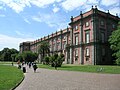
Photo: Mentnafunangann, CC BY-SA 4.0 · Wikimedia Commons
Historic villa / palace, 1742
Royal palace in Naples, Italy which is now used as a museum
The Royal Palace of Capodimonte (Italian: Reggia di Capodimonte) is a large palazzo in Naples, Italy. It was formerly the summer residence and hunting lodge of the Bourbon kings of the Two Sicilies, one of the two royal palaces in Naples. Today, the main building holds the main Neapolitan museum for paintings, and much other post-ancient art, in the National Museum of Capodimonte. This has the best collection of paintings from the distinct tradition of Neapolitan art, and also many works from the Farnese Collection.
The palace was constructed on its somewhat cooler hilltop location (Capodimonte means "top of the hill") just outside the city, with urban Naples ultimately expanding around it. The large park (Real Bosco or "royal woods") is under the same administration, and hosts events such as concerts.
In 1738, King Charles VII of Naples and Sicily (later King Charles III of Spain) decided to build a hunting lodge on the Capodimonte hill. He then decided that he would instead build a grand palace, partly because his existing residence, the Palace of Portici, was too small to accommodate his court, and partly because he needed somewhere to house the fabulous Farnese Collection which he had inherited from his mother, Elisabetta Farnese, last descendant of the sovereign ducal family of Parma.
He commissioned Angelo Carasale, Giovanni Antonio Medrano and Antonio Canevari to build it. However, after Canevari failed to come up with a design for ten months, Medrano began his work. Medrano's design began construction in August 1738, but it was to take more than a century to complete, partly because of the difficulty of transporting piperno, the volcanic rock used, from the quarries in Pianura. Since all surviving drawings bear Giovanni Antonio Medrano’s signature, most scholars give him complete credit. Moreover, the façade bears little in common with Canevari’s oeuvre. Its sober articulation adheres more closely to Herrerian monuments in Spain and the output of the royal military engineer and architect Giovanni Antonio Medrano. Architectural borrowing was never neutral, and at Capodimonte such features harmonized the palace with other royal buildings, thus casting it as a member of a close-knit family of crown structures. The features drawn from Spain would seem to indicate that Medrano oversaw the design. He knew Spanish monuments well, renovated the Palazzo Reale, and designed the Teatro di San Carlo. Medrano probably designed the stairs, for their distinctive C-shape resemble the one he designed for the Teatro di San Carlo.
In 1758, the first part of the palace was opened and the art collection was brought in. In 1759, Ferdinand IV succeeded his father Charles and the following year he appointed the architect Ferdinando Fuga to oversee work on the palace and the grounds. In 1787, on the advice of Jacob Philipp Hackert, a laboratory for the restoration of paintings was created. …
The first and second floors house the National Gallery (Galleria Nazionale).
Elsewhere in the palace the royal apartments are furnished with antique 18th century furniture and a collection of porcelain and maiolica from the various royal residences. The famous Capodimonte Porcelain Factory was just adjacent to the palace; it was started in 1743 by the Bourbon King Charles.
Text from Wikipedia, the free encyclopedia, under CC BY-SA 4.0. Full article: «Palace of Capodimonte».
Events and people from Wikidata (CC0).
Distances are as the crow flies, not walking or driving.


Palace of Capodimonte is in Naples, in the province of Napoli (Campania), Italy. Address: via Lucio Amelio 2. GPS coordinates: 40.86701, 14.25053.
Wikidata dates it to 1742.
Nearby you’ll find: Museo di Capodimonte (0 m away), Palazzo Cilento (200 m away), Capodimonte park (300 m away).
Text. Wikipedia, the free encyclopedia (CC BY-SA 4.0).
Data. Wikidata (CC0); opening hours and contacts OpenStreetMap (ODbL).
Photos. Wikimedia Commons, author and licence on every image.
Updated 28 October 2026. All sources and licences