




- Free 1st Sunday
Photo: Ferdinando Scala., CC BY-SA 3.0 · Wikimedia Commons
Historic villa / palace, 1742
Building in Portici (Naples)
The Royal Palace of Portici (Reggia di Portici or Palazzo Reale di Portici; Neapolitan: Reggia ‘e Puortece) is a former royal palace in Portici, Southeast of Naples along the coast, in the region of Campania, Italy. It now contains a museum complex (Musei della Reggia di Portici) which includes the royal apartments, the Herculanense Museum, the frescoed antechambers, the Chinese Room, the historical library, and the Orto Botanico di Portici, a botanical garden operated by the University of Naples Federico II. These gardens were once part of the large royal estate that included an English garden, a zoo and formal parterres.
It is located just a few hundred metres from the Roman ruins of Herculaneum and was the seat of the Accademia Ercolanese, established in 1758 by Charles VII of Naples (Charles III of Spain), which originally contained a collection of objects from the archaeological excavations at Herculaneum, Pompeii, and Stabiae, and housed restoration activities. The modern Herculanense Museum is a multimedia interpretation into the original museum.
On 3 July 1735 at the age of 18, Infante Charles of Spain was crowned the King of Naples and Sicily. He had taken control of the two kingdoms by military force from Charles VI, Holy Roman Emperor. In 1738, Charles and his consort Maria Amalia of Saxony were favourably impressed with the area of Portici when they visited the villa of Emmanuel Maurice, the Duke of Elbeuf. The couple commissioned this palace in Portici to serve not only as a private residence, but as a place to receive foreign officials travelling to the kingdom.
Work began at the end of 1738 under the direction of Antonio Canevari. Canevari had helped the royal couple in construction of the Neapolitan Palace of Capodimonte. The interiors of the Palace of Portici were frescoed by Giuseppe Bonito, while the gardens were decorated with marble sculptures by Joseph Canart.
Portions of ancient Roman villas and noble residences were discovered in preparing the foundations of the palace, and excavation of the area revealed numerous works of art, among them temple with 24 marble columns. This discovery was put in the Museum of Portici, built for the occasion, and annexed to the Accademia Ercolanese. The museum was founded by Charles in 1755 also to house the findings from the excavations of Herculaneum.
Since the new royal palace was not large enough to house the whole court, it stimulated construction of other grand residences in the neighborhood, 122 of which are now known as the Vesuvian Villas. This also led to the expansion of the Palace of Capodimonte. Charles and his wife kept the Portici Palace as their summer residence and seven of their twelve children were born there.
Upon King Charles' accession to the Spanish throne in 1759, he left his Neapolitan and Sicilian domains to his third son, Ferdinand who would rule until his death in 1825. During the reign of Ferdinand, the palace was overshadowed by the far grander Caserta Palace which became the official home of the court from 1759. Portici was the private home of Infante Felipe, Duke of Calabria, the eldest son of Charles III of Spain. Prince Felipe was mentally disabled and lived in the palace until his death there on 19 September 1777. …
The entrance presents a spacious and majestic façade terraced and equipped with balustrades; the center of the palace is a large quadrangle of which there are two gateways which allowed traffic to pass through; this thoroughfare was once called the Strada delle Calabrie or Road of Calabria. It is today called the via Università. The palace has two large parks: on the West overlooking the Gulf of Naples, and on the East looking towards Mount Vesuvius.
On the left side of the courtyard of the palace is the barracks of the Royal Guards (Caserma delle Guardie Reali) and the Palatine Chapel (Cappella Palatina of 1749), while a majestic salon (1741) leads from the vestibule to the first floor, where the apartment of Caroline Bonaparte is. The salon is richly decorated in Louis XIV style, and the boudoir of the Queen Maria Amalia of Saxony has walls decorated in porcelain of the Capodimonte Porcelain Factory which Maria Amalia helped found in 1743.
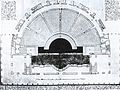
The palace's park, called Giardino della Regina, originally extended from Pugliano towards Vesuvius down to Granatello, towards the sea. It was divided into two parks, the lower having spacious avenues surrounding English gardens. It held works of art including the Fountain of the Sirens (Fontana delle Sirene), the Kiosk of King Carlo (Chiosco di Re Carlo) the Fountain of the Swans (Fontana dei Cigni), and an amphitheatre.
In the upper park was Charles's private zoo with kangaroos, an elephant, two lions, two panthers, four antelopes, an African lioness, a puma, two American tapirs and a porcupine. This novelty was kept by King Ferdinand who maintained that it was to remain on show to foreign dignitaries.
The museum complex (Musei della Reggia di Portici) includes the royal apartments, the Herculanense Museum, the frescoed antechambers, the Chinese Room, the historical library, and the Orto Botanico di Portici. The indoor section opened to visitors on 12 April 2025. The rooms contain frescoes from the 18th and 19th century, inspired by the findings in Herculaneum.
From its establishment in 1758 to the beginning of the 19th century, the museum contained large numbers of artifacts from the excavations, and included restoration laboratories. Among other things, a technique of unrolling carbonized papyri was developed here. Goethe described it in 1787 as "the alpha and omega of all collections of antiquity". But with the flight of Ferdinando IV of Naples to Palermo, the collection fell apart, most of it being transferred to what is now the Museo Archeologico Nazionale in Naples. In 2006, the museum was reopened, and contains multimedia presentations on the history of the excavations, of restoration techniques, and of Charles and his court, as well as reproductions of frescoes and sculptures.
Text from Wikipedia, the free encyclopedia, under CC BY-SA 4.0. Full article: «Palace of Portici».
Events and people from Wikidata (CC0).
Distances are as the crow flies, not walking or driving.


Palace of Portici is in Portici, in the province of Napoli (Campania), Italy. GPS coordinates: 40.81125, 14.34267.
According to OpenStreetMap the opening hours are: 15 October to 15 March · Tuesday to Sunday: 9:30–18:00; 16 March to 14 October · Tuesday to Sunday: 9:30–19:00. Always check the official website before your visit.
Wikidata dates it to 1742.
Nearby you’ll find: Villa Granito di Belmonte (200 m away), Villa Signorini (300 m away), Palazzo Capuano (400 m away).
Text. Wikipedia, the free encyclopedia (CC BY-SA 4.0).
Data. Wikidata (CC0); opening hours and contacts OpenStreetMap (ODbL).
Photos. Wikimedia Commons, author and licence on every image.
Updated 28 October 2026. All sources and licences