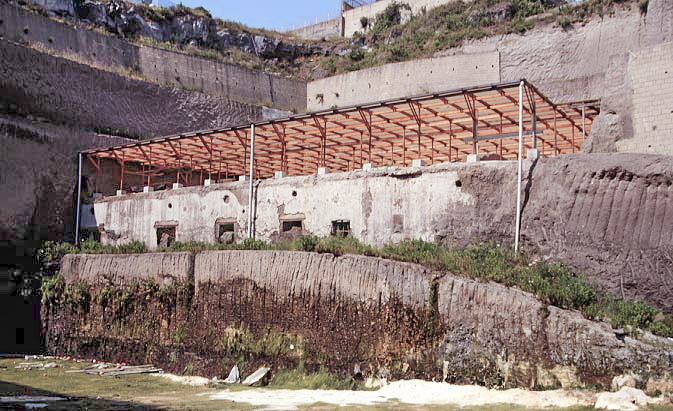


Photo: http://wiki.epicurus.info/User:Erik_Anderson, CC BY-SA 3.0 · Wikimedia Commons
Archaeological site
Villa of the Papyri
Ancient Roman villa in Ercolano, Italy
At a glance
- Type
- Archaeological site
- Protection
- Part of UNESCO World Heritage Site
- UNESCO World Heritage
- Archaeological Areas of Pompei, Herculaneum and Torre Annunziata
- Coordinates
- 40°48′24″ N, 14°20′44″ E
History and description
The Villa of the Papyri (Italian: Villa dei Papiri, also known as Villa dei Pisoni and in early excavation records as the Villa Suburbana) was an ancient Roman villa in Herculaneum, in what is now Ercolano, southern Italy. It is named after its unique library of papyrus scrolls, discovered in 1750. The Villa was considered to be one of the most luxurious houses in all of Herculaneum and in the Roman world. Its luxury is shown by its exquisite architecture and by the large number of outstanding works of art discovered, including frescoes, bronzes and marble sculpture which constitute the largest collection of Greek and Roman sculptures ever discovered in a single context.
It was situated on the ancient coastline below the volcano Vesuvius with nothing to obstruct the view of the sea. It was perhaps owned by Julius Caesar's father-in-law, Lucius Calpurnius Piso Caesoninus.
In AD 79, the eruption of Vesuvius covered all of Herculaneum with up to 30 metres (98 ft) of volcanic material from pyroclastic flows. Herculaneum was first excavated between 1750 and 1765 by Karl Weber by means of tunnels.
Layout
The villa is located a few hundred metres from the nearest house in Herculaneum. Although it now lies inland, before the volcanic eruption of October 79 AD, the structure occupied more than 250 metres (820 ft) of coastline along the Gulf of Naples. On the other sides it was surrounded by a closed garden, vineyards and woods. The villa had four levels beneath the main floor, arranged in terraces, overlooking the sea. It has recently been ascertained that the main floor was 16 m (52 ft) above sea level in antiquity.
The villa's layout is an expanded version of the traditional Campanian villa suburbana. One entered through the fauces and proceeded to the atrium, which functioned as an entrance hall and a means of communication with the various parts of the house. The entrance opened with a columned portico on the sea side.
After passing through the tablinum, one arrived at the first peristyle, made up of ten columns on each side, with a swimming pool in the centre. In this area, were found the bronze herm adapted from the Doryphorus of Polykleitos and the herm of an Amazon made by Apollonios, son of Archias of Athens. The large second peristyle could be reached by passing through a large tablinum in which, under a propylaeum, was the archaic statue of Athena Promachos. A collection of bronze busts were in the interior of the tablinum. These included the head of Scipio Africanus.
The living and reception quarters were grouped around the porticoes and terraces, giving occupants ample sunlight and a view of the countryside and sea. In the living quarters, bath installations were brought to light, and the library of rolled and carbonised papyri placed inside wooden capsae, some of them on ordinary wooden shelves and around the walls and some on the two sides of a set of shelves in the middle of the room.
The grounds included a large area of covered and uncovered gardens for walks in the shade or in the warmth of the sun. The gardens included a gallery of busts, hermae and small marble and bronze statues. These were laid out between columns amid the open part of the garden and on the edges of the large swimming bath.
Works of art
The luxury of the villa is evidenced not only by the many works of art, but especially by the large number of rare bronze statues found there, all masterpieces. The villa housed a collection of at least 80 sculptures of magnificent quality, many now conserved in the Naples National Archaeological Museum. Among them is the bronze Seated Hermes, found at the villa in 1758. Around the bowl of the atrium impluvium were 11 bronze fountain statues depicting Satyrs pouring water from a pitcher and Amorini pouring water from the mouth of a dolphin. Other statues and busts were found in the corners around the atrium walls.
Five statues of life-sized bronze dancing women wearing the Doric peplos sculpted in different positions and with inlaid eyes are adapted Roman copies of originals from the fifth century BC. They are also hydrophorai drawing water from a fountain.
Epicureanism and the library
The owner of the house, perhaps Lucius Calpurnius Piso Caesoninus, established a library of a mainly philosophical character. It is believed that the library might have been collected and selected by Piso's family friend and client, the Epicurean Philodemus of Gadara, although this conclusion is not certain. Followers of Epicurus studied the teachings of this moral and natural philosopher. This philosophy taught that man is mortal, that the cosmos is the result of accident, that there is no providential god, and that the criteria of a good life are pleasure and temperance.
Philodemus' connections with Piso brought him an opportunity to influence the young students of Greek literature and philosophy who gathered around him at Herculaneum and Naples. Much of his work was discovered in about a thousand papyrus scrolls in the philosophical library recovered at Herculaneum. Although his prose work is detailed in the strung-out, non-periodic style typical of Hellenistic Greek prose before the revival of the Attic style after Cicero, Philodemus surpassed the average literary standard to which most epicureans aspired. Philodemus succeeded in influencing the most learned and distinguished Romans of his age. None of his prose work was known until the rolls of papyri were discovered among the ruins of the Villa of the Papyri.
At the time of the eruption of Vesuvius in AD 79, the valuable library was packed in cases ready to be moved to safety when it was overtaken by a pyroclastic flow; the eruption eventually deposited some 20–25 m of volcanic ash over the site, charring the scrolls but preserving them – the only surviving library of Antiquity – as the ash hardened to form tuff.
Text from Wikipedia, the free encyclopedia, under CC BY-SA 4.0. Full article: «Villa of the Papyri».
Photos
Getting there
Portici-ErcolanoTrain, nearest
900 m as the crow flies
Villa of the Papyri
Port8.0 km
Aeroporto di Napoli Capodichino9.8 km
Distances are as the crow flies, not walking or driving.
Loading map…
Nearby
See on the mapMore archaeological sites in Campania

- UNESCO
- Free 1st Sunday

- UNESCO

- UNESCO

- UNESCO
- Free 1st Sunday

- Free 1st Sunday
Frequently asked questions
Where is Villa of the Papyri?
Villa of the Papyri is in Ercolano, in the province of Napoli (Campania), Italy. GPS coordinates: 40.80667, 14.34556.
What else is there to see near Villa of the Papyri?
Nearby you’ll find: Aristides' house (100 m away), House of Argus (100 m away), Genio's house (100 m away).
Sources and licences
Text. Wikipedia, the free encyclopedia (CC BY-SA 4.0).
Data. Wikidata (CC0); opening hours and contacts OpenStreetMap (ODbL).
Photos. Wikimedia Commons, author and licence on every image.
Credits for the 7 photos
- Villaofthepapyri — http://wiki.epicurus.info/User:Erik_Anderson, CC BY-SA 3.0
- Villa of the Papyri — Villa of the Papyri, CC BY-SA 4.0
- Bronze statue of a deer (detail) in Syntagma Square on April 26, 2022 — George E. Koronaios, CC BY-SA 4.0
- Bronze statue of a deer in Syntagma Square on April 26, 2022 — George E. Koronaios, CC BY-SA 4.0
- Female Divinity marble sculpture in Herculaneum — Dudva, CC0
- The second bronze deer (detail) in Syntagma Square on April 28, 2022 — George E. Koronaios, CC BY-SA 4.0
- The second bronze deer in Syntagma Square on April 28, 2022 — George E. Koronaios, CC BY-SA 4.0
Updated 28 October 2026. All sources and licences