

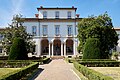


Photo: Dega180, CC0 · Wikimedia Commons
At a glance
- Style
- Renaissance architecture
- Commissioned by
- House of Arcimboldi
- Protection
- Italian national heritage
- Coordinates
- 45°31′08″ N, 9°12′41″ E
- Address
- Viale Sarca, 214
History and description
The Bicocca degli Arcimboldi is an Italian villa built in the second half of the 15th century as the country residence of the Arcimboldi family. Once situated in a totally rural area not far from Milan, it is now located within the homonymous district, in a now totally urbanised context.
History
Subsequent to the period of the Aurea Repubblica Ambrosiana, during the second half of the 15th century, the noble Arcimboldi family of Parma had their country villa built in this area about five kilometres north of Milan. It owes its name of "bicocca" to the fact that it was a sort of stronghold or castle of modest proportions, located at the time in a totally rural context.
Some studies have identified two reference dates within which to ascribe the period in which its construction would have taken place: firstly, 1464, the year in which the Banco Mediceo in Milan was built, from which the string-course frieze under the reredos with the motto droit semper is said to derive; secondly, 1488, the year of Hungary, the mission of Guido Antonio Arcimboldi to the court of Matthias Corvinus, in commemoration of which he commissioned the decoration of the portico (now hidden by later graffiti).
After the extinction of the Arcimboldi, which occurred in 1732, the villa passed to the Arconati, then to the Busca and later to the Sormani. During the first decade of the 20th century it underwent heavy restoration probably directed by Luca Beltrami and carried out by Ambrogio Annoni, architect of the Sovrintendenza. The restoration, of a historicist nature, saw the reconstruction in style of some parts of the building, starting from some original traces or following an analogy with some similar buildings of the time. Several chimneys were inserted on this occasion and, on the eastern front, a bell gable with a clock. In the course of 1918, the Bicocca degli Arcimboldi finally passed into the hands of the Pirelli, who had established here at Bicocca the new production district of Pirelli. The small villa became the site of the rubber museum and the nursery school for the children of workers employed at Pirelli.
In 1933 a second restoration was carried out, again by Ambrogio Annoni, which mainly involved the decorations of the ladies' room, discovered during the previous restoration.
In the 1950s Piero Portaluppi conducted a third restoration that saw the creation of a large grand staircase and a more general redistribution of spaces (dictated by functional needs). The Bicocca degli Arcimboldi has since then become the Pirelli's representative offices, with meeting rooms and canteen for executives. …
Description
The building has three levels, developing on a rectangular floor plan 40 m long and 13 m wide. On the east front, it has a columned portico developed on five round arches, placed asymmetrically, with a wooden trussed ceiling. The top floor consists of a loggia extending across the entire surface of the villa, covered by wooden trusses supporting the roof pitches. A cross-vaulted cellar extends only partially over a square portion of the roof. The only vertical connection prior to the 20th century restoration (which saw the introduction of a three-flight internal staircase) was the external staircase in the forepart at the end of the southern façade.
Some frescoes preserved inside the ladies' room constitute a very rare example of the depiction of the leisure and occupations of the ladies of the court: they depict moments of the mistress's day, from waking up accompanied by music, to playing chess, to preparing the nuptial bed. They are considered one of the best Lombard fresco cycles of the entire 15th century.
The building houses numerous testimonies of the original pictorial decoration, in various states of conservation. In particular, the restorations completed in the 1990s have helped to consolidate and make known the remains of the paintings that decorated the reredos and the portico.
Two figures in particular have been restored between the windows of the reredos: a preparatory drawing of a knight standing in armour, referable to International Gothic stylistic features, and a 16th-century figure, three-quarter-length. …
Text from Wikipedia, the free encyclopedia, under CC BY-SA 4.0. Full article: «Bicocca degli Arcimboldi».
People
Events and people from Wikidata (CC0).
Photos
Getting there
Milano Greco PirelliTrain, nearest
700 m as the crow flies
Bicocca degli ArcimboldiViale Sarca, 214
Aeroporto di Milano-Linate9.5 km
Distances are as the crow flies, not walking or driving.
Loading map…
Nearby
See on the mapMore historic villas and palaces in Lombardy


Frequently asked questions
Where is Bicocca degli Arcimboldi?
Bicocca degli Arcimboldi is in Milan, in the province of Milano (Lombardy), Italy. Address: Viale Sarca, 214. GPS coordinates: 45.51876, 9.21143.
What else is there to see near Bicocca degli Arcimboldi?
Nearby you’ll find: Fondazione Pirelli (100 m away), HangarBicocca (700 m away), Grand Hotel Villa Torretta Milan Sesto, Curio Collection by Hilton (1.4 km away).
Sources and licences
Text. Wikipedia, the free encyclopedia (CC BY-SA 4.0).
Data. Wikidata (CC0); opening hours and contacts OpenStreetMap (ODbL).
Photos. Wikimedia Commons, author and licence on every image.
Credits for the 2 photos
- Bicocca degli Arcimboldi — Dega180, CC0
- Bicocca degli Arcimboldi 0409 — Yorick39, CC BY-SA 3.0
Updated 28 October 2026. All sources and licences