


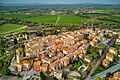


- Most beautiful villages
Photo: Zyance, CC BY-SA 2.5 · Wikimedia Commons
Historic village
Italian comune
Bettona (Latin: Vettona) is an ancient town and comune of Italy, in the province of Perugia in central Umbria, at the northern edge of the Colli Martani range.
The town lies 5 kilometres (3.1 mi) east of Torgiano and 12 kilometres (7.5 mi) south-west of Assisi. It is one of I Borghi più belli d'Italia ("The most beautiful villages of Italy").
Bettona originated as a settlement in the 8th–7th century BC. It was conquered by the Romans in the 4th century BC and became a municipium.
Vettona was mentioned by Pliny among the Umbrian cities and recorded in the Itinerarium Peutingerianum along the route from Amelia to Perugia via Todi. It is also referenced by the Ravennate geographer. In antiquity its territory included that of present-day Collazzone (ancient Urvinum Hortense). Vettona belonged to the Clustumina tribe, while Urvinum was assigned to the Stellatina.
An inscription dated to 123 AD, dedicated by the inhabitants of Urvinum Hortense to Magnia Urbica Augusta, is noted among the archaeological finds of the area.
Bettona had an episcopal seat from an early period. According to tradition, its first bishop was Saint Crispoldus, placed either in the 1st century or around the 4th century, when he is also said to have suffered martyrdom. He was buried in a church later dedicated to him and became the patron saint of the town. The only historically-documented bishop was named Gaudentius, who took part in a synod at Rome called by Pope Hilarius in 465.
The town declined in the early Middle Ages during the barbarian invasions and suffered damage in 548 at the hands of Totila. It subsequently came under Byzantine control, before later becoming part of the Duchy of Spoleto under Lombard rule.
By the late 12th century Bettona had developed into a self-governing municipality. In 1198 it came under Papal authority while remaining within the ecclesiastical jurisdiction of the diocese of Assisi. This led to prolonged conflict with Assisi lasting about thirty years, culminating in Bettona's forced submission in 1223. During this period it allied with Foligno and the Emperor against Assisi and Perugia.
In 1352 Bettona was besieged by Perugia, captured, and burned. The city was demolished, and its stone was reused in the construction of the Palazzo dei Priori in Perugia. Reconstruction was ordered in 1367 by Cardinal Albornoz, and the town was rebuilt with smaller but stronger fortifications.
From 1389 to 1425 Bettona was under the rule of the Trinci family of Foligno. In 1425 it was granted to the Baglioni family, a change that met with local resistance and led to its conquest in 1439 by Malatesta Baglioni. …
Text from Wikipedia, the free encyclopedia, under CC BY-SA 4.0. Full article: «Bettona».
Distances are as the crow flies, not walking or driving.


Bettona is in Bettona, in the province of Perugia (Umbria), Italy. GPS coordinates: 43.01357, 12.48456.
Nearby you’ll find: Convent of Sant'Antonio di Padova (400 m away), Castello di Rosciano (2 km away), Museo del vino (4.2 km away).
Text. Wikipedia, the free encyclopedia (CC BY-SA 4.0).
Data. Wikidata (CC0); opening hours and contacts OpenStreetMap (ODbL).
Photos. Wikimedia Commons, author and licence on every image.
Updated 28 October 2026. All sources and licences