



- UNESCO
- Free 1st Sunday
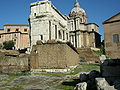
Photo: MM, CC BY-SA 3.0 · Wikimedia Commons
Archaeological site
Building in Roman Forum, Italy
The Basilica Julia (Italian: Basilica Giulia) was a civil basilica in the Roman Forum. Construction began under Julius Caesar in 46 BC and was completed by Augustus, who ultimately dedicated the basilica to Gaius and Lucius Caesar in 12 AD. It served as the headquarters for the centumviri, a judicial court that primarily dealt with matters of inheritance. The basilica was destroyed by fire in 283 AD but was rebuilt and embellished throughout the late Imperial era. The three-story marble structure remained a prominent landmark in the Forum through much of Late Antiquity. By the Middle Ages, however, it had been stripped of its materials, and part of the structure was converted into a Christian church. Today, excavations reveal the foundations and corner walls of the original Augustan basilica, as well as pillars, plinths, and columns from its reconstruction under Diocletian.
The first iteration of the Basilica Julia was begun around 54 BC by Julius Caesar, though it was left to his heir Augustus to complete the construction and name it in honor of his adoptive father. The basilica was built over the remains of two important Republican structures: the Basilica Sempronia, which was demolished by Caesar to make way for the new basilica, and pre-dating both, the house of Scipio Africanus, Rome's legendary general. The Basilica Sempronia was built in 169 BC by Tiberius Sempronius Gracchus and required the demolition of the house of Africanus and a number of shops to make room.
The first Basilica Julia burned in 9 AD, shortly after completion, but it was reconstructed, enlarged, and rededicated to Augustus' adoptive sons Gaius and Lucius in 12 AD. The Basilica was restored after a fire in 199 AD by Septimius Severus, and later reconstructed by the Emperor Diocletian after another fire in 283 AD.
The Basilica is bordered on its short sides by two important ancient roads which led from the Tiber to the Forum: the Vicus Jugarius to the west, and the Vicus Tuscus to the east. The ground floor was divided into five east–west aisles inside, with the central aisle forming a large hall that measured 82 m × 18 m (269 ft × 59 ft), sheltered by a three-story high roof. The adjoining aisles to the north and south of the central hall were divided by marble-faced brick columns which supported concrete arcades; the columns in turn supported the upper level of the basilica, which was used as a public gallery. The floor of the central hall was paved in colorful polychrome marble slabs, contrasting with the plain white marble of the adjoining aisles. The Basilica's façade as it appeared after the Augustan restoration was two stories high and arcaded, with engaged Carrara marble columns decorating the piers between the arches on both levels. …
The earliest excavations of the Basilica Julia in the late 15th and 16th centuries were destructive, their main purpose being to recover valuable travertine and marble for re-use. In 1496, travertine was mined from the ruins to build the façade of the Palazzo Torlonia, the Roman palace of Cardinal Adriano Castellesi. There were also excavations in 1500, 1511–12, and 1514, as well as a destructive excavation in 1742 which uncovered the portion of the Cloaca Maxima which runs underneath the basilica. In the process the Giallo antico yellow marble which covered the floor was stripped and sold to a stone-cutter.
The Chevalier Frédenheim also undertook excavations between November, 1788 and March, 1789; Frédenheim dismantled much of the remaining colored marble pavement and removed many architectural fragments. The site was excavated by Pietro Rosa in 1850 who reconstructed a single marble column and travertine supports. In 1852 segments of concrete vaulting with stuccowork coffering was unearthed but later destroyed in 1872.
Text from Wikipedia, the free encyclopedia, under CC BY-SA 4.0. Full article: «Basilica Julia».
Distances are as the crow flies, not walking or driving.


Basilica Julia is in Rome, in the province of Roma (Lazio), Italy. GPS coordinates: 41.89195, 12.48478.
Nearby you’ll find: Basilica Sempronia (0 m away), Roman Forum (0 m away), Temple of Divus Augustus (100 m away).
Text. Wikipedia, the free encyclopedia (CC BY-SA 4.0).
Data. Wikidata (CC0); opening hours and contacts OpenStreetMap (ODbL).
Photos. Wikimedia Commons, author and licence on every image.
Updated 28 October 2026. All sources and licences