


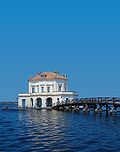


Photo: Kleuske, CC BY-SA 3.0 · Wikimedia Commons
Archaeological site
Baia
Human settlement in Bacoli, Metropolitan City of Naples, Campania, Italy
At a glance
- Type
- Archaeological site
- Coordinates
- 40°49′00″ N, 14°04′11″ E
History and description
Baiae (Italian: Baia; Neapolitan: Baia) is an ancient Roman town situated on the northwest shore of the Gulf of Naples and now in the comune of Bacoli. It was a resort for centuries in antiquity, particularly towards the end of the Roman Republic, when it was reckoned as superior to Capri, Pompeii, and Herculaneum by wealthy Romans, who built villas here from 100 BC. Ancient authors attest that many emperors built in Baia, almost in competition with their predecessors, and they and their courts often stayed there. It was notorious for its hedonistic offerings and the attendant rumours of corruption and scandal.
The lower part of the town later became submerged in the sea due to local volcanic, bradyseismic activity which raised or lowered the land. Recent underwater archaeology has revealed many of the fine buildings now protected in the submerged archaeological park.
Baiae inspired scenes to be depicted on ancient glass flasks made for visitors (probably in Puteoli in the late 3rd to early 4th century AD) many of which have been found scattered throughout the empire, and today kept in many museums notably in Populonia, Empúries and Warsaw.
History
Baiae was built on the Cumaean Peninsula in the Phlegraean Fields, an active volcanic area, on the side of an ancient crater sloping down to the shore. It was perhaps originally developed as the port for Cumae, the Portus Baianus. It also benefitted from thermal springs for bathing establishments.
Around 80 BC it became a fashionable resort for the Roman aristocracy. Marius, Lucullus, and Pompey all frequented it. Julius Caesar had a villa there, and much of the town became imperial property under Augustus.
From 36 BC, Baiae included Portus Julius, the base of the western fleet of the Roman Navy before it was abandoned because of the silting up of Lake Lucrinus (from which a short channel led to Lake Avernus) for the two harbours at Cape Miseno 4 miles (6.4 km) south.
Baiae was already notorious for the hedonistic lifestyle of its residents and guests in the Republican era. In 56 BC, the prominent socialite Clodia was condemned by the defence at the trial of Marcus Caelius Rufus as living as a harlot in Rome and at the "crowded resort of Baiae", indulging in beach parties and long drinking sessions. An elegy by Sextus Propertius written in the Augustan Age describes it as a "den of licentiousness and vice". In the 1st century, "Baiae and Vice" formed one of the moral epistles written by Seneca the Younger; he described it as a "vortex of luxury" and a "harbour of vice" where girls went to play at being girls, old women as girls and some men as girls according to a first century BC wag.
Nero had a notable villa constructed in the middle of the 1st century and Hadrian died at his villa in AD 138. It was also a favourite spot of the emperor Septimius Severus. The resorts sometimes capitalised on their imperial associations: Suetonius mentions in his history that the cloak, brooch, and gold bulla given to the young Tiberius by Pompey's daughter Pompeia Magna were still on display around AD 120. …
The Baianus lacus
The bay of Baia constitutes the remains of an ancient crater partly submerged in and invaded by the sea. In Roman times it was a complete coastal lagoon, the Baianus lacus, and Roman buildings were located on a sandy expanse between the sea and the eastern bank of the Baianus lacus, now submerged, and occupied the internal slope of the crater.
The channel between the lagoon and the sea made by cutting the sandy isthmus that separated them, and is 32 m wide and delimited by two piers about 230 m long and 9 wide. The piers were made of concrete with tuff chips arranged in layers.
The concrete conglomerate was thrown into wooden caissons (arcae) testified by the presence of the typical holes left by the construction piles. In some cases the posts and the planking of the formwork are still perfectly preserved. The north pier is partly preserved in a 63 m length starting from the east.
Archaeology
The statue of the "Aphrodite of Baiae", a variant of the Venus de Medici, was supposedly excavated sometime before 1803, when the English antiquary Thomas Hope began displaying it in his gallery on Duchess Street in London.
The important archaeological remains were intensively excavated from 1941, revealing layers of buildings, villas and thermal complexes belonging to periods from the late Republican age, the Augustan, Hadrianic to the late Empire.
A cache of plaster casts of Hellenistic sculptures was discovered in the cellar of the Baths of Sosandra at Baiae; they are now displayed at the town's archaeological museum. The collection includes parts of several famous sculptures, including Athens's Harmodius and Aristogeiton and the Athena of Velletri. It suggests that the area had a workshop mass-producing marble or bronze copies of Greek art for the Italian market.
In April 2023 the sunken remains of an ancient Roman villa including marble tiled flooring, numerous marble columns and an ornate mosaic were discovered by underwater archaeologists from the Campi Flegrei Archaeological Park. The mosaic included crossing braids and hexagons with concave sides.
Text from Wikipedia, the free encyclopedia, under CC BY-SA 4.0. Full article: «Baia».
Photos
Getting there
BaiaTrain, nearest
500 m as the crow flies
Baia
Pozzuoli4.1 km
Aeroporto di Napoli Capodichino19.9 km
Distances are as the crow flies, not walking or driving.
Loading map…
Nearby
See on the mapMore archaeological sites in Campania

- UNESCO
- Free 1st Sunday

- UNESCO

- UNESCO

- UNESCO
- Free 1st Sunday

- Free 1st Sunday
Frequently asked questions
Where is Baia?
Baia is in Bacoli, in the province of Napoli (Campania), Italy. GPS coordinates: 40.81667, 14.06972.
Can I visit Baia for free?
Yes: entry is free on the first Sunday of every month, under the Italian “Domenica al museo” scheme.
What else is there to see near Baia?
Nearby you’ll find: Parco Archeologico delle terme di Baia- Bacoli (100 m away), Parco sommerso di Baia (600 m away), Emperor Claudius' sunken nymphaeum (900 m away).
Sources and licences
Text. Wikipedia, the free encyclopedia (CC BY-SA 4.0).
Data. Wikidata (CC0); opening hours and contacts OpenStreetMap (ODbL).
Photos. Wikimedia Commons, author and licence on every image.
Credits for the 6 photos
- Baia crater edge — Kleuske, CC BY-SA 3.0
- Beloch - Baiae — Karl Julius Beloch (1854–1929), Public domain
- Ludwig Richter - Blick von Baiae auf Capri — Derbrauni, CC BY 4.0
- Meyer’s Universum Bd. 15. 1852 (140312718) — Joseph Meyer, Public domain
- Meyers Universum Band 15 24 — Meyer’s Universum, oder Abbildung und Beschreibung des Sehenswerthesten und Merkwürdigsten der Natur und Kunst auf der ganzen Erde. 15. Band, Bibliographisches Institut, Hildburghausen, Stecher:…, Public domain
- Punta1 terme sommerse — Dflello, CC BY-SA 4.0
Updated 28 October 2026. All sources and licences