




- UNESCO
- Free 1st Sunday
Photo: Public domain · Wikimedia Commons
Archaeological site
An arch that once spanned the ancient Via Lata (modern Via del Corso) in Rome, Italy, and was demolished in 1662
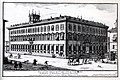
The Arch of Portugal (also referred to as the Arch of Hadrian, the Arch of Tropholi, the Arch of Tripoli or the Arch of Octavian) was an arch of Rome, situated on the ancient via Lata (now the via del Corso), just before its intersection with the via della Vite.
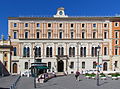
Its current designation as the Arch of Portugal is derived from its location where it stood against the Palazzo Fiano, where from 1488 to 1508 lived the Portuguese cardinal Jorge da Costa, Cardinal Priest of the church of San Lorenzo in Lucina.
The dating of the arch has long been the subject of controversy. For many years it was believed that the arch formed part of an aqueduct branch, with most suggestions linking it to the Aqua Virgo. However, most modern studies now attribute the arch to the period of late antiquity, possibly during the reign of Aurelian (r. 270–275), hypothesising that it acted as a monumental entry into his enormous Temple of the Sun.
In any event, the arch displayed reliefs that belonged to the period of the reign of the emperor Hadrian (r. 117–138), some 140 years before Aurelian's reign. It is suspected that these reliefs were repurposed as spolia in order to decorate the monument built under Aurelian, in much the same way earlier reliefs from Trajan were reused when decorating the arch of Constantine.
Of the extant reliefs, one depicts a scene of the donation of food relief to Roman children, presided over by the emperor Hadrian, while a second shows the apotheosis of Vibia Sabina (the emperor's deceased wife). Uncovered at a separate location from the others, but most likely related, the adventus of Hadrian shows the emperor welcomed by three personifications, representing the goddess Roma, the Roman Senate, and the people of Rome. This third relief was uncovered in the piazza Sciarra.
The arch was constructed in blocks of peperino and travertine, with the arch's attic in brick. The columns, with capitals in Composite order (that is with elements of both Ionic and Corinthian orders), framed a single arch which were partially removed, together with the entablature, between 1550 and 1565.
The arch was finally demolished in 1662 under the orders of Pope Alexander VII, as the arch was rundown and it was a hindrance to the flow of traffic along the via del Corso. The demolition of the arch was noted in a plaque that was posted at the site in 1665. The three Hadrianic reliefs were placed at around the same time in the staircase of the Palazzo dei Conservatori (today the Capitoline Museums).
Text from Wikipedia, the free encyclopedia, under CC BY-SA 4.0. Full article: «Arco di Portogallo».
Distances are as the crow flies, not walking or driving.


Arco di Portogallo is in Rome, in the province of Roma (Lazio), Italy. GPS coordinates: 41.90310, 12.47960.
Nearby you’ll find: Palazzo Fiano al Corso (100 m away), Palazzo Theodoli-Bianchelli (100 m away), Via Tiberina (100 m away).
Text. Wikipedia, the free encyclopedia (CC BY-SA 4.0).
Data. Wikidata (CC0); opening hours and contacts OpenStreetMap (ODbL).
Photos. Wikimedia Commons, author and licence on every image.
Updated 28 October 2026. All sources and licences