




- UNESCO
- Free 1st Sunday
Photo: Rjdeadly, CC BY-SA 4.0 · Wikimedia Commons
Archaeological site
1st-century Roman aqueduct from Lake Bracciano to Rome
The Aqua Traiana (later rebuilt and named the Acqua Paola) was a 1st-century Roman aqueduct built by Emperor Trajan and inaugurated in 109 AD. It channelled water from sources around Lake Bracciano, 40 km (25 mi) north-west of Rome, to ancient Rome. It joined the earlier Aqua Alsietina to share a common lower route into Rome.
It had only fallen into disuse in the 17th century.
The author Frontinus indicated in c. 98 AD that a new aqueduct was being planned, and completion took about a decade. The inauguration of the aqueduct was recorded in the Fasti Ostienses as being dedicated with great fanfare in 109, and stated that the water was tota urbe salientem (issuing throughout the city).
The date of inauguration was also significant for its intended uses, being only a few months before the Naumachia Traiani, the vast, grandstand-encircled pool on west bank of the Tiber, intended for naval spectacles (and only two days after the Baths of Trajan on the Oppian Hill, in the heart of Rome, overlooking the lower Forum Romanum and Colosseum).
Later the Aqua Traiana powered Rome's important flour mills which became critical to its survival during the Gothic Siege of Rome (537–538) when the Janiculum mills were famously put out of action by the Ostrogoths who cut the urban aqueducts. General Belisarius restored the supply of flour by using mills floating in the Tiber. This aqueduct alone was soon repaired but recent excavations revealed that a major branch of the aqueduct (of two) that had powered the mills was never cleared of its blockage from the siege. Nevertheless, the aqueduct continued to supply the Vatican and western regions of Rome until at least the 9th century.
How distribution was achieved is mostly subject to speculation, but some suggest that the aqueduct crossed the River Tiber on a high bridge in the area of the modern Ponte Sublicio, and curved around the Aventine before heading north to the Oppio.
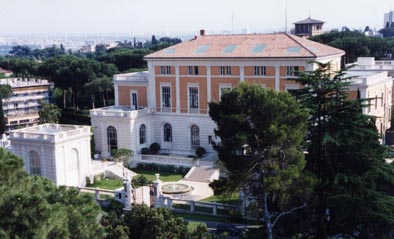
The aqueduct was found on the Janiculum hill under the present American Academy in Rome by excavations in the 1990s.
It fed a number of water mills on the Janiculum, including a sophisticated mill complex revealed by excavations in the 1990s under the present American Academy in Rome.
Although the Aqua Traiana, along with all the other aqueducts, was cut by the Ostrogoths in 537, it was the only one restored by Belisarius before his departure in 547 in order to supply water to the grain mills. Over the next few centuries it once again fell in to ruin and ceased to function. It was restored a second time around the year 775 by Pope Adrian I as a way of alleviating the need for the Roman people to carry water in casks from the Tiber to supply the fountains at Saint Peter's Basilica. Subsequently, it once again fell into disrepair.
Camillo Borghese, on his accession in 1605 as Pope Paul V, initiated work on rebuilding the Aqua Traiana, supervised from 1609 by Giovanni Fontana. At that time, the Roman suburbs west of the Tiber River, including the Vatican, were suffering from chronic water shortage. The new pope persuaded the Municipality of Rome to pay for the development of an aqueduct to provide a better water supply to that part of the city.
In 1612, the aqueduct was completed. It was initially called the Acqua Sabbatina or Acqua Bracciano, but was renamed Acqua Paola in honour of Paul V.
Not all original Aqua Traiana sources were available to contribute water to the Aqua Paola. The most copious sources at Santa Fiora, for example, had long since been purloined by duke Paolo Giordano Orsini, who had diverted them to power mills and industry in the city of Bracciano.
The fountain at the end of the aqueduct was referred to as "Il Fontanone" – the Big Fountain – because of its size. It was in the form of a free-standing triumphal arch constructed in white marble with granite columns on high socles. Most of the material was pillaged from the Forum of Nerva. Originally, it consisted of three large central arches, separated by columns, and a smaller one on each side. Water gushed into five basins at the base of each arch. The designer was Paul V's usual architect, Flaminio Ponzio. Among the team of sculptors involved was Ippolito Buzzi, who was responsible for the Borghese coat-of-arms, flanked by the Borghese eagle and dragon, and held aloft by putti, it is presumed to Ponzio's design.
Then, in 1690, Pope Alexander VIII commissioned Carlo Fontana, Giovanni's nephew, to enlarge the fountain. Carlo replaced the five small basins with an enormous single one, the Fontana dell'Acqua Paola, which remains to this day. In more recent times, a small garden has been arranged, hidden behind the structure.
Text from Wikipedia, the free encyclopedia, under CC BY-SA 4.0. Full article: «Aqua Traiana».
Distances are as the crow flies, not walking or driving.


Aqua Traiana is in Rome, in the province of Roma (Lazio), Italy. GPS coordinates: 41.88860, 12.46410.
Nearby you’ll find: Mausoleo Ossuario Garibaldino (0 m away), Villa Spada al Gianicolo (100 m away), Museum of the Roman Republic and Garibaldi Memorial (200 m away).
Text. Wikipedia, the free encyclopedia (CC BY-SA 4.0).
Data. Wikidata (CC0); opening hours and contacts OpenStreetMap (ODbL).
Photos. Wikimedia Commons, author and licence on every image.
Updated 28 October 2026. All sources and licences