


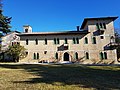

Photo: San Marco Venice, CC BY-SA 4.0 · Wikimedia Commons
Historic villa / palace
Villa Loredan Gasparini
Building in Volpago del Montello, Italy
Volpago del Montello (TV), Veneto
At a glance
- Style
- Neoclassicism
- Architects
- Francesco Maria Preti, Giovanni Miazzi
- Coordinates
- 45°46′40″ N, 12°05′56″ E
History and description
Villa Spineda Gasparini Loredan is an 18th-century Palladian style villa of the noble Loredan family located in the town of Volpago del Montello in the Veneto region of northeast Italy. It is regarded as one of the most beautiful villas of the Veneto.
History
The design of the villa dates back to 1753, when it was commissioned to the architect Giovanni Miazzi by Marcantonio Spineda de Cattaneis, an exponent of the Treviso nobility. The design, however, was largely modified by Francesco Maria Preti, former designer of the Cathedral of Castelfranco Veneto and the Villa Pisani in Stra, in order to achieve greater control over the proportions (according to the rules he established in the 1780 Elements of Architecture treaty). It was Miazzi, however, who completed the building, without making further changes to the master's project.
In the early twentieth century, senator Jacopo Gasparini set up a museum of African relics on the ground floor of the west barn, decorating the environment in a neo-Egyptian style. The artifacts had been acquired during his long diplomatic experience as governor of Eritrea and ambassador to Yemen. In the 1950s, in the part of the estate towards Montello, the subsequent owner Count Piero Loredan (son of Lia Gasparini, daughter and heir of Jacopo) also founded a wine estate, called Conte Loredan Gasparini, which was then separated from the villa and sold to the current owners in 1973. At the end of the century the villa was bought by Benetton, on whose behalf it was completely restored by Afra and Tobia Scarpa, as part of a project aimed at creating the headquarters of the Sportsystem project of the fashion group.
With the loss of direct commitment of the Ponzano Veneto group in the sports sector, in 2008 the villa was purchased by Veneto Banca for the expansion of its management structures and, after its liquidation, became property of Intesa Sanpaolo which, however, did not have a vision for its use and the villa is now occasionally granted for public events.
Description
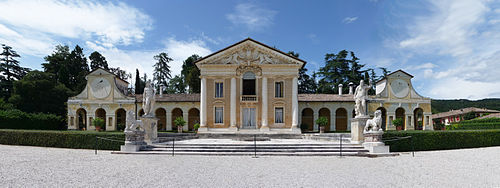
The complex, framed at the rear by the greenery of Montello, follows a symmetrical layout that sees the main body isolated in the center, two independent lateral barchesse and an adjoining chapel, characterized by a circular plan with a dome.
The body of the building is typically Palladian, arranged on three floors, with a composite tetrastyle portico surmounted by a tympanum, surmounted by three statues and containing the coat of arms of the Spineda family. The two side wings have the façade embellished with pilasters, between which there are three orders of single-light windows with aedicule.
The barchesse have three round arches in the center, flanked by two levels of single lancet windows. The arches are divided by semi-columns with composite capitals, which support a molded entablature, on which the volute ashlars are welded in keystone.
Both the barns and the central body throughout the ground floor are treated with ashlar.
Internally, in the hall the external architectures are repeated, while in the side rooms there are stuccoes with Venetian seminato floors. As part of the restoration, a large room was created under the garden, almost the same size, used by Veneto Banca for its shareholders' meetings. Access is from inside the side barns and from the external sides equipped with emergency exits.
Originally the garden was externally characterized by water features and a wood in the southern area; to the north, towards Montello, there was an extensive orchard. The large architectural complex is surrounded by a fish pond and a high wall, once decorated with frescoes, covered in the latest restoration.
To make the site even more spectacular, both to the north and to the south, a wide avenue of cypress poplars, used as a riding school, crossed the properties. Even today, along Via Sant'Eurosia (parallel to the main road), you can see the two cedars that formed the end of the long avenue.
Text from Wikipedia, the free encyclopedia, under CC BY-SA 4.0. Full article: «Villa Loredan Gasparini».
People
Events and people from Wikidata (CC0).
Photos
Getting there
Trevignano-SignoressaTrain, nearest
3.3 km as the crow flies
Villa Loredan Gasparini
Aeroporto di Treviso-Sant'Angelo16.1 km
Distances are as the crow flies, not walking or driving.
Loading map…
Nearby
See on the mapMore historic villas and palaces in Veneto

- Free 1st Sunday


- UNESCO

- UNESCO
- Free 1st Sunday
- UNESCO
Frequently asked questions
Where is Villa Loredan Gasparini?
Villa Loredan Gasparini is in Volpago del Montello, in the province of Treviso (Veneto), Italy. GPS coordinates: 45.77768, 12.09895.
What else is there to see near Villa Loredan Gasparini?
Nearby you’ll find: Villa Vescovile (3.2 km away), Museo dello scarpone e della calzatura sportiva (4.2 km away), Certosa di San Girolamo (7.6 km away).
Sources and licences
Text. Wikipedia, the free encyclopedia (CC BY-SA 4.0).
Data. Wikidata (CC0); opening hours and contacts OpenStreetMap (ODbL).
Photos. Wikimedia Commons, author and licence on every image.
Credits for the 2 photos
- Villa Spineda Loredan — San Marco Venice, CC BY-SA 4.0
- Conte Loredan Gasparini winery Veneto — San Marco Venice, CC BY-SA 4.0
Updated 28 October 2026. All sources and licences