


Photo: Gryffindor, CC BY-SA 3.0 · Wikimedia Commons
Historic villa / palace
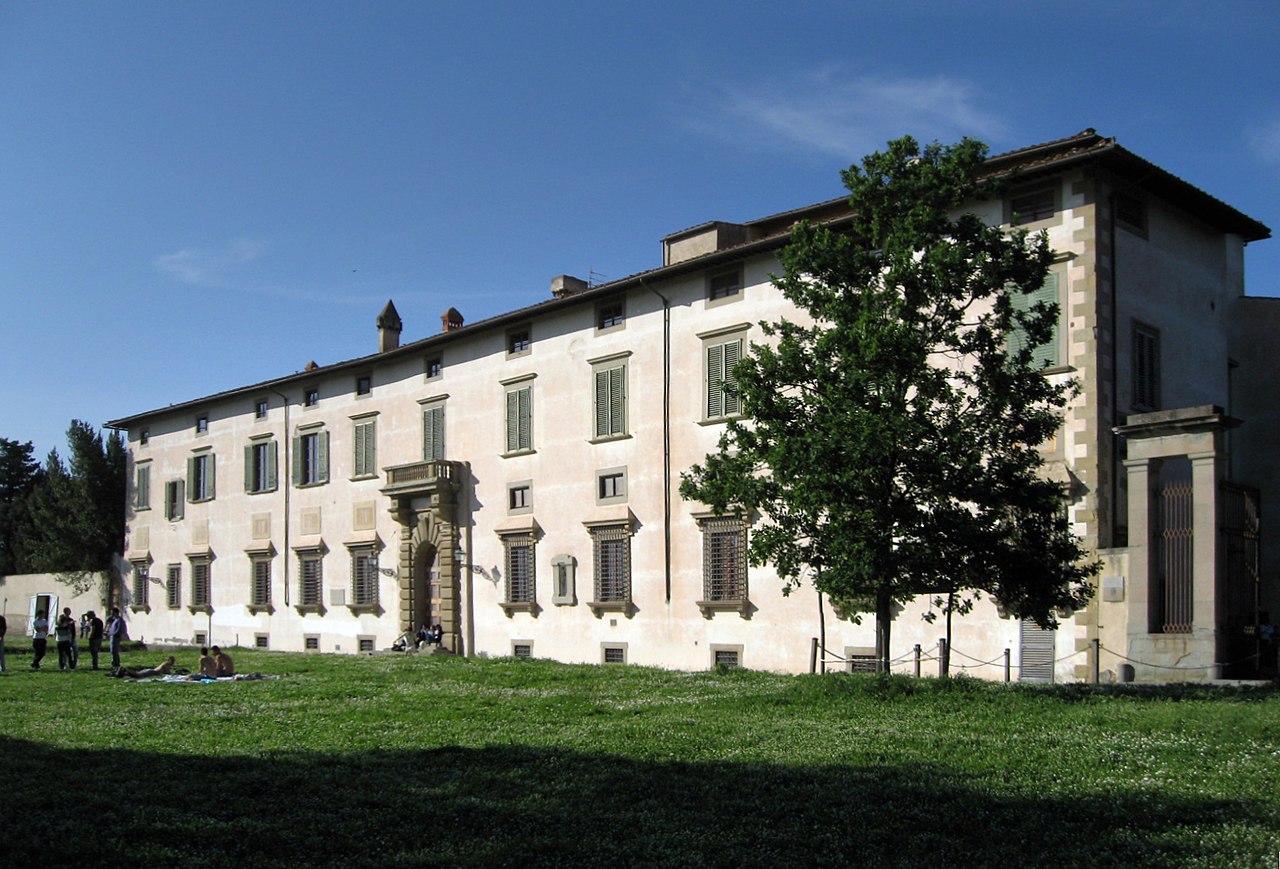
Villa Castello
Medici Villa in the hills near Florence, Tuscany
At a glance
- Architect
- Niccolò Tribolo
- Owner
- Lorenzo de' Medici
- Protection
- Part of UNESCO World Heritage Site
- UNESCO World Heritage
- Medici Villas and Gardens in Tuscany
- Coordinates
- 43°49′10″ N, 11°13′41″ E
History and description
The Villa di Castello, near the hills bordering Florence, Tuscany, central Italy, was the country residence of Cosimo I de' Medici, Grand Duke of Tuscany (1519-1574). The gardens, filled with fountains, statuary, and a grotto, became famous throughout Europe. The villa also housed some of the great art treasures of Florence, including Sandro Botticelli's Renaissance masterpieces The Birth of Venus and Primavera. The gardens of the Villa had a profound influence upon the design of the Italian Renaissance garden and the later French formal garden.
History
Villa Castello is located at the foot of the hills northwest of Florence, near the town of Sesto Fiorentino. The villa was located near a Roman aqueduct, and took its name from the water cisterns (castella) near the site.
A fortified building had been standing on the site since at least 1427, and was purchased in 1477 by Lorenzo and his brother Giovanni di Pierfrancesco de' Medici. This the year after their father died at the age of 46, leaving the young boys wards of their cousin Lorenzo il Magnifico, of the senior branch of the Medici family and de facto ruler of Florence.
They reconstructed the old building, adding a courtyard, a loggia, kitchens and stables. The house was inherited by a famed condottiere, or mercenary soldier, Giovanni dalle Bande Nere and his wife, Maria Salviati, the parents of Cosimo, who was born in 1519, and lived in the house as a child.
In 1537, the 26-year-old Duke of Florence, Alessandro de' Medici, was assassinated, and Cosimo, though he was only seventeen and a relatively unknown member of the Medici family, was elected by the influential men of Florence to replace him. They were under the impression that they could control him, but they were mistaken. In 1537, the young Cosimo faced a rebellion by a faction which wanted to restore the Republic of Florence. He defeated them at the Battle of Montemurlo, and established himself as the unrivaled ruler of the city.
Once his power was secure, Cosimo began to spend more time at his villa in Castello. As the architect and writer Giorgio Vasari wrote, "At this place the Duke began to build a little, one thing after another, to the end that he might reside there more commodiously, himself and his court."
Cosimo commissioned the engineer Piero da San Casciano to construct a system of aqueducts to bring water to the villa and its gardens, the sculptor Niccolò Tribolo to create fountains, statues and a garden, and the architect Giorgio Vasari to restore and enlarge the villa.
First, under the direction of Piero da San Casciano, an aqueduct was constructed from the Castella higher up the slope of Monte Morello to a small reservoir he built on the hill above the villa. Later, when more water was needed, a second aqueduct was built from another spring at Petraia. …
The features of the garden
The fountain of Hercules and Antaeus, designed by Niccolò Tribolo, was the most prominent and famous landmark of the garden. It illustrates the legend of Antaeus, a giant who challenged travelers along a road to fight, and killed them. He was finally challenged by Hercules, who realized that the power of Antaeus came from his contact with the earth. Hercules lifted Antaeus from the ground and crushed him to death. The statue symbolized the victory of Cosimo de' Medici over the enemies of Florence, particularly the rebels who tried to depose him in the early months after he became Duke.
Tribolo decorated The fountain from top to bottom with marble and bronze sculptures. The marble pool into which the water poured had eight sides, as did the base of the fountain. Around the base were marble statues of children, life sized and in full relief, protected by the tazza, or basin above as if they were sheltering from the rain. The basin, according to Vasari, "sends a very beautiful rain, like the dripping of a roof." There were more bronze figures around the lip of the tazza, holding festoons of products of the sea. The smaller tazza above was also supported by statues of children. Four heads of capricorns, a combination of a fish and a ram, one of the emblems of the Medicin family, looked down from the upper basin. Above that basin, a pedestal was decorated with more figures of children. Atop the pedestal was the statue of Hercules and Antaeus,
At the very top was the statue of Hercules and Antaeus, designed by Tribolo but executed by Bartolomeo Ammannati. Vasari wrote: "From the mouth of this Antaeus he intended that, instead of his spirit, there should pour out through a pipe water in great abundance, as indeed it does." Because the reservoir providing the water for the fountain was located high above in the upper garden, the water spouted out of the mouth of Antaeus in a jet three meters high, visible all around the garden.
The fountain also has one other water feature: a hidden pipe with small nozzles was circled the fountain; by turning a key, the water could be turned on, drenching the spectators with fine jets of water. …
The influence of Villa di Castello
The gardens of Villa di Castello had a profound influence on the Italian Renaissance garden and later on the French Renaissance garden and on the French formal garden. In Italy, Niccolò Tribolo copied several of the features of the Villa di Castello, including a grotto, fountains, and a series of monumental stairways in his plans for the Boboli Gardens in Florence. Tribolo also designed the botanical garden in Florence, the third in the world, on a similar geometric pattern, organized around a central fountain.
Villa di Castello also strongly influenced the later Medici villas, such as the Villa di Pratolino, constructed by Francesco I de' Medici, Grand Duke of Tuscany between 1569 and 1581. These gardens, like Villa di Castello, were built on a hillside, and featured a statue of Appennino, this one by Giambologna, multiple grottos, fountains, and hidden water jets to drench visitors. Unfortunately they were largely destroyed in 1820.
The Italian style was already known in France before Villa di Castello; King Francis I had commissioned Tribolo to make a statue for a garden fountain he built for his chateau at Fontainbleau, but the popularity of Italian gardens greatly increased after Cosimo built Villa di Castello. The first grotto in France was built at Fontainbleau in 1541.
The Italian garden style was promoted with great energy by two relations of Cosimo: Catherine de'Medici (1519-1589), the wife of King Henry II of France, and Marie De'Medici (1575-1642), the wife of King Henry IV of France. After Catherine became Regent in 1560, she began to build a new palace and the Tuileries Garden in the Italian style. The new garden, finished in 1564, featured a grotto with animals and figures made of pottery, a labyrinth, and flowerbeds laid along a central axis in geometric patterns. …
Text from Wikipedia, the free encyclopedia, under CC BY-SA 4.0. Full article: «Villa Castello».
People
Events and people from Wikidata (CC0).
Photos
Getting there
Firenze CastelloTrain, nearest
800 m as the crow flies
Villa Castello
Aeroporto Firenze Amerigo Vespucci2.4 km
Distances are as the crow flies, not walking or driving.
Loading map…
Nearby
See on the mapMore historic villas and palaces in Tuscany

- Free 1st Sunday

- UNESCO
- Free 1st Sunday

- UNESCO
- Free 1st Sunday

- Free 1st Sunday

Frequently asked questions
Where is Villa Castello?
Villa Castello is in Florence, in the province of Firenze (Tuscany), Italy. GPS coordinates: 43.81944, 11.22817.
What are the opening hours of Villa Castello?
According to OpenStreetMap the opening hours are: Every day: 8:30–18:30. Always check the official website before your visit.
What else is there to see near Villa Castello?
Nearby you’ll find: Giardino Storico della Villa Medicea di Castello (0 m away), Grotto of animals (Villa di Castello) (200 m away), Villa Il Pozzino (300 m away).
Sources and licences
Text. Wikipedia, the free encyclopedia (CC BY-SA 4.0).
Data. Wikidata (CC0); opening hours and contacts OpenStreetMap (ODbL).
Photos. Wikimedia Commons, author and licence on every image.
Credits for the 7 photos
- Villa Castello Florence Apr 2008 (37) — Gryffindor, CC BY-SA 3.0
- Villa medicea di Castello Facciata (vista frontale) — Avemundi, CC BY-SA 3.0
- Giusto utens, lunette delle ville medicee, 1599-1602, dalla villa di artimino, castello 01 — Sailko, CC BY-SA 3.0
- Villa di Castello - avenue of trees — SiefkinDR, CC BY-SA 3.0
- Sala delle udienze di maria maddalena d'austria, ville medicee, castello — Sailko, CC BY 3.0
- Ninfea 3855 — Assianir, CC BY-SA 3.0
- Ritratti degli accademici della crusca, 00 — Sailko, CC BY 3.0
Updated 28 October 2026. All sources and licences